
What the papers said
10 articlesArticles10 · 15 April 1914 – 12 June 1915
15 April 1914The New York Dramatic Mirror1 min
“Beating Back, the autobiography of Al Jennings, the former bandit and present politician, is to be produced in motion pictures by the Thanhouser Film Corporation. Under this title the story was published in the Saturday Evening Post, and aroused much comment. The story has in it many opportunities for strong picture work in Jenning’s life as a train robber, convict, county official, and his present strenuous activity in Oklahoma politics. Jennings, accompanied by sheriff ‘Bill’ Tillman, of Oklahoma, arrived in New York last Saturday for a conference with C.J. Hite, president of the Thanhouser Corporation. The picture will be marketed by the Direct-From-Broadway Features.”
15 April 1914The Evening Standard (New Rochelle)1 min
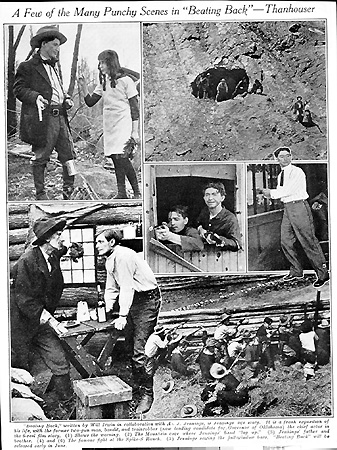
“Director Carroll Fleming and his assistant Perry Horton have gone to Ogdensburg, New York [sic] with a company of 63 members, Thanhouser actors and rough riders. They are to stay two weeks, making some of the scenes of the big film depicting the life of Al Jennings, the famous bandit who later became a state official [sic; his bid for governor was unsuccessful—Ed.]. Al Jennings is with the company doing the role he acted in real life in his youth. The rough riders are to be Jennings bandits. There are 30 horses with the troupe. Director James Durkin, with his assistant C. J. Sullivan, Jr. and another company are leaving for Ogdensburg to make other Western pictures. They are to use the horses of the first troupe. Among the local people with them are Morris Foster, Boyd Marshall, and Charles Emerson.”
30 April 1914The Evening Standard (New Rochelle)5 min
“The visit of the Thanhouser people to Ogdensburg, New Jersey has been a blessing to the inhabitants of that place in more ways than one. First, the movie people startled the little mountain town by their sudden arrival; 60 of them on the same train. This was followed by the next day by ‘wild West capers’ and a bold holdup in which revolvers and rifles were fired and several were ‘killed.’ On the following day the inhabitants were further scandalized by the holding up of the train which arrives every day, and the kidnapping of a beautiful young girl and her chaperone from New Rochelle by a gang of desperate outlaws lead by Al Jennings, the most desperate of the band. All this tended to magnify the type in which the name of the town is printed on the map and gave the people some excitement and the county newspaper some good copy with real headlines.
“In the second place, when some of the bolder inhabitants ventured near and asked the man in charge what was that funny little box with legs, with a crank, and were told it was a motion picture camera, the inhabitants began to understand. And, after a few days, they began to realize that here was real entertainment and that they were the ones privileged to witness these scenes actually acted before the rest of the world saw them on the screen. The people of Ogdensburg then began to take an interest in the individuals of the Thanhouser bunch, and even the mountain maids ventured to drop their eyes, blush, and make figures with their toes in the dusty road instead of running away when a handsome outlaw raised his hat in passing. Even Al Jennings, whose story they soon heard, began to lose his terror for them.
“Each night, a certain group of the ‘stay-out-all-night,’ who, when they are at home congregate at the railroad station to see the train come in, have acquired the habit of sitting in the general store taking part in the general conversation and learning the gentle art of hitting the general sawdust box. From them the inhabitants have learned wonderful things about Newark, New York, New Rochelle, and all the other large cities of the world and have even heard stories first hand of the terrible battles of the Spanish and the Boer wars and thrilling elephant and man-eating tiger hunts. But they were most interested in the stories of Indian fights and the real Western holdups told by the Thanhouser outlaws. One old man, the ‘Sage of Ogdensburg,’ remarked one night in the midst of a story, ‘W-e-e-l, youngster, yer look mighty young ter have taken part in all that excitement and devilment, but I guess you Western fellers don’t show your ages much.’
“In the third place, the Thanhouser people have proved to be as good hearted as they are interesting. Actors have the name of being generous. The Thanhouser people have that reputation here. And, last Saturday night they gained it in Ogdensburg when they gave a minstrel show in Madden’s Opera House for the benefit of a poor family. It was the first minstrel show the town had ever seen, and it was an event that will be handed down in the traditions of the burg as being among the great events of the nation. Literally half the town was there. The other half couldn’t get into the hall. The house seats 200 people if the fire rules are observed, and it was packed to its legal capacity and a little over, for the house manager sneaked his family and his daughter’s young man up the back way. Also, the janitor got in for nothing.
“Before the doors were open at seven o’clock, there were 100 people standing outside waiting to get in. Perry Horton was in charge of the box office and received a dime for each ticket he handed out. Occasionally he had to change a half dollar, and once a dollar bill bearing the scars of a safety pin was offered hesitatingly by a little old lady who held up the line while she counted each dime of her change, twice, and then turned to the wall and slipped them into a flannel bag and slipped it in her stocking.
“At 7:45, Mayor Dolan, of Ogdensburg, who assisted Mr. Horton in the box office and lent his official presence to the affair, hung the ‘SRO’ sign outside the door. There was not such a sign in the house and Mr. Horton hurriedly scribbled the letters on a piece of cardboard. When the people who could not get in saw the sign, they asked what the letters meant. And the mayor made a speech in which he explained that the letters meant ‘standing room only,’ but the town fireman declared that he would permit no standing in the aisles. He had some words with the mayor and carried his point. Two hundred people stood outside near the windows where they could hear an occasional high note of the chorus.
“The opera house did the only business in town that night. The proprietor of the general store closed his emporium, went home and washed, ate his dinner, and put on a red necktie. Then he told his wife that he was going to visit a sick friend. His wife and seven children accidentally were ushered to seats in the same row with him. He had gone alone for economy. The hotel office was closed and the safe locked. The station agent closed the railroad station and attended the show. The admission price was placed at ten cents so that everyone could afford to see the show and because the expenses were small. They cleared $66.55, which was turned over quietly to the poor family with the kind wishes of the entire company. The brotherly feeling of the actors did as much good as the money, and the outlaws can own the town if they want it while they are there.
“It was a good show though it was thrown together in a hurry. H. Blakemore and Eddie Ford were ‘bones,’ and J. Sullivan and G. Hollingshead were the ‘tambos.’ The circle consisted of Harvey Yale, Fred Yale, Al Reitz, Carl Geenen, L. R. McCaskill, S. A. Blackmer, S. Jackson, and Willie Noel. ‘Chief Iron Tail’ Harry A. Marks was interlocutor, and Billy Sullivan was the pianist.
“The audience reveled itself until the bell rang for the curtain to roll up, eating peanuts and gumdrops, dodging spitballs from the gallery and eyeing young lovers who sat as far as possible from the kerosene lamps so they could hold hands. The scene that greeted them and the volume of harmony that burst upon their ears as the curtain rose to the snappy strains of the opening chorus, Melinda’s Wedding Day, made that assemblage catch its breath and stare. ‘Gee! This is grand opera,’ the clerk of the general store exclaimed audibly to his girl. Joke after joke made the audience shout with laughter and hold their faces when they began to ache. The special numbers were the song, Great to Meet, Harvey Yale; recitation, ‘Jim Bludso,’ S. Blackmer; comic song, Oh, Oh, Oh, G. Hollingshead; quartet, cowboy medley, McCaskill, Blakemore, Ford, and Yale; piano solo, Pickles, Billy Sullivan; comic song, Barber Shop, J. Sullivan; song, To Have to Hold to Love, Eddie Ford; and comic refrain, Bully, Harry Blakemore. The closing chorus was Uncle Joe. The evening ended with dancing.”
2 May 1914Reel Life1 min
“Al J. Jennings, sometime two-handed gun fighter, train robber, bandit, and all-round ‘bad man’ of Oklahoma, but now reformed and a very active candidate for governor of the state where once there was a big price on his head, is hard at work in the picturization of his life story, Beating Back, at the Thanhouser plant in New Rochelle. Jennings and Will Irwin, who collaborated with the former outlaw in the Saturday Evening Post serial that is one of the most remarkable stories ever filmed, reported recently to President Hite to go over the details of the picture. It was decided that Beating Back will be made into a six-reel production under the direction of Carroll Fleming, who used to be producing director of the New York Hippodrome.
“Some remarkable locations were of about 25 frontier colts, and stance Jennings’ and Irwin’s opinions of the verity of the site with the Oklahoma scenes of Jennings’ outlawry ran parallel with Fleming’s. A big company of riders—made up of ex-cavalrymen, range riders, cowboys, and Texas rangers—was assembled, and then Jennings, who had returned to Oklahoma to procure his old rifles, pistols, saddles, bridles, etc., was sent for. The day he and Irwin showed up at the Thanhouser camp the members of the outfit determined to welcome Jennings as befitted so famous an ex-outlaw. Forty riders, in Western garb and swaying easily in their saddles, galloped up to the station just as the train pulled in. Jennings, with true appreciation of the affair, threw up his hands instantly and surrendered himself and Irwin to the tender mercies of Fleming and his crew. But a good Sister of Charity, who had come to the station to take the train westward and who ‘wasn’t in on the plant,’ to quote Fleming, begged the Westerners not to kill anybody. After she had been assured that the gunplay was only in fun, she thanked the outfit, and, with a blessing, boarded the train.”
5 May 1914The Evening Standard (New Rochelle)1 min
“The Thanhouser brigands arrived home from Ogdensburg, New Jersey, Sunday night after holding up a train on a little branch road in the mountains near Wharton. Al Jennings, the famous reformed outlaw of Oklahoma, was with them. G. Hollingshead had a wild ride on a frisky horse Sunday morning. He was riding near Ogdensburg when the horse started to run and dashed along the mountain roads for two miles, wrecking a bicycle on the way. Hollingshead stuck to the saddle and brought the animal back.
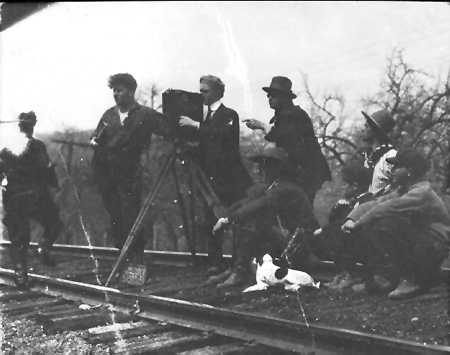
“When the troupe left Ogdensburg, the people of the town presented Director Carroll Fleming with a set of resolutions of appreciation. The last scene by the troupe was the train robbery, including the blowing up of the express safe. A complete train and crew were chartered for the day, and the outlaws and cameramen took their station in the mountains. When the train came puffing around a curve, Al Jennings galloped out with his band, stopped the crew, tied up the engineer and crew and while some of his band kept the passengers covered with their revolvers, the others entered the express car, overpowered the express messenger, who fought like a demon, dragged out the big safe and blew it up. The safe was made of light wood by ‘Props [Joseph] Turner’ at the local studio and weighed about 10 pounds. It was good for one shot only.
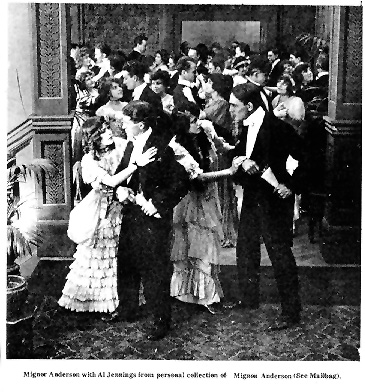
“William Noel remained over to clean up and see that no one owed anything. He was returning at 9:45 o’clock last night and walking down North Avenue dressed in riding breeches, boots, sombrero, etc. and carrying a big suitcase when Miss Mignon Anderson and David Thompson passed on the other side of the street. Dave called out, ‘Hello, Bill,’ and Bill replied, ‘Oh, Hell—‘, the rest of the word being cut off short by the escape of a front pivot tooth which evaded his search for half an hour.”
23 May 1914Reel Life1 min
“AL J. JENNINGS RESUMES THE BANDIT BUSINESS. Hands up! Al Jennings, one-time train robber and knight of the road, demands your attention. He now is being filmed in Beating Back, a Thanhouser six-reel feature in which all of his adventures as an outlaw are being reproduced. The whole film telling the story of his adventures and of his downfall will constitute a release which will teach a powerful moral lesson. Following President Roosevelt’s pardon, society accepted Jennings back into its fold and his homefolk in Oklahoma now are urging his candidacy for governor of his state. ‘Not to give Mr. Jennings every courtesy and accord him every right would be to take away that which society has given back to him. We would be criminals then, and we alone,’ said Katherine Bement Davis, Commissioner of Corrections of New York, at a recent luncheon given by Mr. Hite at the Plaza Hotel in honor of Mr. Jennings.
“Carroll Fleming, former producing director at the Hippodrome, is directing Beating Back, the Jennings film which is based on Jenning’s autobiography which appeared in The Saturday Evening Post. Mr. Jennings is enthusiastic over the picture but insists that the punishment for his deeds of outlawry which fell to his lot in real life shall not be slurred. Moreover, in the screen story Mr. Jennings wishes to have his life-film point a strong moral, and Director Fleming and President Hite of the Thanhouser Film Corporation fully agree with the one time ‘Railroad Robin Hood’ in this respect.”
28 November 1914The Moving Picture World1 min
“When the Thanhouser Company brought the Al Jennings picture, Beating Back, in Kansas City, Missouri, they were informed that the pictures would have to be shown to the board of censorship before they could exhibited publicly. The consequence was that the films were rejected both by the censors and by the board of appeals, to which they were later referred. Immediately the Thanhouser representative secured a restraining order permitting them to show the films. However, by this time the afternoon matinee which had been advertised, was given up. That evening the appeal board met again, and at this meeting it was decided that the pictures were not as bad as the appeal board thought they were when it passed upon them in the morning. The pictures had a very successful run in Kansas City, and after finishing four days in the Convention Hall were booked for four days in the Maze Theatre. At Convention Hall Al Jennings gave a short speech before each performance, and explained the pictures as they were shown. In regard to the action taken by the censors in Kansas City, Mr. Jennings said, ‘I have been living an upright life for the last 12 years, and I could not or would not allow anything to be shown on the moving picture screen that would have any immoral influence whatsoever because it would immediately reflect upon me, and situated as I am at the present time this would be very undesirable, if not dangerous.’”
30 May 1915The Morning Telegraph2 min
“When Beating Back was shown last Sunday at Sing Sing no fewer than eight prisoners presented themselves to the film’s representative and said they had served in the Columbus penitentiary at the same time that Al J. Jennings (the hero of Beating Back, or the villain, depending entirely on one’s point of view and conscientious scruples) was a federal prisoner there. The eight expressed themselves as delighted with the new method of renewing their acquaintance with the famous ex-bandit. This suggests a new line of endeavor for reformed outlaws. It (the new line of endeavor) consists of stealing Mahomet’s old stuff and, since the mountain cannot go to said Mahomet, of having the well-known Mahomet go to the equally well-known mountain. Since a cruel and unkind fate prevents those within penitentiary walls from calling on their friends in the great world outside, why should the friends in the great world outside not have themselves screened and then have the film projected within the walls once dedicated to silence and solitary confinement but, in the march of modern ideas, rededicated to the salvation, not the destruction, of human minds?
“Then may we expect to see headlines saying something like: ‘OLD PAL VISITS CONVICTS Appears on Screen Before them to Show Them Error of Their Ways.’ Or perhaps the news announcement would appear thus: ‘CONVICT SEES FAMILY GROW—Film Shown in Prison Tells No. 42244 How His Kids Are Making Good.’ Then, too, motion pictures in the prisons throughout the country could be used educationally. For instance—by showing pictures of high finance methods, by exposing the peculiar methods whereby a bale of hay is made to grow (in the prospectus) where only a blade of grass existed before, by filming the latest scientific methods of murder, manslaughter and mayhem. By showing such pictures the lower order of convicts could be educated to a higher plane of endeavor upon their release. And, reversing the process, to those who are in jail for crimes involving misuse of the mails, juggling with figures (not in the tango parlors, but in ledgers and books of account), and for similar offenses, pictures could be shown illustrating the best methods of safe-cracking, second-story work and highway robbery. Thus to the high-brows would be brought tuition in elemental crimes and to the low-brows would be carried instruction in the gentle art of thimble-rigging devices. These brilliant ideas, of course, emanate from the sometimes amusing but always ingenious devices of the Beating Back press agent, who coyly remarks that they are not copyrighted.”
12 June 1915The Moving Picture World1 min
“Beating Back, the five-part film dramatization of Will Irwin’s famous Saturday Evening Post serial, is now being offered to states rights buyers. Beating Back is the life story of Al J. Jennings, formerly an Oklahoma bandit and all-round ‘bad man,’ but lately candidate for governor of the very state that once had put a $20,000 price on his head. Jennings plays throughout the five thousand feet in which the story of Beating Back is told. His career—as lawyer in the days when Oklahoma was a territory; a subsequent going to the bad when his brother Ed was shot from ambush; his years as a train robber and outlaw; his escape to South America; his return to Oklahoma and the life of banditry; is capture and confinement for life in a Columbus, Ohio penitentiary; how Senator Mark Hanna became interested in him and secured from President McKinley a commutation of his sentence to five years; Jennings’ pardon and restoration to citizenship by President Roosevelt, and his political career in Oklahoma after he had proved his reformation—all of this is vividly portrayed in Beating Back.
“The picture was made by the Thanhouser Company, which provided an all-star cast consisting of Morris Foster, Frank Farrington, Albert Froome, Mignon Anderson, Fan Bourke, Madeline Fairbanks, and many others noted on the screen to support the one-type time outlaw in the portrayal of his sensational life story. There are feats of horsemanship and rifle-shooting throughout the picture. The robbery of the Rock Island train which resulted in Jennings’ capture is shown, as well as the famous Spike S Ranch where Jennings, and his brother, and two others successfully fought off more than 60 United States marshals and deputies. The film version of Beating Back is as sensational as Jennings own career....”
Note: The preceding article, published a year after the picture’s release, indicates that the film was still being promoted. Apparently the film had been cut to five reels.
12 June 1915The Moving Picture World1 min
“The seventeen hundred prisoners in Sing Sing have evidenced their appreciation of Beating Back in a letter written by the Mutual Welfare League at the prison, the organization under whose auspices the famous Al Jennings-Will Irwin film was shown last Sunday. The letter is as follows: ‘Dear Sir: We shipped Beating Back as promised the following day, and hoped it reached you in due time. It certainly taught a wonderful moral lesson, and I am sure the ‘boys’ here will benefit a great deal by your letting us have so wonderful a production. Thanking you for past favors I am, Very truly yours, Chairman, Entertainment Committee.’...”
Note: The preceding article appeared over a year after the film’s release.
Know where this print is, or another copy?
Prints of films thought lost still turn up in attics, private collections and archives. A record like this one is how the next one gets found.
Tell us about a printCast and crew
- Director
- Carroll Fleming
- Cast
- Al Jennings as as himself
- Madeline Fairbanks as daughter of John Harless
- J. Morris Foster as Frank Jennings, Al’s brother
- Photographed by
- Henry Cronjager
Every name opens that person's page, with each film they appear in and which of them you can watch.
Watch instead
Films you can watch from the same company
More about this film
- Filmed in
- New Rochelle; Ogdensburg and Franklin, New Jersey
- Bowers’ notes
- On June 9, 1914 Thanhouser deposited 45 prints of scenes from the film with the Copyright Office. There was no specific date of release, but it is apparent that the film was shipped to various exchanges around this time. 2. Although the film was made by Thanhouser at its New Rochelle studios, it was released through a Mutual subsidiary, Direct-From-Broadway Features, which maintained offices in the Mutual Building at 71 West 23rd Street, New York City. A full-page advertisement by this firm appeared in The Moving Picture World, April 11, 1914, and invited inquiries. Another full-page advertisement in the April 25, 1914 issue of the same publication noted that states-rights sales were “going like hotcakes.” A full-page advertisement in the May 16, 1914 issue advised readers that just the states of Arkansas, Texas, and Missouri remained available. 3. In 1914, the Photoplay Arts Portfolio of Thanhouser Motion Picture Stars noted concerning Morris Foster: “[He] played Frank Jennings in Beating Back, the pictured life of Al Jennings, reformed outlaw and bandit. Mr. Foster put Jennings’ ability as a horseman to the test during the taking of the pictures, doing stunts on horseback which surprised the one-time train robber.” 4. This film was released in six reels. However, it it believed it was later edited to five reels (as mentioned in The Moving Picture World, June 12, 1915, for example). 5. Kevin Brownlow’s book, The War, the West and the Wilderness (Knopf, 1979), devotes a subchapter to Al Jennings and discusses the present film. 6. This film was released in four reels in England, under the title Dare Devil Jennings.
- Posters and media
From Volume II: Filmography of Q. David Bowers’ Thanhouser Films: An Encyclopedia and History, reproduced with permission and unchanged. Read the history of 1914 →
Cite as: Bowers, Q. David. Thanhouser Films: An Encyclopedia and History, “Beating Back”. thanhouser.org/films/beating-back/
Where a print is held
- Held by
- Library of Congress
- Completeness
- Unknown