1911Thanhouser Company900 feetDrama

The Jewels of Allah

No copy you can watch online. No print is known to survive. What follows is what does: the release, the cast, the story, and what the trade press said at the time.

The story

“A mosque in the desert, where Arabs worship, is looted by a band of the Foreign Legion and the jewels stolen by an officer in command, a reckless French count. A sheik, unable to save the gems, vows to devote his life to recovering them, and patiently tracks the count over land and sea to England. The count meets an American girl, whose father has millions, and makes desperate love to her. The girl has a faithful suitor, a young American, but the dazzle of the title wins her, and she agrees to marry the man who has a romantic career and an established title. Through one of his faithful allies the sheik learns of the engagement, and sets off for the summer home of the millionaire. He spies about the house and looks in the window in time to see the count gravely investing his fiancé with his ‘family jewels,’ which are really the loot of the Arabian temple.

“The sheik determines to recover by force the gems that were stolen by violence. At night, when all in the house have retired, he forces a way in. But he is just a trifle too late, for the girl, afraid to keep such valuables in her own room, steals downstairs and places them in her father’s safe. Just as she swings the door shut, the sheik enters and overpowers her. He binds and gags the girl, while she sits helpless in the room, he works to open the safe. The girl frees herself of the gag, but is afraid to scream for help, as the dangerous looking Arab, with a sharp knife, is only a few feet away. But the telephone is near her, and while the attention of the intruder is distracted, she takes the receiver from the hook with her teeth (her hands being still bound) and softly calls up the man she knows she can rely upon in an emergency, her American admirer.

“The young man, seated gloomily in his library, hears the call and is prompt in responding. He does not wait to get other help, he only realizes that the girl he loves is in danger, and he hastens to her side. The sheik puts up a good battle, but is speedily overpowered. Then explanations are demanded. The man from the desert explains his mission. He convinces them that he is not a criminal, but a victim of injustice. The count does not deny his guilt, but tries to justify himself. The girl listens to him in silence and turns the jewels over to the Arab, saying that she does not want the jewels of a thief, nor will she marry one. The Arab, full of joy, returns to his desert. The count presumably goes back to France, while the young couple are happy ever after.”

Summary from The Moving Picture World · 21 October 1911
What the papers said

3 reviews · 1 advertisement

“No more interesting story nor entertaining film has been seen in recent weeks. Its very novelty of theme and originality make it a notable offering, to say nothing of the varied opportunity for scenic display, such as the desert views, the luxurious home interiors and American scenes. The photoplay narrates the stealing of certain jewels from a Mohammedan mosque by …

Read in full · 1 min

“No more interesting story nor entertaining film has been seen in recent weeks. Its very novelty of theme and originality make it a notable offering, to say nothing of the varied opportunity for scenic display, such as the desert views, the luxurious home interiors and American scenes. The photoplay narrates the stealing of certain jewels from a Mohammedan mosque by Europeans, a certain count securing them and later giving them to an American girl to whom he becomes engaged. The Arabs trace the jewels to her home, and one of them attempts to get them back. The girl discovers him trying to open the family safe, but though he has bound her to a chair she manages to phone her American lover, who comes to her aid. Explanations are made, the count is sent for and given his ‘walking papers,’ and the girl becomes the promised bride of the Yankee. The parts are all well played.”

The Morning Telegraph · 29 October 1911

“This picture fails to give much illusion of real happenings. The early scenes of the mosque where the jewels were kept and are captured by the Frenchman are cheap looking and artificial. The sheik who had charge of the gems swears to recover them, and he follows the count to England. This French count is to be married to an …

Read in full · 1 min

“This picture fails to give much illusion of real happenings. The early scenes of the mosque where the jewels were kept and are captured by the Frenchman are cheap looking and artificial. The sheik who had charge of the gems swears to recover them, and he follows the count to England. This French count is to be married to an English girl, who really loves another man. The sheik, on getting the jewels back, discredits the count and reunites the true lovers. It is not a dull picture as much as a very unconvincing one.”

The Moving Picture World · 4 November 1911

More reviews

1 November 1911The New York Dramatic Mirror1 min

“One finds this a superior production from the telling, the pointed acting, and for the most part the fine quality of the settings and scenic effects. A continental count, while touring in Arabia, steals the sacred jewels from the Mohammedan mosque. He later gives them to an American girl to whom he becomes engaged. Of course, there is the honest American lover with whom she is united when the Arab sheik, tracing the count to this country and jewels to the girl, decides to simplify matters by stealing them back. While he is in the process of so doing the girl appears. He overpowers her, but she manages to ‘phone for assistance, which is rather unconvincing, as he might have heard. On the arrival of the others the count is discredited, the sheik possessed of his jewels, and the lovers united.”

Advertisement

21 October 1911The Moving Picture World1 min

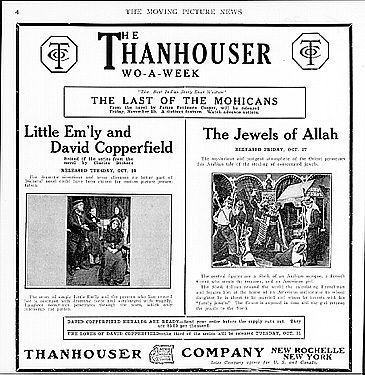
“The mysterious and pungent atmosphere of the Orient permeates this Arabian tale of the stealing of consecrated jewels. The central figures are a sheik of an Arabian mosque, a French count who steals the treasure, and an American girl. The sheik follows around the world the Frenchman and locates him at the home of an American millionaire to whose daughter he is about to be married, and whom he invests with ‘his family jewels.’ The count is exposed in time and the girl returns the jewels to the sheik.”

Have you seen this film, or a print of it?

Prints of films thought lost still turn up in attics, private collections and archives. A record like this one is how the next one gets found.

Tell us about a print

Cast and crew

No cast or crew is credited in the surviving sources for this film. Bowers records the title and the release; the names did not come with them.

Watch instead

Films you can watch from the same company

Matched by cast, director and kind

More about this film

Bowers’ notes

The release date was given erroneously as October 20, 1911 in The Moving Picture News, October 14, 1911.

Posters and media
Press for The Jewels of Allah. Advertisement from THE MOVING PICTURE NEWS, October 14, 1911. Courtesy of Bebe Bergsten.

From Volume II: Filmography of Q. David Bowers’ Thanhouser Films: An Encyclopedia and History, reproduced with permission and unchanged. Read the history of 1911 →

Cite as: Bowers, Q. David. Thanhouser Films: An Encyclopedia and History, “The Jewels of Allah”. thanhouser.org/films/the-jewels-of-allah/

Where a print is held

Held by
No print known