“This very entertaining and absorbing photoplay is Mary Lawson’s Secret. Its interest lies in the well maintained suspense and pathos. The opening of the story showing the advent of the new doctor into the town, and the gradual monopoly of the old practitioner’s patients affords a certain amount of human interest and at the same time provides the foundation for the motive of the crime. The interest lies not in the mystery surrounding the guilty one, because the audience has every chance of becoming cognizant of that from the very beginning, but instead lies in the solution and the unraveling of the complicated situations. We are led to believe that the old doctor will confess to the crimes sooner or later, but instead of having gasped out the confession upon the deathbed or the guilty one harassed unto desperation by his conscience, there has been offered a slight touch of originality in having Mary discover the doctor in the coffin, thinking all along that it contained her husband. This naturally lends a particular charm and surprise to the ending. A smooth running plot and an even continuity speaks well of the direction. The atmosphere has been well maintained and the photography the very best. Charlotte Walker has been supplied with a vehicle that affords her ample opportunity for strong dramatic situations, which she handles in a way that is very praiseworthy. J.H. Gilmour, who portrays the character of old Dr. Kirk, presents a pleasing bit of character acting. In fact the entire cast deserves mention. Mary Lawson’s Secret is a play well adapted for community theatres and those houses looking for wholesome entertainment. It is quite up to the high-water mark of Thanhouser productions.”
REVIEW by Dickson G. Watts, The Morning Telegraph, March 18, 1917:
“The sustained interest of this production lies not in any new theme but in a succession of surprising twists to the action. In this department Lloyd Lonergan has fairly outdone himself. For each reel there is a new development that will keep audiences guessing, and in this way exceptionally good entertainment is assured. Exhibitors will also have the name of Charlotte Walker as a drawing card. The action of the picture is swiftly moving, and despite one or two weak spots, consistently portrayed, with fine continuity as an added asset.
“Mary Lawson is insulted by the new doctor of the town where she lives and, in the hearing of the nurse, quarrels with him. On the same evening she is sent by her mother to summon him hurriedly, finding him dead with a knife beside him. She is discovered by passers-by beside the body with the knife in her hand. On this circumstantial evidence and the testimony of the nurse she is convicted of murder in the second degree, despite the efforts of Dr. Kirk, the old family physician, to save her. This is one of the weak spots of the drama. The audience is led to suspect the nurse, whose relations with the dead man are exposed in the first reel. Escaping from her guards through the aid of a friend, Mary goes west, where she finds employment in a factory. Later she marries a fellow workman, John Harlow. The husband takes her east, under the pretext of finding a better position, and then surprises Mary and the audience by disclosing himself as a young millionaire who, on a bet, has been posing as a laborer. Shortly after the honeymoon Mary meets Dr. Kirk, now a wastrel. The man explains that he had been driven from his practice by his townspeople because of his activities in Mary’s behalf. He demands that he be introduced into Harlow’s home as Mary’s uncle, threatening to betray her secret should she refuse.
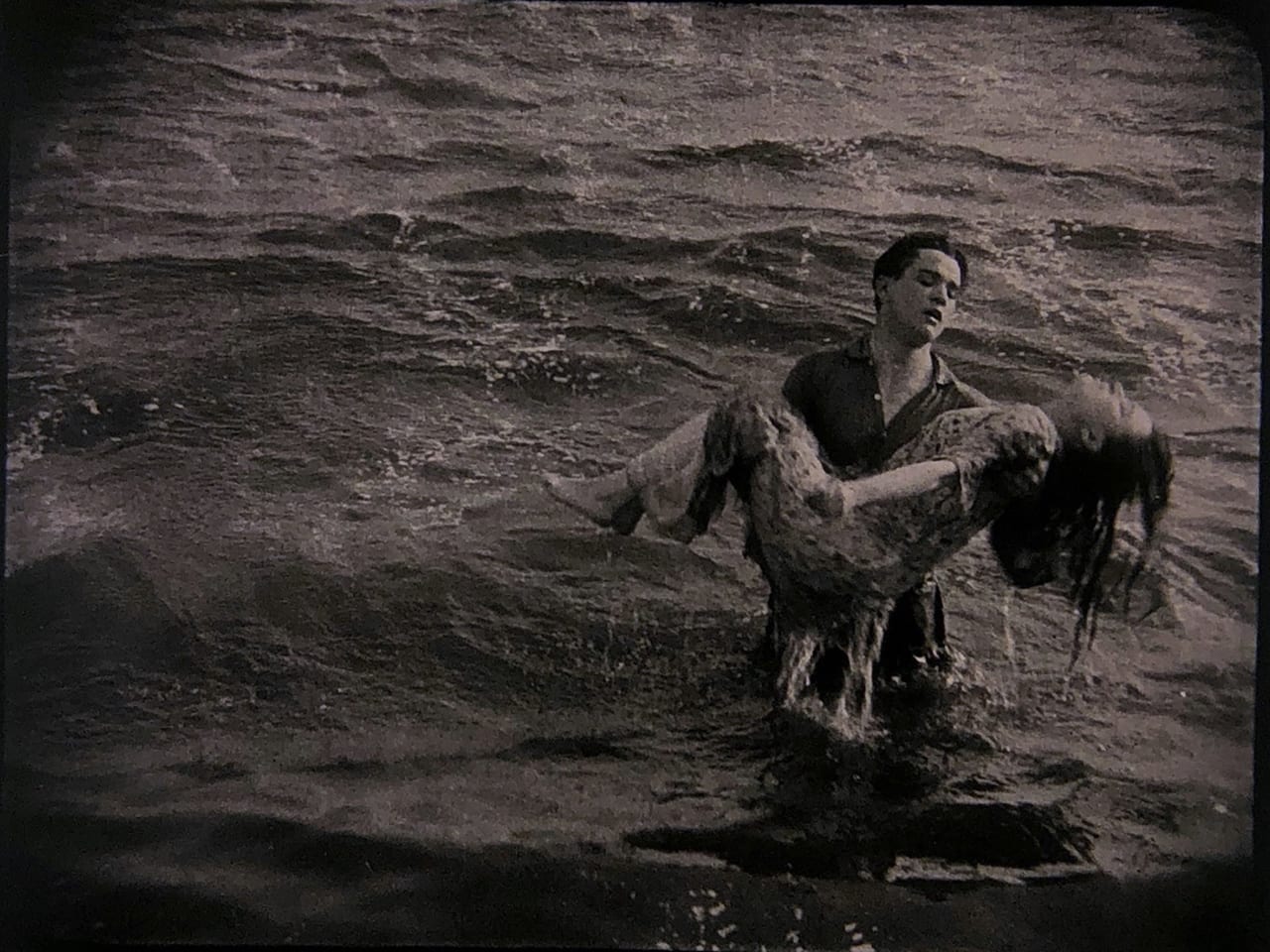
“Sometime later, through the gossip of her servants, Mary learns that the police are coming to arrest her. She confesses to Harlow, escaping with him in a motor boat which is wrecked in a storm. Reviving on the rocks in the early morning, the girl overhears the conversation of some searchers and is led to believe, together with the audience, that Harlow’s body has been recovered. Wishing to see him once more, Mary risks returning to her home. In the coffin she finds Kirk, and then learns from the police that the doctor is the real murderer. The cast employed in this production is in every way capable, as is the direction. The settings and photography will be found good.”
REVIEW by Edward Weitzel, The Moving Picture World, March 31, 1917:
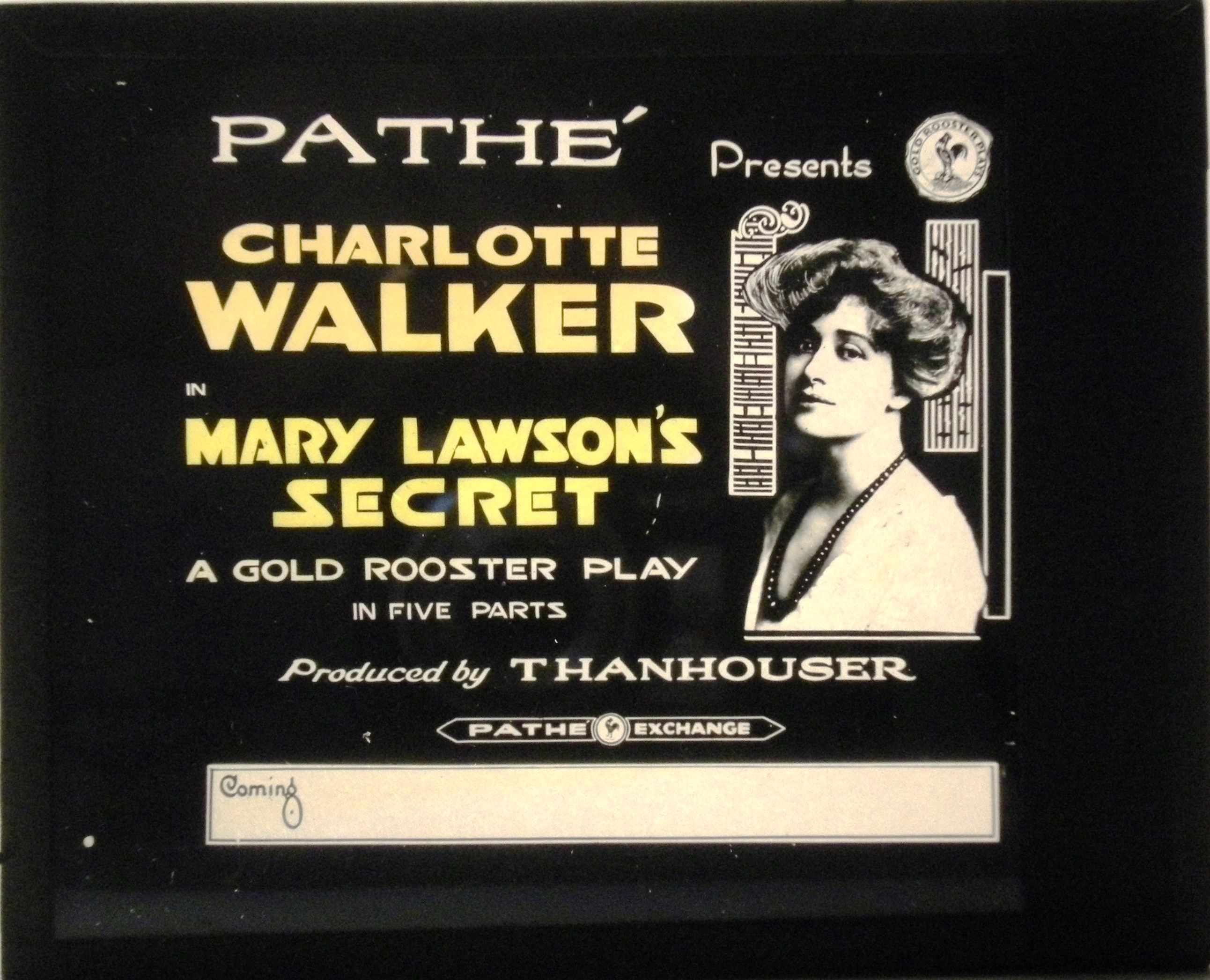
“A mystery story in which the secret is kept until the end may be said to fulfill its mission. Such a story is to be found in Mary Lawson’s Secret, a five-reel photoplay produced by Thanhouser and featuring Charlotte Walker. An unexplained murder in the early part of the drama sustains the interest and, as in all crime stories, it is just as well not to scan too closely the use of coincidence made by the author. Lloyd Lonergan, who wrote the scenario for Mary Lawson’s Secret, has used the expedient freely and constructed a photoplay that catches the attention quickly and holds it firmly until the end of the picture.
“A young girl living in a small place is convicted of murdering a young doctor, who lured her into his office and insulted her. This doctor had a rival in town, an elderly man who had practiced there for many years. While on her way to serve a life sentence, Mary Lawson escapes and, eventually, becomes the wife of a wealthy man. She does not tell her husband her secret until the officers of the law get on her track. Just as they are about to arrest her again, the real murderer confesses. The variety of incidents and the expert handling they receive, give the drama its chief claims to consideration. On the production side, skillful use of his material by director John B. O’Brien and excellent playing by the cast insure a favorable impression for the drama. Charlotte Walker, although somewhat mature for the part, plays Mary Lawson with earnestness and wins sympathy for her at each stage of the plot. J.H. Gilmour, William Davidson, N.S. Woods, Inda Palmer, and Robert Vaughn are the members of the supporting cast. Several waterscapes showing an approaching storm are worthy of note.”