The story
“Silas Marner is driven from his native village because of a false charge against him. He goes away to England and starts a new life. Being a skillful weaver, he makes money rapidly, and being friendless, by his own choice, naturally becomes a miser. He places his earnings near the fireplace, so that it is always near him. Dunstan, the worthless son of the squire, spies him one night. While Silas is out of the house for a few minutes, Dunstan slips in and takes the gold. Making his escape in the dark, Dunstan slips and tumbles into a nearby stone pit. The loss almost unhinges the reason of Silas. He falls asleep before his fire one night, and dreams that his gold has returned. Opening his eyes, he rushes forward to reclaim it. He is doomed to disappointment. The ‘gold’ is the hair of a tiny girl. Her starving mother managed to reach the doorstep of Silas, and there fell dead. Her plight touches the heart of the old weaver. In later years he had occasion to bless his choice. For the little girl, she grew to womanhood, became a loving and affectionate daughter.
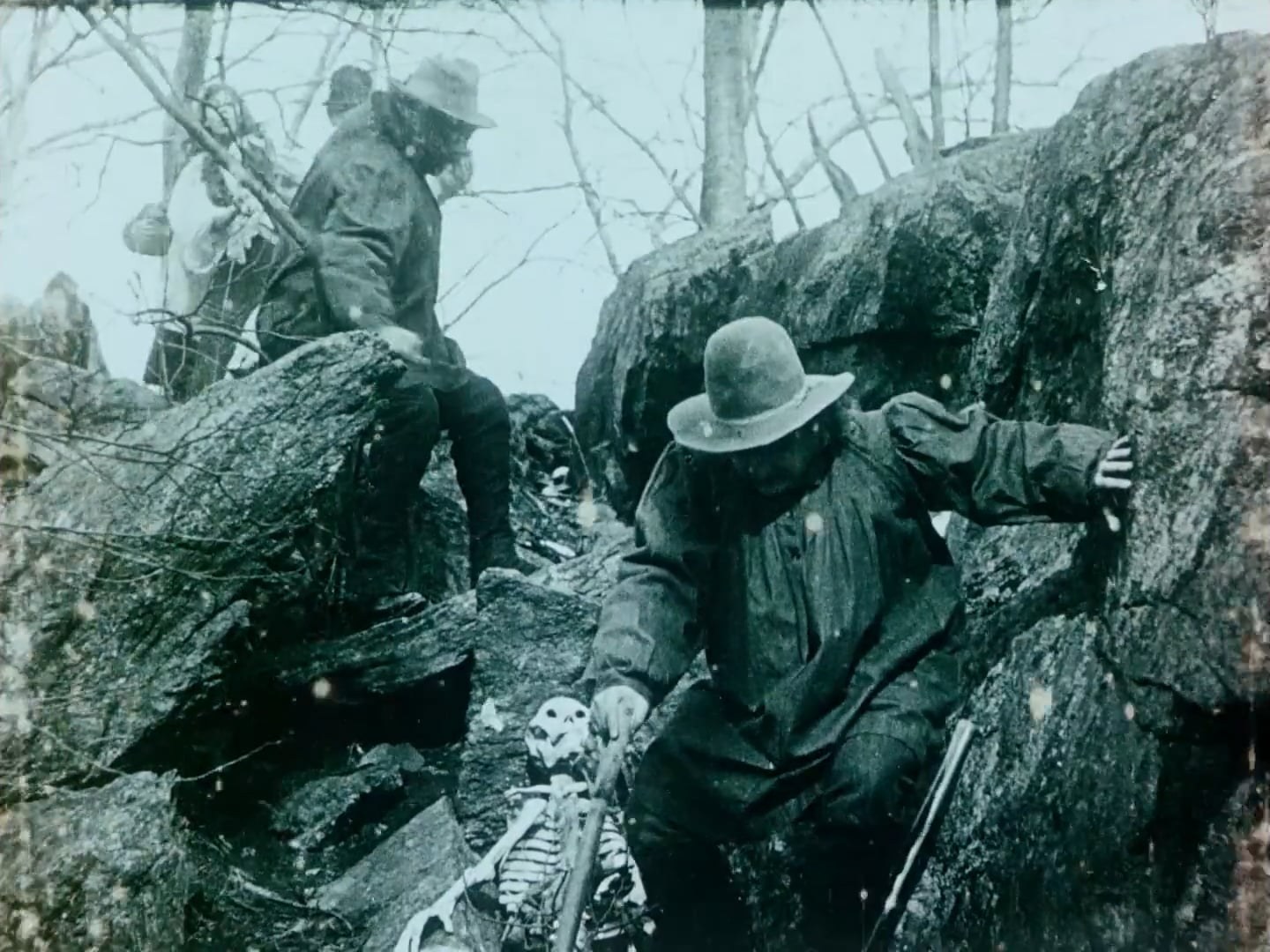
“In the course of time the old stone pit was drained out, and the workmen solved the mystery of the robbery. Dunstan’s skeleton was found with the bags of money nearby. The adopted daughter brings the money to Silas. For a moment he clutches the coins eagerly. Then he casts them aside and turns to the girl. He realizes that he is no longer Silas Marner, the miser, but a man who has reason to be happy and grateful. Once he thought that money meant everything in the world, but now he understands that the shining heap of gold is not worth one strand of his daughter’s sunny head. The money is hers, for she is his, and he knows now that love is a treasure no miser can buy.”
Summary from The Moving Picture World · 1 April 1911
Background of the scenario
Silas Marner, the tale of the weaver of Raveloe, was one of the best known stories of George Eliot, pseudonym of Mary Ann Evans (1819-1880). Mary Ann was the youngest daughter of Robert Evans, an agent for an English estate. She was strongly influenced by love and duty from religious schooling, and this is evident in her novels. Her first work was a translation of David Strauss’ Life of Jesus, published in 1851 by John Chapman, owner of the Westminster Review, a publication to which she later contributed frequently. Her work on this book introduced her to modern biblical scholarship and deprived her of the fundamentalistic religious views she had hitherto held. Thereafter she considered herself a Positivist, though religion continued to be an important theme in her writing.
In 1854 she met G. H. Lewes, a married man, and the two spent the rest of his life as scandalously close friends. Adam Bede, published in 1859, established her as one of the leading novelists of her time. The Mill on the Floss (dramatized for the screen by Thanhouser, and released on December 16, 1915) was her next success, released in 1860. Silas Marner repeated the success in 1861. Queen Victoria and Ivan Tergenev (the first Russian writer to achieve success throughout Europe) recognized her as the greatest living novelist, following the release of Daniel Deronda in installments during the years 1874-1876.
Silas Marner is the tale of a reclusive weaver who works only to add to his cache of gold coins secreted in his rural cottage. His precious gold is stolen, and he has nothing to live for, when a young waif is abandoned near his cottage and enters his life. Caring for her, he raises her to adulthood, only to learn that she is the daughter of an evil neighbor by an old marriage, and the neighbor demands her return. The girl refuses to go, and she and Silas live happily ever after.