The story
The Early Life of David Copperfield
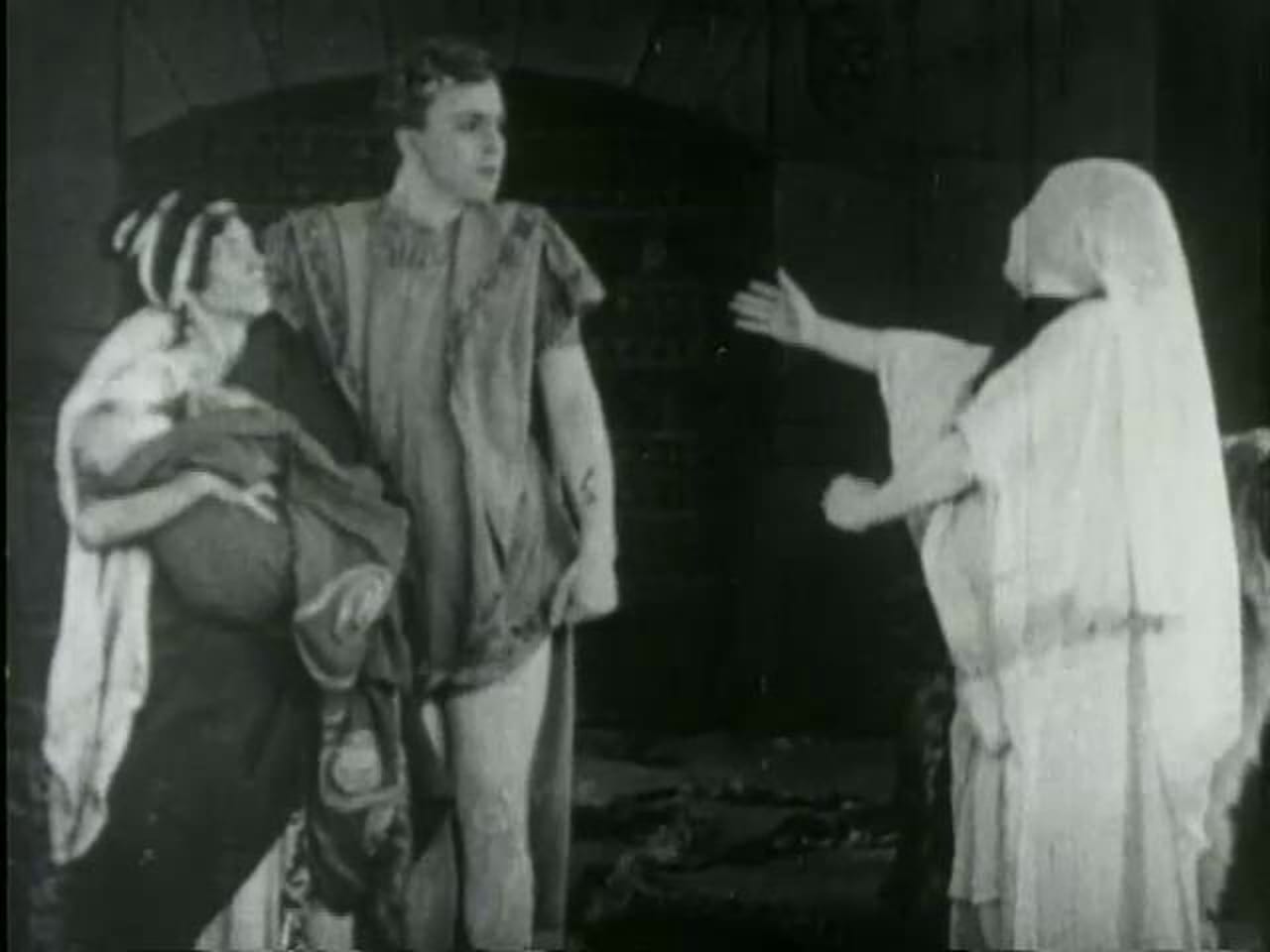
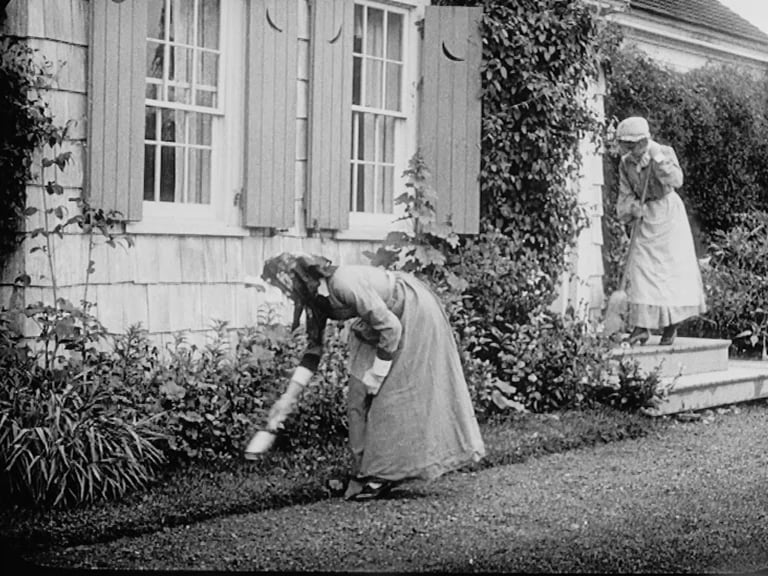
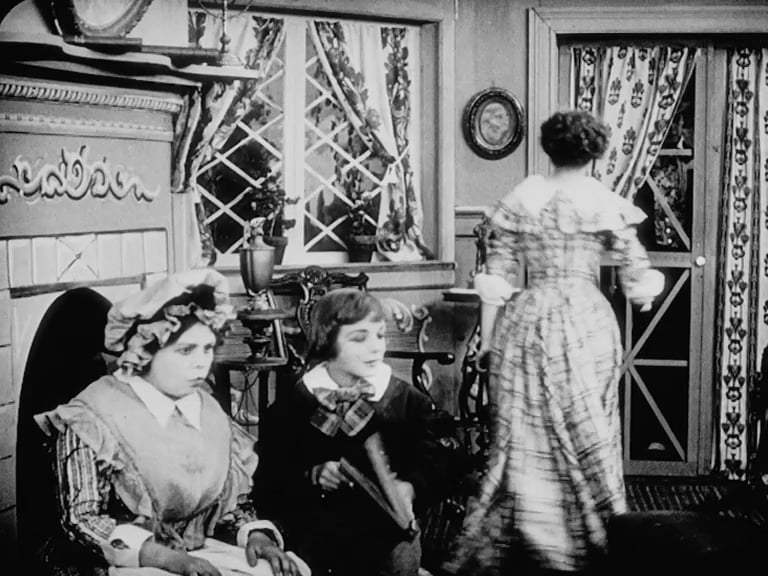
“The film starts with the time that Aunt Betsey, an eccentric spinster, flattens her nose against the windowpane before she enters the Copperfield home, over which the stork is hovering. Aunt Betsey in anticipation of a birth had set her mind on a girl—because she abhors boys. When it is therefore announced that the stork has brought a boy, she vanishes from the house ‘like a discontented fairy.’ David’s mother is a helpless young woman, impractical and unassertive. She married an elderly gentleman, who dies before David is born. Eight years after David’s birth, she is flattered by the attentions of Edward Murdstone, who is ardent in his courtship because the widow’s money is such a tantalizing incentive.
“David shows his dislike for Mr. Murdstone. His mother marries, however, while he is absent on a trip with Peggotty to her brother’s house at Yarmouth. There he meets hearty fish-folk, among whom he finds little Em’ly. With the marriage of his mother to Murdstone begins a series of hardships which finally end when his mother dies. After his mother’s death, Mr. Murdstone places him in a bottling factory, but David runs away and finds refuge with his Aunt Betsey.”
Summary from The Moving Picture World · 14 October 1911
Background of the scenarioBowers
David Copperfield is a novel with a plot too crowded with material to do justice with summarizing, and it took Thanhouser three reels to present it. Even so, the film was simply a series of vignettes or tableaux; to have presented the story with its full original meaning would have taken many hours of screen time. Indeed, the basic work contains enough plots to make up several stories. Basically, it tells of a recalcitrant David, his flight from school, problems of his youth under various harsh circumstances, difficulties in love, and growing up, all while surrounded by numerous highly individualistic and memorable people. In retrospect, even the character names seem descriptive of the people they designate. The work is from the pen of Charles Dickens (1812-1870), whose biography is discussed under the entry for the film, The Old Curiosity Shop, released on January 20, 1911.
In the construction of this novel, much autobiographical material was used. The trials and tribulations of Dickens’ own childhood are largely reflected in story of David. It is no wonder, then, that Dickens said of his own work: “Of all my books I like this one best; like many fond parents I have in my heart of hearts a favourite child, and his name is David Copperfield.”
What the papers said 6 reviews · 1 article · 1 advertisement
“Confined to a space of 3,000 feet, three reels, this monster subject is yet one of the most brilliant productions released through the regular channels for some time. Unlike so many reproductions of famous stories of famous plays, this one would have been immensely interesting without the fame already attached to it, for it is so cleverly done and as …
Read in full · 3 min
“Confined to a space of 3,000 feet, three reels, this monster subject is yet one of the most brilliant productions released through the regular channels for some time. Unlike so many reproductions of famous stories of famous plays, this one would have been immensely interesting without the fame already attached to it, for it is so cleverly done and as clearly put on that it is at once intelligible and entertaining as plain simple production. The proper atmosphere has been obtained with stage arrangements and varieties of scenes too numerous to mention. The costuming, not an easy thing to do correctly, has been carefully handled by both the director and by each actor in the cast. The numerous seaside scenes, the boarding school of Creakle’s and Aunt Betsey’s house are all real and natural places, well gotten up and so well connected with the play that they remain indelibly stamped upon the memory long after the film has been seen.
“The production is divided into three distinct parts as well as the film itself, each part being commensurate with the divisions in the film, so that each reel is a complete story by itself, and can, if necessary, be exhibited as a complete story. The first is ‘David Copperfield’s Younger Life;’ the second story of ‘Steerforth,’ and the third, the ‘Loves of David Copperfield.’ The three films will be released on three consecutive Tuesdays, so that any exhibitor using but one Thanhouser film per week will be sure to get the entire production without interruption. David Copperfield is, of course, played by three different people, but each actor carries the part well. David is not the central figure, however, as the book is not so much concerned with what David did as what he saw. The director has noticed this and has laid much emphasis upon the characters surrounding David. Thus, Micawber, while a humorous character, is one of the most interesting in the cast. Little Em’ly attracts more attention than perhaps any other single player for her size and manner provokes sympathy throughout the play both when played by the Thanhouser Kid in the first scenes and by an older actress later.
“Next to Em’ly and Micawber, Uriah Heep is perhaps the most interesting person both for his make-up and splendid acting. Murdstone, David’s foster father, has created himself a conspicuous part, and despite the disagreeable scene in which he encounters Aunt Betsey and her broom, he gains the sympathy of the audience. While we do not see Aunt Betsey drive the donkeys off the lawn, we saw the lawn and Aunt Betsey in it. Her adoption of David, while occupying only a very few feet of film, is a graceful accomplishment. Her surprise is excellently expressed when David appears ragged and tattered before her eyes, while her indignation at Murdstone’s attempt to take David away is nicely handled. She succeeds in creating good humor in this scene without spoiling the dramatic effect which has been created shortly previous.
“Dora might have been improved, for she seems to be an almost sensible girl instead of the little doll Dickens has created her. She is pretty, however, one can find no fault with David when he becomes infatuated with her. Perhaps her part only lacks naturalness in the light of the splendid character of the other parts, and surely she has a hard part to play. In the hands of the director of the company the splendid play is made to live over again, each person alive before the eyes and yet of that seemingly unchangeable character as Dickens has created each. The film is the prize of the winter season so far as the season has progressed, and sets the pace which will be hard to follow by large productions coming later.”
“Like many former photo presentations of noted stories, this first of the Thanhouser Dickens series is in reality a run of tableaux of the first part of David Copperfield, which, with the aid of many sub-titles, pictures events in the beginning of the book. In other words, it acts as a series of moving illustrations to the text. It begins …
Read in full · 1 min
“Like many former photo presentations of noted stories, this first of the Thanhouser Dickens series is in reality a run of tableaux of the first part of David Copperfield, which, with the aid of many sub-titles, pictures events in the beginning of the book. In other words, it acts as a series of moving illustrations to the text. It begins with the lad’s birth when his Aunt Betsey is furious because he is a boy, depicts the wooing of Mr. Murdstone and his marriage to David’s mother, David’s visit to Peggotty’s brother Dan and his meeting with little Em’ly, his return home and ill treatment by his step-father, the death and funeral of his mother, his being taken to school where he is abused by the boys and his being placed in the bottling works from which he runs away to his aunt, his journey thither, his arrival and reception, and the visit of Mr. Murdstone, who is sent on his way by the irate aunt. The photography is excellent, the acting of a high order, the settings well made and the exteriors creditably chosen. To students of Dickens it will prove interesting and should have usage in literary classes.”
More reviews4 · 30 September 1911 – 25 October 1911
30 September 1911The Moving Picture News · Parts I, II, and III2 min
“All lovers of Dickens, all students of literature, almost anyone with an appreciation for the classics, will not fail to experience a keen thrill of delight when they see exhibited on the screen in life-like portrayals these ingenuous, unctuous and whimsical characters who live between the covers of David Copperfield. As if taken bodily from the book and ‘checked’ through the projector, so real are these characters reproduced in the Thanhouser production. The pictures will long be a monument to the art and talents of that intelligent coterie of artists up at New Rochelle. The most conservative of critics could not help but bubble with enthusiasm after observing this production. It passes all belief that such a difficult task of the filming of the characters of this wonderful novel could have been achieved with such marvelous fidelity to the text. This may sound like exaggerated praise, but it is really a modest statement compared to the actual laudation this work deserves. The first of the series of the pictures is called The Early Life of David Copperfield, the second Little Em’ly and David Copperfield, and third, The Loves of David Copperfield.
“David’s early career was far from being a happy one. Every opportunity to ‘bring out’ the pathos and humor of this period of his life has been taken advantage of. All of the important incidents from the time he is born on the unlucky Friday to the day he runs away from the bottling factory to seek refuge with his eccentric aunt, have been picturesquely recorded. For dramatic situations, tense climaxes and opportunities for strong pantomimic acting, no better period could have been chosen than the one dealing with Little Em’ly, David, Ham and Steerforth. The pictures tell a story that holds your interest from beginning to end. The realistic acting of the different players is astonishing. They all display a wonderful knowledge of the characters they portray and as a result they ‘live’ their parts.
“Throughout his life David Copperfield was shadowed by a ‘jinx’ that was difficult for him to shake off. Even in his love affairs misfortune follows him. Interwoven with his domestic troubles the pictures show the forgeries of the obsequious Uriah Heep and his undoing by the loquacious Mr. Micawber. The smoothness and finesse of the entire performance is evidence of the attention of the Thanhouser directors paid to details. The reproduction of the quaint Dickensian atmosphere made the demands on the directors exacting. They did their share of the work creditably. This production can well be featured as ‘An Evening with Dickens.’”
30 September 1911The Moving Picture World · Parts I, II, and III1 min
This review is reprinted in the narrative section of the present work.
11 November 1911The Moving Picture World · Part I1 min
“Such a picture as this depends largely on characterization, and also the atmosphere that is given by costumes and settings. In both, the Thanhouser Company has been very successful and is worthy of high praise. The story is well acted and made clear—how could it help being interesting? It is a masterpiece. Perhaps Aunt Betsey is most praiseworthily pictured, but all of the parts are well done.”
25 October 1911The New York Dramatic Mirror · Part I1 min
“Much care and understanding has been brought to bear upon this production, and the spirit of Dickens’ characters is admirably realized. The settings and backgrounds have also been made and chosen as suggestive and representative. The production, however, suffers the general fate of its kind. It is in places almost a series of illustrations and tells the story too much by titles—an error that in many instances could have been avoided. Each character is finely conceived, and David is among them. He is seen to visit the old sailor brother of his nurse, where he is much impressed with Little Em’ly. Then he returns to find his mother married, is sent away to school, from which he is summoned back by the announcement of his mother’s death. After the funeral, he is sent to work in the bottle factory, but he escapes to his aunt. When his stepfather appears before this lady, she drives him off with a broom.”
Article
16 September 1911The Moving Picture World1 min
“THANHOUSER’S ‘DAVID COPPERFIELD’ REGULAR RATES. David Copperfield, the Dickens story in three reels by Thanhouser Company, will be issued as a regular release and on the same day of three successive weeks. Each reel is complete in itself and presents a concrete epoch in the life of Dickens’ great character. As no extra price is charged for the reels, exhibitors are warned that no extra price should be paid. It has come to the knowledge of the Sales Company that rental agencies had been in the habit of demanding an extra price of subjects that are in great demand, such as the Thanhouser Romeo and Juliet, Itala’s Clio and Phyletes, Nestor’s Mutt and Jeff and others which are supplied at the regular rate. Manufacturers who issue feature reels feel that the business as a whole should benefit by their effort and if anyone is to profit it should be the manufacturer by the sale of extra copies to meet the demand, thus encouraging them to still greater effort.”
Advertisement
14 October 1911The Moving Picture World1 min
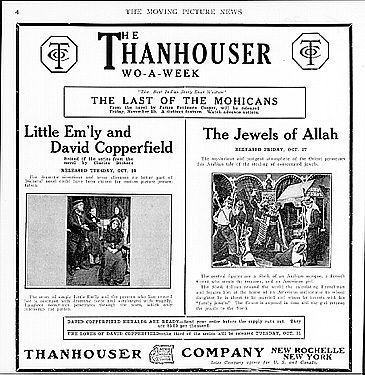
“First in the series from the novel by Charles Dickens. People who most affect the early life of David Copperfield are his mother, Mr. Murdstone, Peggotty, Ham, Little Em’ly, Uncle Dan, Mr. Creakle, Steerforth, and Aunt Betsey. All exert their influence either for good or evil. The associations and environments of his younger days indelible enstamp upon David’s character as strongly defined traits. David and his early associates are reproduced amidst a Dickensenian atmosphere, in remarkable fidelity to the great novel. All the most dramatic and picturesque incidents of this period of his life are shown. The critics all agree that this production is a revelation.”
Bowers’ notes
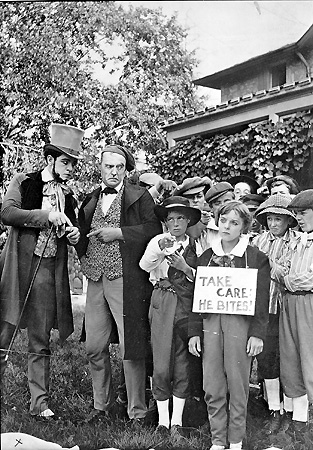
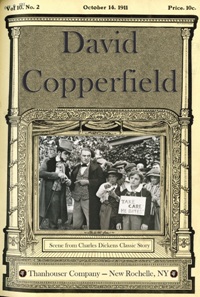
- First reel of a three-part series, followed by Little Em’ly and David Copperfield (October 24, 1911) and The Loves of David Copperfield (October 31, 1911) Exhibitors were advised to show each reel in the week it was released, then show all three at once at a later time, as part of a “David Copperfield Night.” 2. The Moving Picture World, September 16, 1911, mentioned that this reel would be released in October: “The first of a series from the novel by Charles Dickens. To be followed on consecutive Tuesdays by two big productions, each complete in itself, showing the career of David Copperfield...” The week before in The Moving Picture World it was announced that this reel would be released in September, and apparently the schedule was pushed back a month. Some announcements placed the release date as October 16, 1911, an error, as this would have been a Monday, which was not a Thanhouser release day. 3. The role of Emily was spelled as “Em’ly” in most Thanhouser publicity; this is per the spelling in Dickens’ novel. 4. American Film-Index 1908-1915 credits Theodore Marston as the director and scenario writer for this and numerous other early Thanhouser films, particularly “classics.” This error has been repeated by several writers who drew from that text. However, correspondence with Gunnar Lundquist, co-author of that that book, reveals that an erroneous information source was consulted, and that Theodore Marston never directed Thanhouser films (although his brother, Lawrence, was a Thanhouser director). Contemporary trade sources consulted, including The Moving Picture News (June 1, 1912) and The Moving Picture World (August 12, 1912), credit George O. Nichols as the director of this and the two other David Copperfield films. 5. A scene from this film, showing David Copperfield wearing a sign lettered ‘TAKE CARE, HE BITES!’ appeared on the cover of The Moving Picture World, October 14, 1911. 6. On The Moving Picture World, issue of September 16, 1911, it was announced that the Vitagraph Company of America was working on David Copperfield as a three-reel subject, a film which never saw completion. It was common at this time for Independents to copy what the Licensed firms did, or, in this case, for a Licensed company to copy an Independent. Each thus took advantage of the other’s publicity.
Little Em’ly and David Copperfield
“This picture shows David already grown to manhood at an inn in Yarmouth. Here he meets Steerforth, a chum of his boyhood days, at the Salem House. David invites Steerforth to come with him to visit his friends at Yarmouth. They arrive just when the announcement is made of the engagement of little Em’ly to Ham. David is enthusiastic and congratulates the seemingly happy couple. He then introduces Steerforth, who is attracted by little Em’ly’s simple beauty. At the first opportunity he makes love to her. Little Em’ly sees in the suave Steerforth her ideal and eventually he is able to induce the misguided girl to elope with him to Italy. Before leaving she sends a note to Ham, which wrings the heart of her faithful lover.
“In Italy, the caddish Steerforth tires of Em’ly and deserts her. Little Em’ly then finds herself adrift. Later, after a long illness, broken in spirit and mind, she arrives in London, where Mr. Peggotty and David find her and provide for her future. In the meantime Steerforth sails for England. The boat in which he sails is wrecked off the coast of Yarmouth. Ham sights the wreck and in attempted rescue is drowned. Steerforth’s body is washed ashore. Whimsical fate brings the bodies of Steerforth and Ham side by side. The last scene closes with David, hat in hand and bowed head, standing between the bodies of two of his friends.”
Summary from The Moving Picture World · 21 October 1911
What the papers said 3 reviews
“David, grown to manhood, leaves home for a visit to Yarmouth and at a roadside inn meets Steerforth, whom he brings with him. On their arrival they hear of the engagement between Emily and Ham. During the next few days Steerforth and Emily are seen together much of the time. Then Emily defends Martha, who is being stoned by the …
Read in full · 1 min
“David, grown to manhood, leaves home for a visit to Yarmouth and at a roadside inn meets Steerforth, whom he brings with him. On their arrival they hear of the engagement between Emily and Ham. During the next few days Steerforth and Emily are seen together much of the time. Then Emily defends Martha, who is being stoned by the villagers. After seeing Steerforth and Emily together some more they elope and Ham is given her farewell note, which he shows to David, and which they take to the uncle and aunt.
“In Italy Emily is deserted by Steerforth, when she tries to cast herself into the sea, but is rescued by an Italian woman. In England she goes to Martha, who befriends her. The old folks come to her and she writes her husband that she is going to Australia and begs him to forget that she had ever wed. Ham later sees a ship in distress, and after picturing the crowds on the beach Ham attempts to swim out and saves one lone person, who proves to be Steerforth, Ham being drowned in his attempt. The water scenes are well taken save that no storm is pictured. The rest of the film is much like the first in that it is really a series of motion illustrations to the original, with interjections in type to explain the action. It would hardly carry as a strong motion picture story were one unfamiliar with the Dickens’ novel, in other words. In point of costume and settings, as well as of environs chosen, it is admirable.”
“Second in a series of Dickens’ great novel. This, of course, is a seaside picture. It has the good qualities of the first film. It is a sadder story and was harder to act convincingly. It is, however, very successful and effective. Some of its scenes are highly commendable. Little Em’ly is charming, and the other characters are very well portrayed.”
More reviews
1 November 1911The New York Dramatic Mirror · Part II1 min
“The excellent characterization shown in the first reel of this subject is continued in this second instalment of the life of David Copperfield. The same indication to tell the story too much by titles is noted; otherwise it is a production of high order. David, now grown to manhood, visits Little Em’ly with his friend Steerforth. Little Em’ly is to marry Ham. Steerforth wins her away and flees to Italy with her, where he abandons her. Later, she arrives in London, where she meets David, who cares for her. On his way to England, Steerforth is drowned in a shipwreck, in which Ham attempts a rescue. Both men are drowned, and the tragedy is witnessed by David.”
Bowers’ notes
This is the second reel of a three-part series, and was preceded by The Early Life of David Copperfield (October 17, 1911) and followed by The Loves of David Copperfield (October 31, 1911)
The Loves of David Copperfield
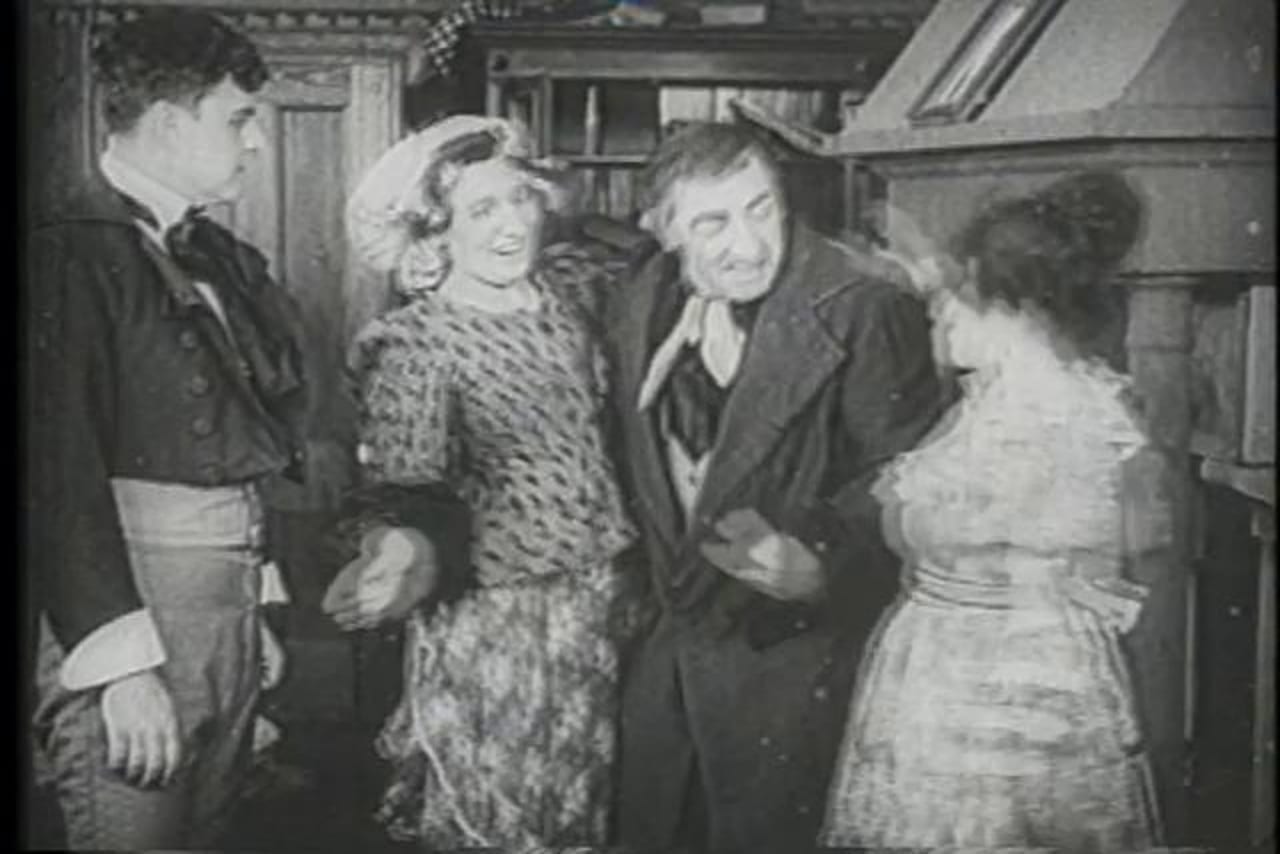
“Uriah Heep, the humble creature, loquacious Mr. Micawber, eccentric Aunt Betsey, Mr. Wickfield, the lawyer, Dora, the ‘doll-wife,’ lovelorn and sighing Agnes and the others all move about in a sphere totally Dickensian. The scenes are set in Mr. Wickfield’s home and his office, the homes of Aunt Betsey and David, and the church in which David is married to Dora. The different incidents chosen for the reproduction helped to bring out forcibly the characteristics of the chief actors. The picture introduces the irrepressible Mr. Micawber, who is always waiting for something to ‘turn up.’ It covers a period of the story where David and his Aunt Betsey come to the office of Wickfield and Heep on a business transaction. Heep, the humble creature, is portrayed with utmost startling realism.
“Threaded with the machinations and forgeries of Uriah Heep and his final undoing through the sagacity and suspicions of Mr. Micawber, are David Copperfield’s love affairs. David is much attached to Agnes and Dora, but Dora’s doll-like face and childish manners captivate him and he marries her. The marriage does not turn out a happy one, for Dora is a poor housekeeper with little mentality and less adaptability. Dora dies shortly after her marriage and on her death bed she asks Agnes to marry David. Agnes is in love with David from the very first, and when he returns from a trip abroad, after the death of his wife, he learns of Agnes’ love for him and he marries for the second time.”
Summary from The Moving Picture World · 28 October 1911
What the papers said 2 reviews · 1 advertisement
“The Loves of David Copperfield is the complete title of this film which is the third and last of this Thanhouser Dickens series. In some respects it is a trifle more pleasing than the preceding reels, perhaps because some of the characters stand out more forcibly, notably those of Micawber and Uriah Heep; and it also gives an impression of …
Read in full · 1 min
“The Loves of David Copperfield is the complete title of this film which is the third and last of this Thanhouser Dickens series. In some respects it is a trifle more pleasing than the preceding reels, perhaps because some of the characters stand out more forcibly, notably those of Micawber and Uriah Heep; and it also gives an impression of being a bit more pretentious mechanically, though the first two parts were entirely adequate in this regard, for in atmosphere the Thanhouser Company has attained remarkable effects, both as to costumes and settings.
“But like its fellow offerings this last reel is in reality little more than a continuance of the tableaux—living illustrations to the text, save that the characters move about, which was not possible in the days when we delighted in ‘wax works’ performances. A subtitle and then the action following it, another sub-title and another scene, and so on until the end of the tale. This is not a slur upon the makers by any means, for little else could be accomplished in motion pictures with this particular Dickens story, which lacks rapid and vivid action of modern day literature, such as is contained in his A Tale of Two Cities, recently successfully made into a film. [This reference is to a three-reel Vitagraph film released in March of the same year.] This last reel takes in the planning of Uriah Heep to rob Aunt Betsey, the engaging of Micawber as a clerk in the counting house, the marriage of David and Dora, Micawber getting proof of Heep’s forgery, David’s wife proving herself a poor housekeeper. Dora becomes ill and sends for Agnes, on her deathbed Dora begs Agnes to wed David, after Dora’s death David starts for abroad, two years later David returns. David learns of Agnes’ love, and the tale ends in their embrace.”
“This is the third in the David Copperfield series. A very great deal of matter is crowded into this part. It doesn’t grip quite so powerfully as the first two parts, but that isn’t saying that it is weak. It is very interesting and good. Taken as a whole, the three reels are very much worthwhile. The novel has been …
Read in full · 1 min
“This is the third in the David Copperfield series. A very great deal of matter is crowded into this part. It doesn’t grip quite so powerfully as the first two parts, but that isn’t saying that it is weak. It is very interesting and good. Taken as a whole, the three reels are very much worthwhile. The novel has been done before. No comparison is needed. Spectators may prefer this character as portrayed in one and that character as portrayed in the other. But most will be very pleased and delighted with these other motion pictures of our best novel.”
MUSICAL ACCOMPANIMENT (Parts I, II, and III). Musical suggestions from the Colonial Theatre, West Hoboken, New Jersey, for the David Copperfield series were published in The Moving Picture World:
Advertisement
28 October 1911The Moving Picture World1 min
“This chapter of David’s life presents a simple study of character development. David’s message to Dora, his ‘doll-wife,’ is unfortunate and does not result in happiness for either. Dora dies shortly after their marriage. David two years after the death of his first wife learns that Agnes is in love with him. He marries her and in the second matrimonial adventure he is more fortunate than in the first. The story of Uriah Heep’s forgeries are threaded with David’s love affairs. Loquacious Mr. Micawber also plays a prominent part in this chapter of the play.”
Other notices3
FIRST REEL1 min
-
Song of Comfort, by Charles Davidson (McKinley Publishing Company).
-
Charme d’Amour, by Edward F. Kendal (Witmark).
-
Temptation Waltz, by Henry Bauer (Bauer Music Company).
-
Heather Rose, by G. Lange, op No. 8. (McKinley Publishing Company).
-
Halcyon Waltz, by Gertrude Buck (Thompson Music Company).
SECOND REEL1 min
-
Good-bye, by F. Paolo Tosti (McKinley Publishing Company).
-
I Adore Thee, E. Van Alstyne (McKinley Publishing Company).
-
Dear Eyes, Dear Heart, by Paul B. Armstrong (McKinley Publishing Company).
-
Sweet Remembrance, by W.A. Pratt (McKinley Publishing Company).
-
Juanita, by T.J. May (McKinley Publishing Company).
-
Anchored, by Mitchell Watson (McKinley Publishing Company).
THIRD REEL1 min
-
My Lady’s Bower, by Hope Temple (McKinley Publishing Company).
-
Golden Butterfly, by Reginald DeKoven (J.H. Remick).
-
Queen of My Heart, by Alfred Cellier (McKinley Publishing Company).
-
Moonlight Fancies, by T.H. Collinson (Oliver Ditson).
-
No Blossoms, by Abbie A. Ford (McKinley Publishing Company).
-
My Lady’s Laughter, by Charlotte Blake (J.H. Remick) arranged by J.B. Lampe.
-
Only Once More, by Frank L. Moir (McKinley Publishing Company).
Bowers’ notes
This is the third reel in a three-part series, and was preceded by The Early Life of David Copperfield (October 17, 1911) and Little Em’ly and David Copperfield (October 24, 1911).