1916Mutual MasterpictureFive reelsDrama

The Traffic Cop

No copy you can watch online. No print is known to survive. What follows is what does: the release, the cast, the story, and what the trade press said at the time.

The story

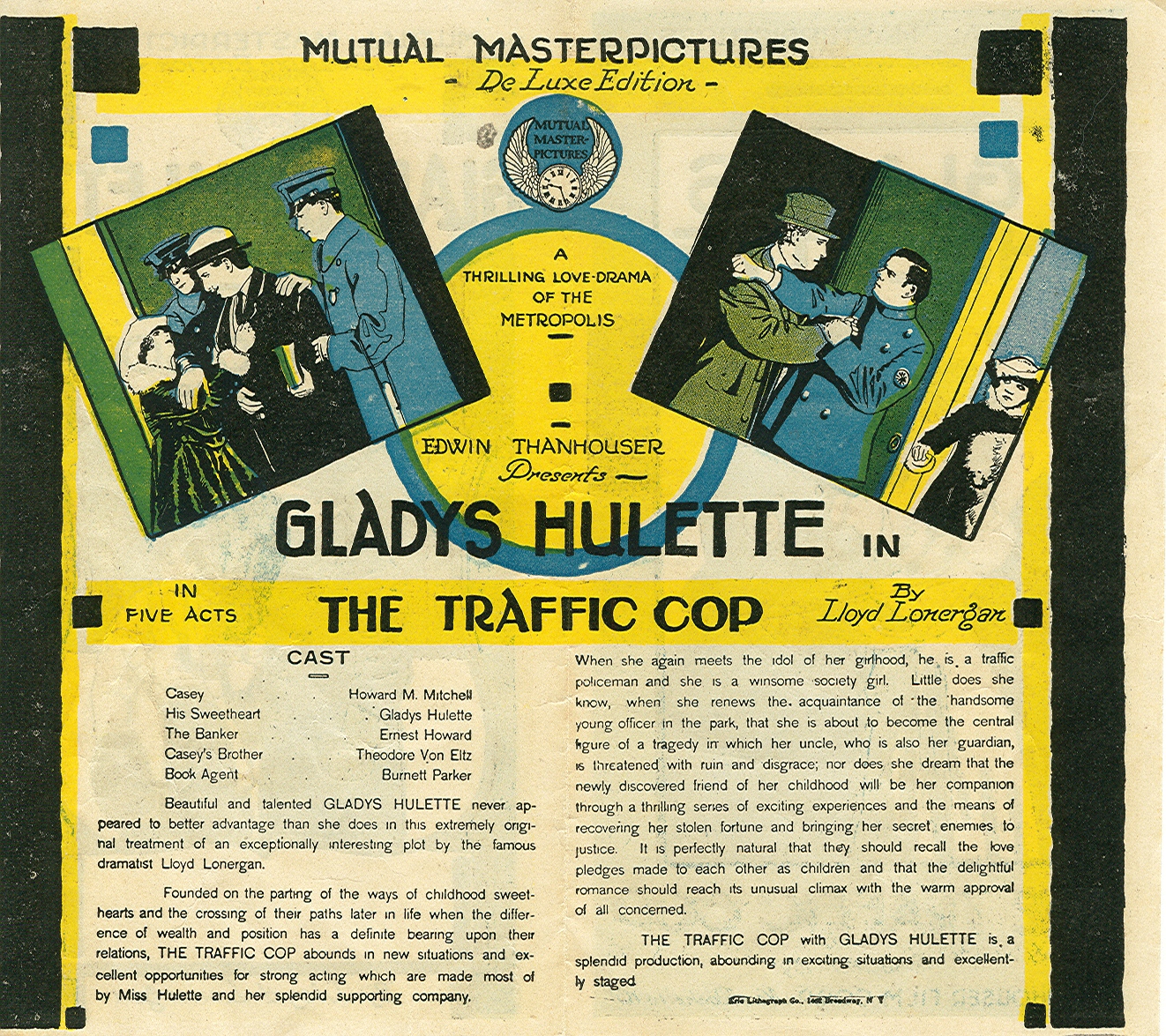
“Every policeman’s life is more or less made up of adventures that seldom befall the ordinary citizen. And every citizen is, with but few exceptions, interested in the guardians of the city’s peace—whether he be the man on the ‘beat,’ the sleuth from headquarters, or the broad-chested, powerfully built ‘traffic-cop’ at the corner. In The Traffic Cop, the forthcoming Thanhouser-Mutual Masterpicture, DeLuxe Edition, such a policeman exists in the person of Howard M. Mitchell, handsome hero of Thanhouser-Mutual productions. Throughout this production is woven an appealing story of the heart—the love of the policeman for the banker’s daughter—in which Gladys Hulette essays the role of the ‘poor little rich girl.’ The story of The Traffic Cop follows:

“The financier’s beautiful niece and ward was riding in the park one day when her horse ran away. Casey, the cop, by daring horsemanship rescued her. Then they found that they had known each other when they were children. The girl had visited her grandmother in the country, and ‘the cop’ was ‘the little boy next door.’ They had drifted apart, but the incident in the park brought them together again, and Casey became a frequent visitor at the banker’s home. Some time later the banker became involved in speculations. To carry on his market operations he had utilized the funds entrusted to his care. An unexpected visit of the bank examiners precipitated matters, but the banker, aided by his cashier, so arranged matters that the blame fell upon the policeman’s brother. The niece overheard arrangements being made for the teller’s arrest, and hurried around to his home to give him warning. Before he could escape the police arrived. The teller tried to escape by the roof, but the sleuths were cunning and had cut off escape that way before entering by the main door.

“With escape cut off above and below, the teller was in a dangerous position. The girl was resourceful, however. She bade the man hide in an inner room, saw a book agent in the hall, lured him into the apartment, and when the police dropped in a few moments later, they arrested the book agent. After they were out of the house the teller escaped. He had explained to the girl that he did not dare surrender, as his own record would be against him, although he swore he was innocent. After he had gone the girl lingered in the flat a few minutes, attracted by the photo of a certain young man, and was there when Casey returned home. She told him what had happened. Before she could get away her uncle arrived with the police captain, intending to question the girl who had tricked the police. The only person to meet them was Casey. The banker wanted to search the place, but Casey refused to permit this, although he permitted the captain to do so. In the inner room the captain found the girl, who hastily told him her story. Then the captain returned to the others, announced that the suspect was not in the house, and that he had no interest in the girl (‘whoever she may be’), for she had not committed any crime.

“The banker determined to search the house himself. Casey, by a clever ruse, gave the girl a chance to escape. The banker departed, vowing vengeance. After this happening, the girl decided to leave her uncle’s home. He had told her that her fortune had been lost. Casey, in whom she confided, decided to try and wrest a confession from the cashier. He made him a prisoner and took him to a tiny island. The cashier finally confessed. Casey saw a way to cinch the case. Soon afterward the banker received word from the cashier’s landlady that when the man disappeared he had left a diary. The banker was shown a diary, which contained entries referring to all of his supposedly hidden crimes. In a panic he agreed to buy it, and when the money had been passed over, the room, heretofore in darkness, was brilliantly lighted, the ‘landlady’ threw off her wrapper, revealing Casey; while the niece, the cashier, the policeman’s brother and the Captain came forward from their hiding places. One part of the cashier’s confession told of how the girl’s fortune had been stolen, and after brief legal proceedings she recovered it. Then she married the policeman.”

Summary from Reel Life · 25 March 1916
What the papers said

2 reviews

“This will be found to be an intensely interesting and original five-reel number, the story of which was written by a Lloyd Lonergan for the Thanhouser Film Corporation. …

Read in full · 2 min

“This will be found to be an intensely interesting and original five-reel number, the story of which was written by a Lloyd Lonergan for the Thanhouser Film Corporation.

“The traffic policemen of New York City are figured to a considerable extent in the film. The story shows how the younger brother of a police officer gets into trouble and is helped to escape arrest under a false accusation of embezzlement, through the quick wit of his brother’s sweetheart. Howard Mitchell and Gladys Hulette are the stars of the play.”

REVIEW by Louis Reeves Harrison, The Moving Picture World, April 15, 1916:

“The Traffic Cop is unique in some respects, and it will probably be popular, but it’s main assets are the impersonations of Gladys Hulette and Howard M. Mitchell, the flash of some bright subtitles and an occasional glimpse of inside police methods. There is ingenuity shown where the heroine diverts attention from a falsely-accused man who is escaping from the police—he compels an unsuspecting book agent to be caught in her company when she realizes the police will be obliged to identify him as the man they are after by the place they find him and the company he is in—enabling the innocent man to get away pending detection of the one who is really guilty. Miss Hulette is fully equal to the opportunities afforded her in this and other situations, and she helps materially to carry the play on to success by the grace with which she portrays a woman of tact, one who knows how to do the right thing at the right time.

“Howard M. Mitchell is an athletic hero, a fighting cop, who wins the heroine through the spirited chase of a runaway horse on which he is mounted, and he does well wherever he is called on for mental revelation, but the story is not particularly strong on psychology, and, at this stage of motion picture development, that means the story is not particularly strong. Nearly every pronounced feature success contains a certain amount of fascinating psychology from beginning to end. There is observable in the Thanhouser intelligence of production which avoids offense to intelligence of the audience, and that is always a big step toward high artistry of production.”

The Moving Picture World · 15 April 1916

This review is reprinted in the narrative section of the present work.

Variety · 7 April 1916

Have you seen this film, or a print of it?

Prints of films thought lost still turn up in attics, private collections and archives. A record like this one is how the next one gets found.

Tell us about a print

Cast and crew

Cast
Barnett Parker as book agent
Ernest Howard as her uncle
Gladys Hulette as his sweetheart
Howard M. Mitchell as Casey, the cop
Theodore Von Eltz as Casey’s brother

Every name opens that person's page, with each film they appear in and which of them you can watch.

Watch instead

Films you can watch from the same company

Matched by cast, director and kind

More about this film

Filmed in
New York City, with scenes showing the New York City Police Department.
Bowers’ notes
  1. This film was originally scheduled to be released on Thursday, April 6, 1916, after which the schedule was moved forward to the 8th. Certain printed schedules were uncorrected. 2. Detailed suggestions for musical accompaniment for this film were given by S.M. Berg in the “Music for the Picture” column in The Moving Picture World, April 22, 1916. Many of the film’s subtitles were given. 3. Some accounts list Ernest Howard in the role of the leading lady’s father, rather than uncle.
Posters and media
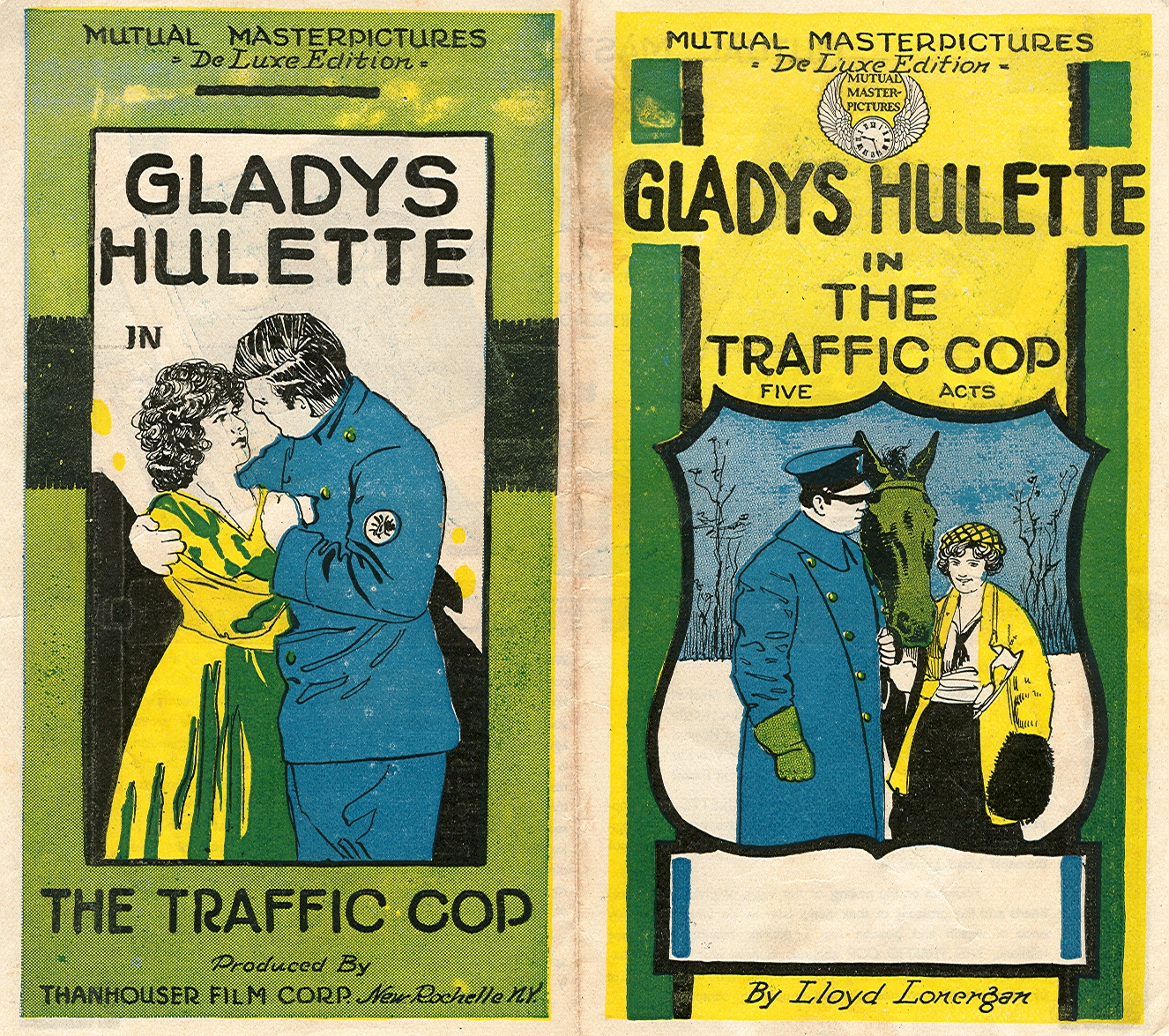
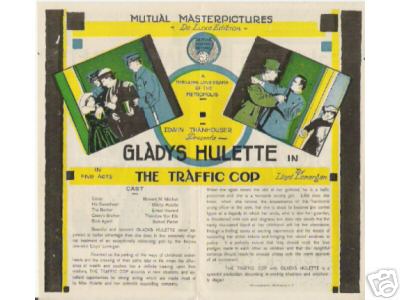
Herald for The Traffic Cop. advertising Herald for The Traffic Cop.Herald for The Traffic CopHerald for The Traffic Cop. advertising Herald for The Traffic Cop.

From Volume II: Filmography of Q. David Bowers’ Thanhouser Films: An Encyclopedia and History, reproduced with permission and unchanged. Read the history of 1916 →

Cite as: Bowers, Q. David. Thanhouser Films: An Encyclopedia and History, “The Traffic Cop”. thanhouser.org/films/the-traffic-cop/

Where a print is held

Held by
No print known