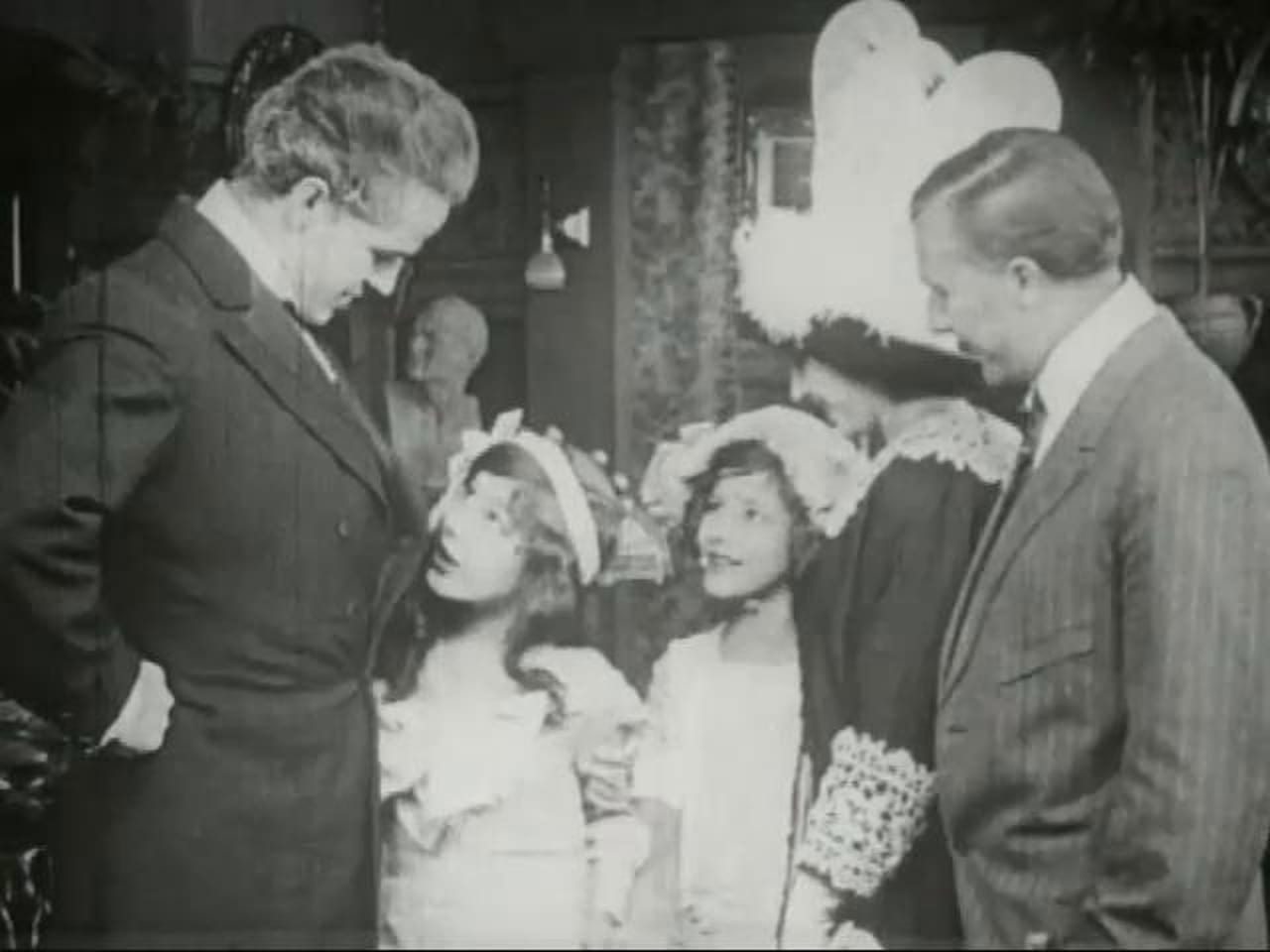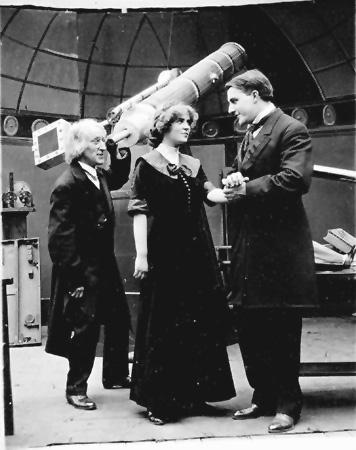
A frame from Cally’s Comet. William Garwood in CALLY’S COMET. Courtesy Ralph Graham, M.D.

1911Thanhouser Company1,000 feetComedy

Cally’s Comet

No copy you can watch online. No print is known to survive. What follows is what does: the release, the cast, the story, and what the trade press said at the time.

The story

“May Deering is the daughter of a celebrated astronomer who is more interested in the heavens than he is in his daughter’s sweetheart, Jack Webster. In fact, he holds not a tiny jot of interest when the latter calls one evening and sees the ideal of his dreams. This ideal takes ejectment from the house very much to heart, and with her sweetheart she plans that it shall not happen again—but that Jack shall see her again, for all that. So next day Jack enters in the costume and make-up of a dignified star gazer, and is hardly welcomed by his ‘brother astronomer,’ Professor Deering, who is proud to see from the visitor’s card that he is: Graf Heinrich von Twiller, A.M.B.C., Professor of Astronomy, University of Bauergarten. Professor Deering rushes the visitor to his observatory and discusses all the recent discoveries with him, finally inviting him to look through his telescope. The visiting astronomer takes a peek and pretends to find something very unusual. He pulls Professor Deering to the instrument, but the latter searches in vain for the unusual signs Von Twiller says he noticed. While Professor Deering is busy at the telescope his visitor becomes busy kissing his daughter, and each time Deering takes an extra peek, the visitor takes an extra kiss.

“Professor Deering leaves his visitor for a moment, and the latter reveals a paint pot and brush that he had sneaked in with him. Grabbing the outer lens of the telescope he paints the design of a comet on it, and when old Deering comes back and puts his eye to the instrument again, he dances with joy at what he sees. Then he rushes out to some of his friends to glimpse at the marvelous sight. May and the visitor laughs heartily, and the latter pulls off his spectacles and whiskers. Professor Deering then pops in, to see his ‘brother astronomer,’ revealed as Jack Webster, and orders him from the house. At this point the servant brings in a delegation of scientists who have responded to Professor Deering’s invitation to see the comet, but with the aid of a cloth and water, Jack has erased it from the lens. Professor Deering collapses when he finds the comet no longer apparent. Then Jack does his best work and promises the Professor that he will replace the comet and save him from disgrace at the hands of fellow scientists if he will consent to May’s marrying him. The Professor says ‘yes,’ and his good name is saved to him, and May is saved to Jack.”

Summary from The Moving Picture World · 22 April 1911
What the papers said

3 reviews · 1 advertisement

“An amusing little story with very few surprises and very little suspense, but with very good acting. The daughter of Cally, the astronomer, is in love with a man named Jack, but father objects to his daughter’s marriage with him, preferring that she marry a man well versed in astronomy, preferably a noted astronomer. Jack conceives a plan to meet …

Read in full · 1 min

“An amusing little story with very few surprises and very little suspense, but with very good acting. The daughter of Cally, the astronomer, is in love with a man named Jack, but father objects to his daughter’s marriage with him, preferring that she marry a man well versed in astronomy, preferably a noted astronomer. Jack conceives a plan to meet with father’s requirements. He works a trick which makes father believe that he has discovered a new comet and allows the credit to go to father. Jack has disguised himself as a professor of astronomy and working the comet trick, and through an accident, his identity is discovered. Jack, feeling he would not be granted the hand of Cally’s daughter, decides that he had better lose the comet for a while and does so, refusing to locate it again unless he can marry the girl. The father consents and the fake comet is again brought into the range of the telescope and Cally is made famous and Jack gets the girl and incidentally she him.”

The Billboard · 22 April 1911

“This comedy offers a novelty. Its scenes are laid in the observatory of a professor of astronomy. The love story is interfered with by the professor, who objects so strenuously to Jack that he ejects him with more force than elegance. Jack wins, for the restoration of the comet by means of the paintbrush secures him the object of his affection. It all runs smoothly afterward. It is a pleasant comedy, with a touch of novelty that increases its interest.”

The Moving Picture World · 29 April 1911

More reviews

26 April 1911The New York Dramatic Mirror1 min

“As Professor Cally is imbued with the idea that his daughter can marry only some eminent professor of astronomy, the young man who had decided to marry his daughter concludes to assume to be such a person. With the necessary make-up, he arrives at the house and proceeds to discover a comet, which is done by painting one on the end of the telescope. Before the gathering of scientists arrive his deceit is discovered, and the comet is washed off. He agrees to find it, if the professor will give him his daughter, and pressed by the waiting scientists, the father consents and forthwith the comet is painted on again. It is an amusing conceit generally well played, but the part of the lover played in a lighter vein would have no doubt added to the spirit. The scene where he comes in without his glasses on might have been left out.”

Advertisement

15 April 1911The Moving Picture World1 min

“Cally’s Comet will make your business soar the day you run it, if you advertise it properly a day or two before you run it... The best novelty and comedy of the month.”

Have you seen this film, or a print of it?

Prints of films thought lost still turn up in attics, private collections and archives. A record like this one is how the next one gets found.

Tell us about a print

Cast and crew

Every name opens that person's page, with each film they appear in and which of them you can watch.

Watch instead

Films you can watch from the same company

Matched by cast, director and kind

More about this film

Bowers’ notes
  1. Called a comedy in some notices, a drama in others. 2. The title was obviously inspired by Halley’s Comet, which had appeared in the skies in 1910, on its 76-year circuit around the sun. 3. The first word in the title was spelled Calley’s in a synopsis in The Moving Picture World, April 8, 1911, but not in a Thanhouser advertisement in the same issue.
Posters and media
Still for Cally’s Comet. William Garwood in CALLY’S COMET. Courtesy Ralph Graham, M.D.

From Volume II: Filmography of Q. David Bowers’ Thanhouser Films: An Encyclopedia and History, reproduced with permission and unchanged. Read the history of 1911 →

Cite as: Bowers, Q. David. Thanhouser Films: An Encyclopedia and History, “Cally’s Comet”. thanhouser.org/films/cally-s-comet/

Where a print is held

Held by
No print known