“As a whole: entertaining; story: conventional; star: lacks vivacity; cast: adequate; settings: good; photography: clear.
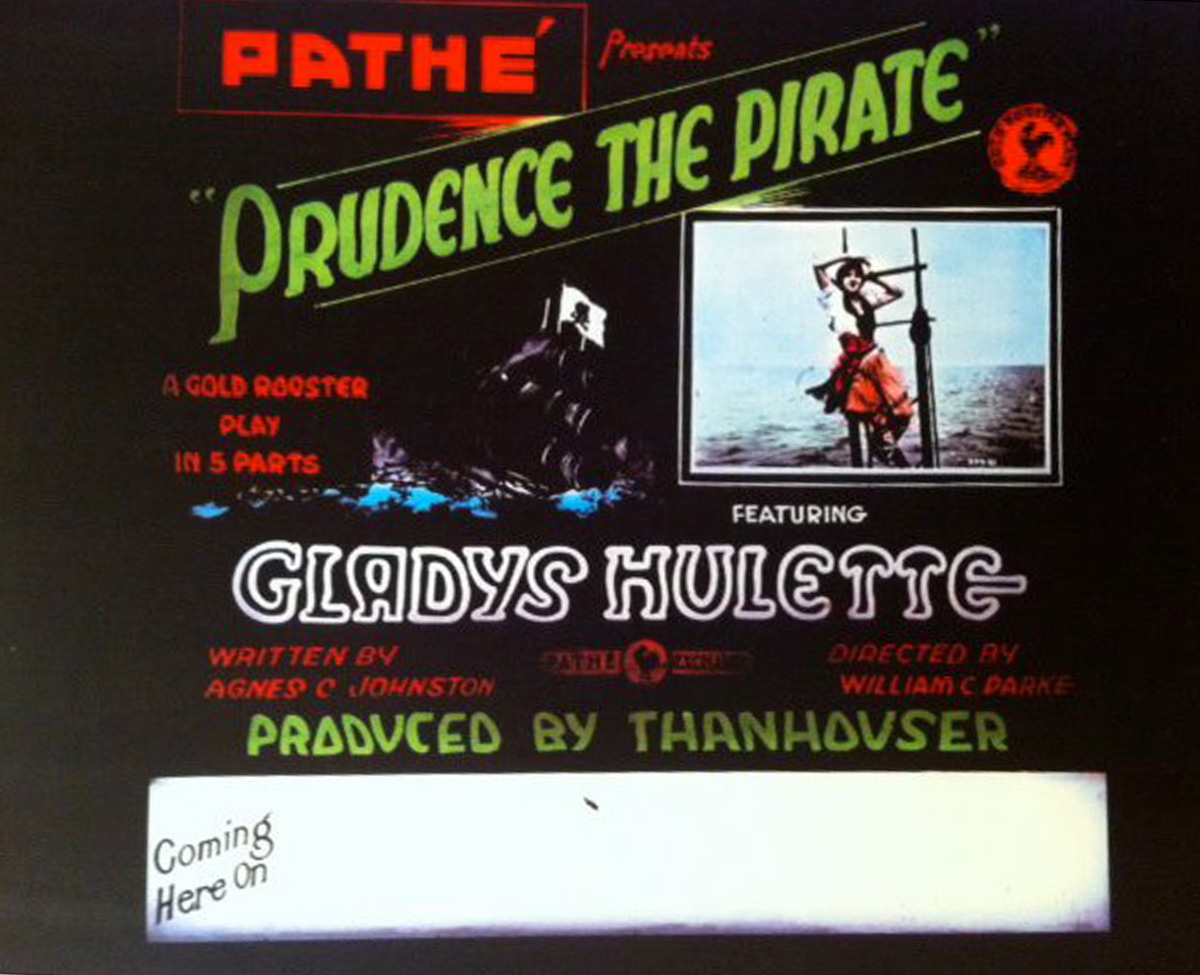
“In this Thanhouser photoplay we are given some fine touches of comedy, good direction and excellent screen acting. Flora Finch is cast in the role of Aunty, while Riley Chamberlin contributes a goodly portion of the fun as Meeks. Miss Hulette, beautiful and pleasing as ever, did not seem to get all the comedy out of the part assigned to her. The supporting cast is well chosen. Prudence should prove to be a good attraction and is well up to the Thanhouser standard. Prudence, just out of boarding school, returns to her aunt’s home where she is to enter society. She objects decidedly, and after several escapades, particularly directed against one Astorbilt, the season’s ‘catch,’ she finds a warm friend finally in the person of the family butler. Meeks confides to Prudence that he has been a sailor and ‘seen things.’ When pressed further concerning his seafaring life he confides that he was once a pirate. He tells of his adventures and Prudence, her romantic nature fired, decides to becomes a buccaneer. A schooner is rented and christened The Bucket of Blood, a motley crew of tramps are put aboard, and all is in readiness for a voyage except a chaperon and a deck scrubber. Prudence attacks her aunt’s houseboat and kidnaps the old lady and Astorbilt to fill those capacities. Astorbilt, however, bribes the crew to mutiny, and Prudence finds herself in irons on her own ship. The rough and tumble life aboard The Bucket of Blood changes Astorbilt from a pink tea person to a man of steel and Prudence falls in love with him. Fire breaks out on the ship and Astorbilt swims with Prudence to a bell buoy and saves her life. There Prudence, with her customary disregard for convention, promises to lower the black flag and surrender her heart forever. It is a clever comedy, indeed.”
REVIEW by Agnes Smith, The Morning Telegraph, October 8, 1916:
“One of the pleasantest little plays seen in some time is Prudence and the Pirate [sic], a picture which has been cleverly written, well directed and which gives Gladys Hulette an opportunity to prove again that she is one of the most refreshing young actresses on the screen. The story tells of Prudence, a lively young person, who hankers for the wild, roving life of a pirate. Of course, her aunt wants to turn her into a debutante, but Prudence rebels and actually succeeds in getting a pirate vessel and assembling a villainous crew. Her first act is to capture her aunt’s houseboat, carry off her auntie to act as a chaperone, and run away with Astorbilt, a young millionaire, for a deck scrubber. With a prim aunt, a millionaire, a pretty young girl, an adoring young boy, a staid old butler and a whole crew of hoboes on board, the funny complications which enliven life on the Bucket of Blood can be imagined. In the end the millionaire proves to be not only a good sport but a good hero. When the ship catches on fire, he risks his life to rescue Prudence, who has been locked in a cabin. When the picture closes we find Prudence making up her mind to have orange blossoms and a veil, even though they are awful conventions.
“Agnes C. Johnston has set about writing her story as though she had never seen a moving picture in her life and didn’t know that by every screen convention the millionaire should have been the villain and Prue’s young admirer, the hero. As it is, there is not a commonplace character or a hackneyed situation in the whole picture; the people are all human beings and the comedy is lively, good humored and original. As for the subtitles, many of them are good laughs in themselves. An exceptional cast makes the most of the characters, and William Parke’s direction is entirely satisfactory. He has incorporated many humorous touches that are sure to be appreciated. The one and only Flora Finch is seen as Prue’s aunt, and Riley Chamberlin does his inimitable character work as Meeks, the butler who inspires Prue with longings to follow the black flag. Barnett Parker deserves credit for resisting all temptations to overdo a part which might easily have been exaggerated. He makes Astorbilt a likable man. A funny little dog called Panthus, because he pants so much, is responsible for some of the comedy, and William Parke, Jr., is a good, small boy.”
REVIEW by George Blaisdell, The Moving Picture World, October 21, 1916:
“In Prudence the Pirate Gladys Hulette has a youthful role finally fitted to her tender years—surely as Prudence she looks not more than 16, and it is a more or less accepted fiction that a female is only as old as she looks. The story is by Agnes Johnston. It is a craftsmanlike piece of work, especially that part of it which is devoted to the draughting of the leaders. They have more than a distinct comedy flavor; there is always presence of literary touch. Miss Hulette is supported among others by Flora Finch and Riley Chamberlin. These two unusually clever character actors prove to be just the team that one knowing their individual capacity for mirthmaking would be led to expect. The general result is worthwhile. Prudence the Pirate will make good entertainment. Miss Hulette as Prudence shows marked skill in comedy interpretation. She has the pep and abandon of a young girl. Prudence is romantic, with a leaning to the piratical. She imposes her pranks on relatives and servants alike. Her misadventures have the natural effect of indefinitely postponing her formal debut in society even while her feminine ways are hastening the ensnaring of the smitten Astorbilt.
“Miss Finch is seen as the prim aunt who unsuccessfully tries to keep her niece within the bounds of conventionality; but who likewise finds her matchmaking ambitions gratified when Prudence, in her own ways secures the hand-picked prize, Mr. Chamberlin’s Meeks, the family butler. Meeks loses his standing as a temperance advocate on the invitation of Prudence. He looks on the punch when it is red; his position is placed in still greater jeopardy when the hastily gathered pirate crew of the Bucket of Blood kidnaps him and carries him away to don a pirate’s scarf. Barnett Parker is Astorbilt; he does a good bit of character drawing of the wealthy young man none too strong in his masculinity. Yet he does not overdo the part. The remainder of the cast gives satisfactory support.”