The story
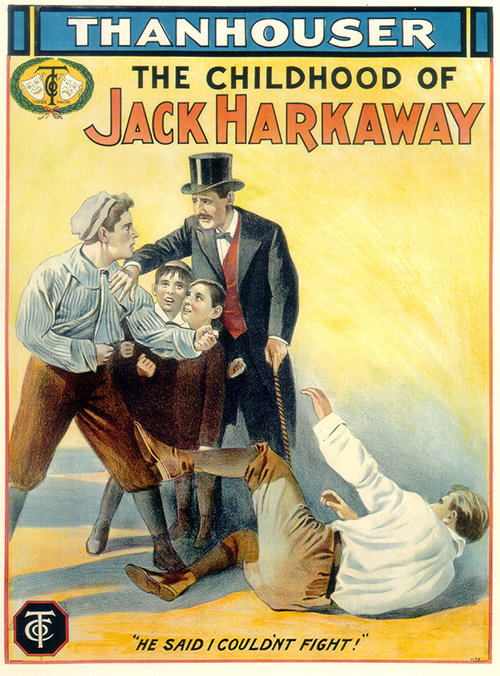
“Jack Harkaway is of aristocratic birth, being the son of a wealthy Englishman’s daughter and a poor young man, with whom she has eloped. Her parents bring about a separation and compel her to place the child in the hands of strangers, who are bribed to keep his whereabouts a secret from his mother. At the age of 12 Jack is placed in a school, the master of which is prejudiced against him, owing to the boy’s mischievous disposition. After having received severe and unjust punishment from the schoolmaster, Jack decides to run away from school, and escapes from the room in which he is locked, through the window.
“Wandering along a country road, he accidentally overhears two sneak thieves planning to rob a house. Jack makes his way to the house in time to warn its mistress of the proposed robbery. Two men servants are placed in hiding, when the would-be thieves put in an appearance there and are immediately captured. Jack is given a fine supper by the lady of the house, who is very grateful to him. And when the schoolmaster, accompanied by Jack’s guardian, arrives, she is touched by the boy’s appeal not to be turned over to his rough-looking ‘friends.’ Upon getting a closer view of the man who calls himself the lad’s guardian, she realizes that he is the man to whom she was forced to give over her child. The man admits that Jack is her own boy, and the picture ends with the men being turned out of the house and Jack restored to his mother’s arms.”
Summary from The Moving Picture World · 24 December 1910
Background of the scenario
Jack Harkaway was the hero of a series of boys’ adventure stories written in the 1870s and 1880s by S. Bracebridge Hemyng. Born in London in 1841, S. Bracebridge Hemyng was the oldest son of Dempster Hemyng of the British bar. He was educated at Eton, and was called to the bar in 1860. In the meantime, he had begun writing in 1860, and disliking the life of a barrister, he eventually decided to become a full-time novelist. During a span of about 25 years he turned out 50 novels. His first Jack Harkaway story, Jack Harkaway’s School Days, appeared serially in the weekly magazine, Boys of England, in 1871. During the same decade Hemyng moved to America, where he stayed for a few years before returning to his native land. Eighteen stories featuring the character were created, including The Adventures of Young Jack Harkaway and His Boy Tinker, Jack Harkaway in Search of the Mountain of Gold, Jack Harkaway in the Transvaal, Jack Harkaway Among the Malay Pirates, Jack Harkaway Among the Brigands, and many others, the last of which featured the youth in combat with the Boers in 1899. Boyish pranks, violence, and sensational episodes were part of these stories, but the young people in the stories maintained an aspect of purity, even though they were dealing with adult drunkards, criminals, and other unfortunate elements of society. Hemyng wrote other works, including Eton School Days and a series about Dick Lightheart, but none achieved the fame of the Harkaway series. Hemyng died destitute in 1901. In the early 1900s, a number of his works were reprinted and enjoyed a wide circulation in England and America. The Childhood of Jack Harkaway was a popular stage play in the 1890s.