The story
“In Longfellow’s beautiful poem, he tells of the children’s hour—that time of day when the little ones are permitted to meet their elders on equal grounds. He describes the love that exists between the grandfather and the three little grandchildren, who each night insisted upon coming into his study, where, for one golden hour, they reigned supreme, and he was their willing and devoted servant. As the poet says, speaking of his hero -
They climb into my turret
O’er the arms in back of my chair
If I try to escape they surround me
They seem to be everywhere.
“The grandfather entertains the children with fairy stories that never grow old, and the evening passes as happily for him as it does for them.”
Summary from The Moving Picture World · 15 November 1913
Another synopsis, from Reel Life · 8 November 19131 min
“Longfellow’s love for his three little girls he immortalized in ‘The Children’s Hour,’ one of the sweetest poems in our literature. Everybody remembers the stanzas, beginning:
Between the dark and the daylight
When the night is beginning to lower,
Comes a pause in the day’s occupations
That is known as the Children’s Hour.
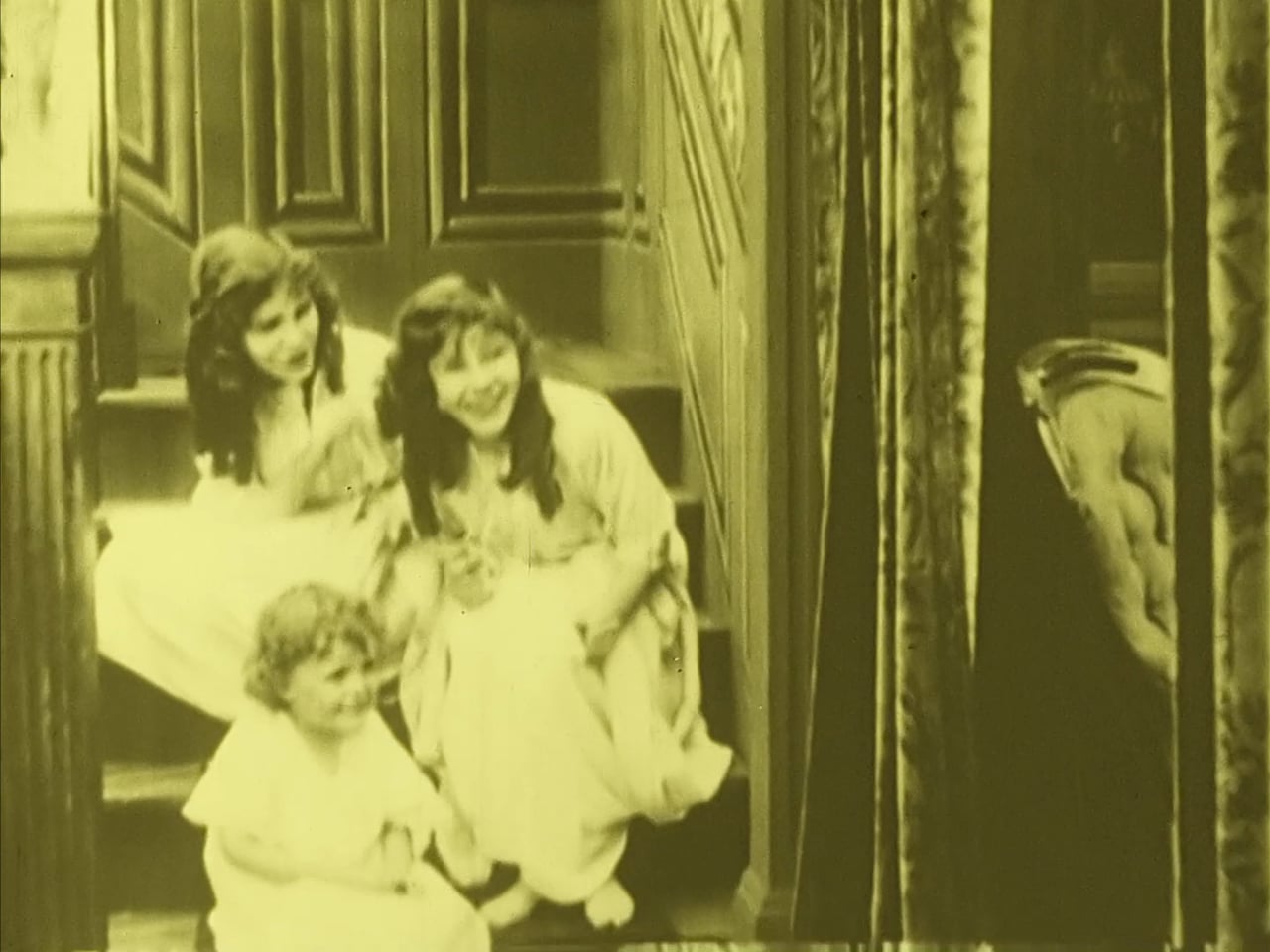
“The poet conjures up a beautiful picture of ‘grave Alice and laughing Allegra—and Edith with golden hair’—as they storm the study at twilight, to climb on his knees, and listen to stories in the firelight—almost devouring their father with kisses—twining their little arms about him—calling out all the tenderness and gentle humor and poetic fancy, of ‘the children’s poet.’ The Thanhouser Company has reproduced Longfellow’s poem—and the film is one of the rare and attractive offerings among the new plays. It is scarcely a play itself—rather, an intimate glimpse into old Craigie House in Cambridge—into the happy home of America’s ‘sweetest singer.’ To see it, is distinctly a privilege. The poem is enacted, stanza by stanza. The children are ready for bed. We see them in their rooms, in their nightgowns—and then the poet sitting in the study below, listening to the ‘patter of little feet’—and the sweet, soft voices, as they tiptoe down the hall stair, and cluster together, laughing and whispering, plotting to take him by surprise. He ‘plays possum’—and they are delighted to find him, to all appearances, asleep in his chair. It is delicious to clamber up over the high back and over the arms—and tickle his face and pull his long, white hair—and have him wake up, so surprised to find them there! Then there is storytelling until nurse and mother come and carry them off to bed. And after they are gone, the poet sits, dreaming in the firelight, smiling to himself. The two beautiful closing quatrains of the poem express his reverie. He falls asleep there—and in the room overhead, three little faces lie on the pillows, with eyes shut fast.”