
What the papers said
3 reviews · 1 advertisement“Marguerite Snow and the Thanhouser Kidlet are featured in this attractive story. The opera scenes are more realistic than is often the case in screen productions. The story occupies two reels. Miss Snow appears as a dancer who incurs the lasting hate of a manager because she rebukes him so severely for attempting improper advances. Later she comes to America …
Read in full · 1 min
“Marguerite Snow and the Thanhouser Kidlet are featured in this attractive story. The opera scenes are more realistic than is often the case in screen productions. The story occupies two reels. Miss Snow appears as a dancer who incurs the lasting hate of a manager because she rebukes him so severely for attempting improper advances. Later she comes to America to dance at the Metropolitan. She brings her little child with her. The manager learns that the dancer is in New York, and as a means of revenge kidnaps her child. He then makes it plain how the mother can obtain the little one’s release. The baby is locked up in a house on West 23rd Street and, being lonely, opens the window and strolls along the balcony to the next house. There she says she is lost, and points out her mother’s picture in a paper. The result is a speedy return to her mother and the arrest of the kidnapper. The appearance of the little girl on the stage of the opera house is a very attractive scene. Miss Snow’s acting is very excellent throughout.”
“A two-reel picture of Bohemian fashion with a theatrical background. Its heroine, Marguerite Snow, is a dancer of worldwide reputation who, in the days of her struggle, has offended the story’s villain. It becomes an overdrawn melodrama which could hardly be acted without its players showing, now and then, a sense of humor at it. It furnishes several very pretty …
Read in full · 1 min
“A two-reel picture of Bohemian fashion with a theatrical background. Its heroine, Marguerite Snow, is a dancer of worldwide reputation who, in the days of her struggle, has offended the story’s villain. It becomes an overdrawn melodrama which could hardly be acted without its players showing, now and then, a sense of humor at it. It furnishes several very pretty scenes, including some dances; it has an interesting atmosphere all through. Perhaps one of its distinct assets is that it does amuse. The photography is clear and commendable.”
More reviews
18 February 1914The New York Dramatic Mirror2 min
“In this two-part drama we are made sympathetic onlookers of the experiences and vicissitudes of a noted ballet dancer, from her first promotion to a leading part at the Municipal Theatre in Munich, until she becomes internationally famous and is engaged as a star for the Metropolitan in New York. It is eminently a noteworthy offering and carries the spectator along from start to finish. There is not a dull moment throughout its entire length. Anna, the heroine, is a ballet dancer in Munich. When her dancing master at the theater puts her into the lead he is encouraged to make amatory advances, but she repulses him and he vows revenge. It must be explained that she is married and is loyal to her husband. Later she becomes known overseas and is engaged to appear at the Metropolitan Opera House. Her husband being a bed-ridden invalid, she comes to America with her five-year-old daughter.
“In the meantime the revengeful ballet master of her earlier Munich days has come also to New York, and when he learns that Anna is now in the city he plans a terrible revenge—he kidnaps the little daughter and locks her in a cheap downtown boarding house. Then he goes to the opera dressing-room to inform the hapless that she must yield to his advances or she will never see her child again. Just then she is called to the stage to dance her part in the ensemble ballet, but the threats of the villain are too much for her and she falls in a faint on the stage. In the meantime the little girl has escaped from her imprisonment by walking along a narrow balcony to a room next door. Here comes in the ubiquitous newspaper, in which little daughter points out a ‘picture of mama.’ The kind lady rushes the child to the opera house in time to revive the great dancer from her momentary swoon and to cause the arch conspirator to be led off to punishment. Marguerite Snow appears in the title role and scores notably in the part. No overacting is in evidence on her part, her presentation being a real contribution to film histrionism.”
February 13, 1914 (Friday)
No Thanhouser release because of the two-reel film the preceding Tuesday.
Advertisement
7 February 1914Reel Life1 min
“The Dancer, two reels, again gives you the return of Marguerite Snow in a powerful emotional role—one that brings recollections of Miss Snow in East Lynne, Carmen, Lucile, and her greatest emotional successes. The story is a thrilling one of life behind the scenes. Arthur Bauer plays a villainous stage manager, and the Thanhouser Kidlet is the dancer’s little daughter. Carey Hastings, Justus D. Barnes and N.S. Woods have strong parts, too.”
Have you seen this film, or a print of it?
Prints of films thought lost still turn up in attics, private collections and archives. A record like this one is how the next one gets found.
Tell us about a printCast and crew
- Cast
- Arthur Bauer as the villainous stage manager
- Helen Badgley as Anna’s little daughter
- Marguerite Snow as Anna, the dancer
Every name opens that person's page, with each film they appear in and which of them you can watch.
Watch instead
Films you can watch from the same company
More about this film
- Posters and media
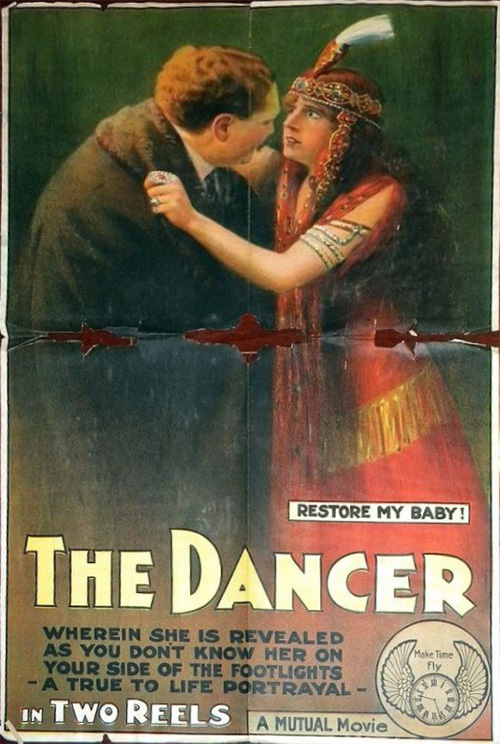
From Volume II: Filmography of Q. David Bowers’ Thanhouser Films: An Encyclopedia and History, reproduced with permission and unchanged. Read the history of 1914 →
Cite as: Bowers, Q. David. Thanhouser Films: An Encyclopedia and History, “The Dancer”. thanhouser.org/films/the-dancer/
Where a print is held
- Held by
- No print known