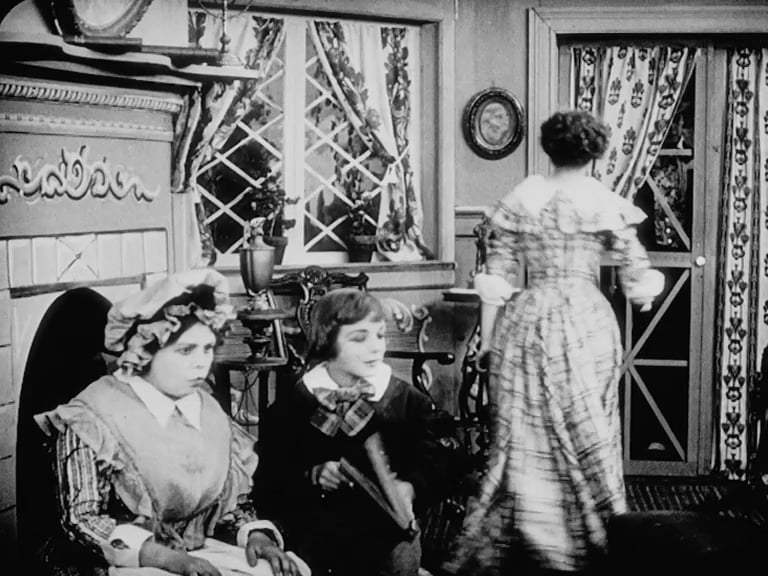
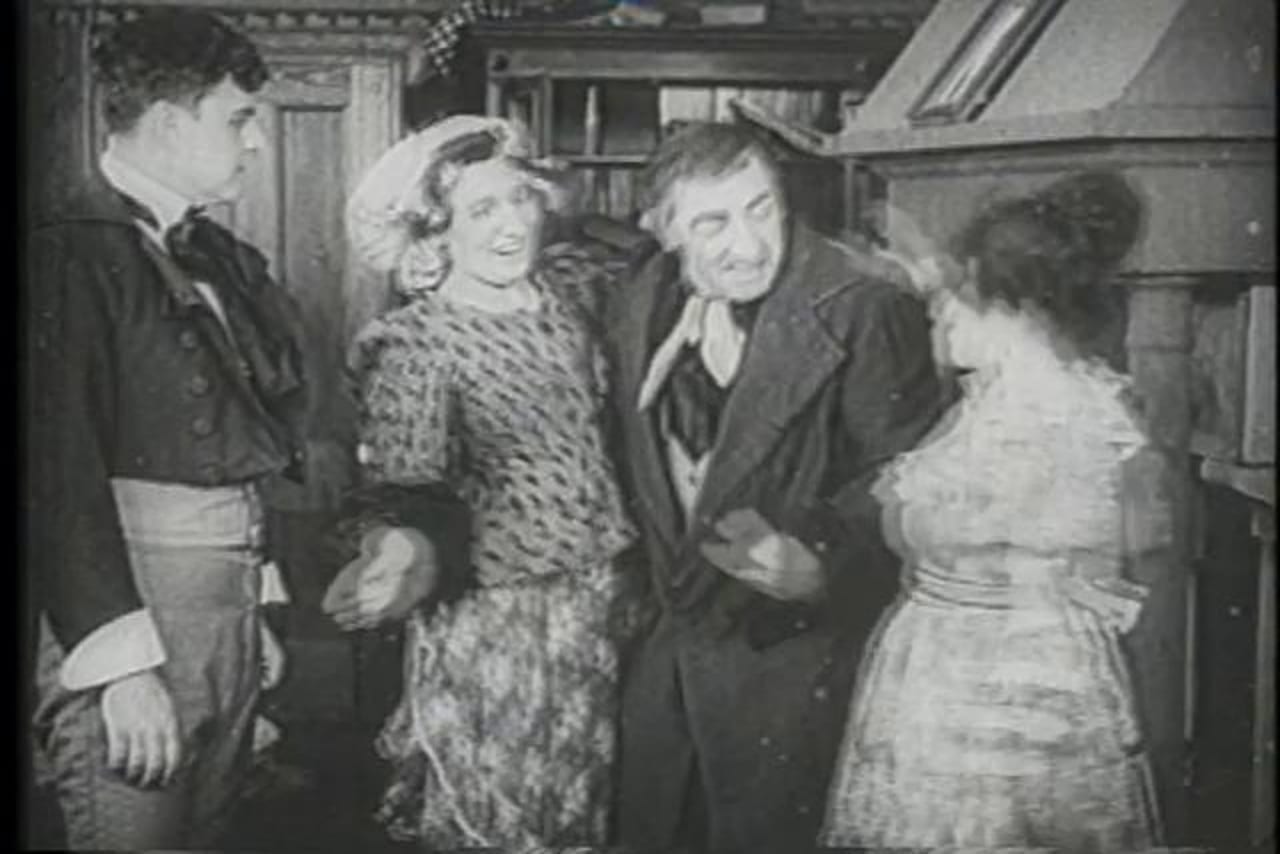
1911Thanhouser Company1,000 feetDrama

The Declaration of Independence

No copy you can watch online. No print is known to survive. What follows is what does: the release, the cast, the story, and what the trade press said at the time.

The story

“John Hancock, one of the most ardent of American patriots, had more to lose than had practically any of his associates in the Revolution against George III. A millionaire at the time when a man with $10,000 was regarded as wealthy, the Revolution absolutely beggared him, as he had predicted it would, but from start to finish he did all he could to win freedom for his country. To Samuel Adams is accorded much of the credit of winning the handsome young millionaire to the side of the patriots, but his sweetheart, Dolly Quincy, afterward his wife, also had much to do with the stand he took. For she was an ardent American.

“Hancock was an active figure in the famous Boston Tea Party, when the tea ships from England were attacked, and the wares thrown overboard. He did not, like some of the others, try to avoid recognition by disguising himself as an Indian, but was present with the crowd on the ship, trying to preserve order, seeing that nothing except the tea was disturbed. Hancock was really the cause of the first fighting, that of Lexington, when the British regulars were repulsed by the farmers and minutemen. Gage dispatched troops to seize munitions of war at Concord, but on the way they were ordered to stop at Lexington, where Hancock and Adams were, and arrest both men as traitors, Gage planning to send them to England for trial and execution.

“But the plan was foiled by Paul Revere, who, learning of the expedition in time, made his historical ride and, besides arousing the countryside, gave Hancock and Adams a warning that enabled them to make their escape. Hancock was a member of the Continental Congress, and his election as president came about in a dramatic way. The patriots were in session when an official message came from Gage, offering pardons to ‘all rebels’ except Hancock and Adams, who it was declared ‘would receive condign punishment.’ The answer was the prompt election of Hancock as president, when Benjamin Harrison introduced him to the assembly judge as its presiding officer, he remarked grimly: ‘We will show Britain how much we value her proscriptions.’ As presiding officer, it was Hancock’s privilege to first sign the Declaration of Independence, which he did in large, bold characters, saying ‘I write so that George III may read without his spectacles.’ And at the time he signed there were many among the patriots who believed that Hancock had signed his death warrant. Hancock gained his nickname, ‘the cavalier of American liberty,’ because of his elaborate costumes. Even in these days he would be called a dandy. His scarf was particularly remarked upon at a time when Americans, particularly in New England where he lived, were plainly dressed.”

Summary from The Moving Picture World · 1 July 1911
What the papers said

2 reviews · 3 articles · 1 advertisement

“This patriotic play is deserving of high expressions of praise for more reasons than one. In the first place it is so well put on that it gives one a graphic idea which no mere reading could possibly do, of those stirring days at the commencement of the Revolution. In the second place it is highly entertaining as a motion …

Read in full · 1 min

“This patriotic play is deserving of high expressions of praise for more reasons than one. In the first place it is so well put on that it gives one a graphic idea which no mere reading could possibly do, of those stirring days at the commencement of the Revolution. In the second place it is highly entertaining as a motion picture story, its skirmishes and other military features being exceedingly well carried out. Historically it is valuable and should assuredly be slated by those entertaining the use of motion pictures in schools and similar courses. It includes in its personnel many famous historical characters, all of whom are finely reproduced by players of the Thanhouser Company, among whom are John Hancock, Paul Revere, Samuel Adams, Dorothy Quincy and others.

“It begins with the first uprising among the younger patriots, then reproduces the Boston Tea Party, the warrant for the arrest of Hancock, his flight, to Lexington, the signal arrangement between Paul Revere and his accomplice in the Old South Church tower, the ride of Revere, the general uprising of the Minute Men, the Battle of Lexington, the meeting of the first Congress at Philadelphia and the signing of the Declaration of Independence. This latter is splendidly reproduced, especially the signing of the document and the grouping of the characters. It would have greatly improved this scene could it all have been photographed at one time, instead of having to move the camera so as to include the players a few at a time.”

The Morning Telegraph · 9 July 1911

“The picture in the future will find a place equal in value only to the written historical records, and second in importance only to the original occasion it so graphically represents.”

The Moving Picture World · 15 July 1911 · This review commented on the content of the film, and concluded with the statement

Articles3 · 17 June 1911 – 8 July 1911

17 June 1911The Moving Picture News1 min

“The first-print copy of The Declaration of Independence was projected at the Thanhouser studio in New Rochelle yesterday and fulfilled all the producer’s expectations. Good black and white photography was a feature of the showing, and the little audience present manifested real enthusiasm over the picture. Those in the first-print audience not connected with the Thanhouser plant were surprised to find that the film dealt not only with the Declaration of Independence but with the Boston Tea Party, Paul Revere’s ride, the redcoats’ retreat from Lexington; and in addition to all this gives the life of John Hancock, the first signer of the Declaration and the first American millionaire, telling his famous love story and inspiring patriotism in others by showing how true a patriot that he was. It was Hancock who, with most of his wealth lying in Boston holdings, said ‘Burn Boston and make John Hancock a beggar, if the public good requires it....’”

24 June 1911The Moving Picture World1 min

“The film deals not only with the Declaration of Independence but with the Boston Tea Party, Paul Revere’s ride, the redcoats’ retreat from Lexington, and in addition to all this gives the life of John Hancock.... The business-getting lobby arrangement will be found in the display of plenty of American flags, four muskets (preferably old), two drums (preferably old), the famous Trumbull picture of the signing of the Declaration (can be rented from any picture store), in fact similar copies of the Declaration (can be rented from any picture store). A good arrangement of these would be: Flags—drape out front for best effect; drums—one on each side of lobby, crossed by two muskets; muskets—two crossed above each drum; ‘signing’ picture—hang or fasten to one side of lobby; ‘Declaration’ facsimiles—hang or fasten the side lobby opposite ‘signing’ picture. If you have a board for circulars, drape with flag and tack on literature pertaining to the reel. Posters can be put up in the usual place. A release of so patriotic a nature as this affords the exhibitors a chance to advertise his show as one that should not be missed.”

8 July 1911The Moving Picture World3 min

“The Thanhouser Company’s patriotic film for the Fourth of July pictures, in a way that stirs, the heroic acts of our forefathers. It is called The Declaration of Independence, and its scenes are laid in Boston, on the road to Lexington, and in Philadelphia. The love story of John Hancock, the man who could sign his name for kings to read, and Dolly Quincy, one of the belles of Boston, furnishes a thread on which the thrilling incidents that film pictures are strung. The picture opens with a garden party, in which we meet Samuel Adams, the rich John Hancock, and Dolly Quincy. Hancock was such a dandified man that everyone thought him a royalist; but after he meets Dolly he becomes a patriot so staunched that at the famous ‘Boston Tea Party,’ which is shown, Hancock directs the emptying of the cases of taxed tea, and does it without disguise. The authorities decide to arrest him for high treason, and we are permitted to read the warrants. He is warned, and the minutemen conduct him in his coach to Lexington. We see them as they reach the house where he is to stay, and they cheer for liberty again and again. But Hancock is not safe even in Lexington, for General Gage is about to take his redcoats there and intends, after destroying some military stores, to capture him. Shortly we see that Gage is reckoning without his host, without the ever-ready minutemen, and without Paul Revere.

“General Gage’s troops begin the march, but, look! High up in the tower of the old South Church there comes a light. That is Paul Revere’s signal. He waits besides his white horse. One light means that they will come by sea, and he must be sure of their route before he starts, so he still watches. Another light appears, and two lights gleam side by side from the tower. It is by land that they come, and he is off. Now follows a wild night ride down toward Lexington. There is a cry of alarm, a knock on a door, the minuteman and his sons, musket in hand, are out and ready. Calmly the redcoats march. Don’t they see the people are hurrying out of the sight this way and that? Are they contemptuous of these farmers? Let them be contemptuous. Wait! There is a cloud of white smoke above the fences. That is from the shots heard round the world. The red-coated regulars tremble; their line breaks; now they are in retreat. The pictures now show us Philadelphia and the hall where the Continental Congress is meeting. The Declaration of Independence is brought in and read. One after another, these brave men, putting their fortunes in jeopardy, putting their necks in a noose, rise and sign the paper. It is a scene to fill the heart with fervor; it is a scene to thrill us and to make us proud. And to look upon pictures of such scenes as a new and better way to spend our glorious holiday than even to fire a cannon.

“There will be many admirers of the Thanhouser pictures who will look twice to recognize their favorite players as found ‘neath powdered wig in The Declaration of Independence. It was imperative in order that an accurate reel be turned out that the players bear resemblance to the original participants in the stirring events of ’76, and that to look the part, each player had to assume a ‘makeup’ that almost amounted to a disguise. But by the aid of the list below, identification of favorites becomes simple: John Hancock—George Lessey; Dolly Quincy—Julia Taylor; Paul Revere—Frank Crane; Samuel Adams—Justus Barnes; Thomas Jefferson—David Thompson.”

Note: The preceding paragraph represents a very rare instance in 1911 of cast members being identified in The Moving Picture World.

Advertisement

24 June 1911The Moving Picture World1 min

“The most pretentious patriotic picture ever attempted. A marvelous filmization of the greatest event in American history—out Tuesday July 4th.”

Have you seen this film, or a print of it?

Prints of films thought lost still turn up in attics, private collections and archives. A record like this one is how the next one gets found.

Tell us about a print

Cast and crew

David Thompson as Thomas Jefferson
Frank H. Crane as Paul Revere
George Lessey as John Hancock
Julia M. Taylor as Polly Quincy
Justus D. Barnes as Samuel Adams

Every name opens that person's page, with each film they appear in and which of them you can watch.

Watch instead

Films you can watch from the same company

Matched by cast, director and kind

More about this film

Bowers’ notes
  1. This is the first Thanhouser film for which The Moving Picture World listed a detailed cast roster. Earlier comments indicated that the reviewer was not familiar with most Thanhouser cast members seen on the screen, a notable exception being Marie Eline (whose name was often misspelled as Maria). Apparently, before this time Thanhouser did not furnish cast lists to that publication. 2. A similarly-titled production was released later in the year by Edison.

From Volume II: Filmography of Q. David Bowers’ Thanhouser Films: An Encyclopedia and History, reproduced with permission and unchanged. Read the history of 1911 →

Cite as: Bowers, Q. David. Thanhouser Films: An Encyclopedia and History, “The Declaration of Independence”. thanhouser.org/films/the-declaration-of-independence/

Where a print is held

Held by
No print known