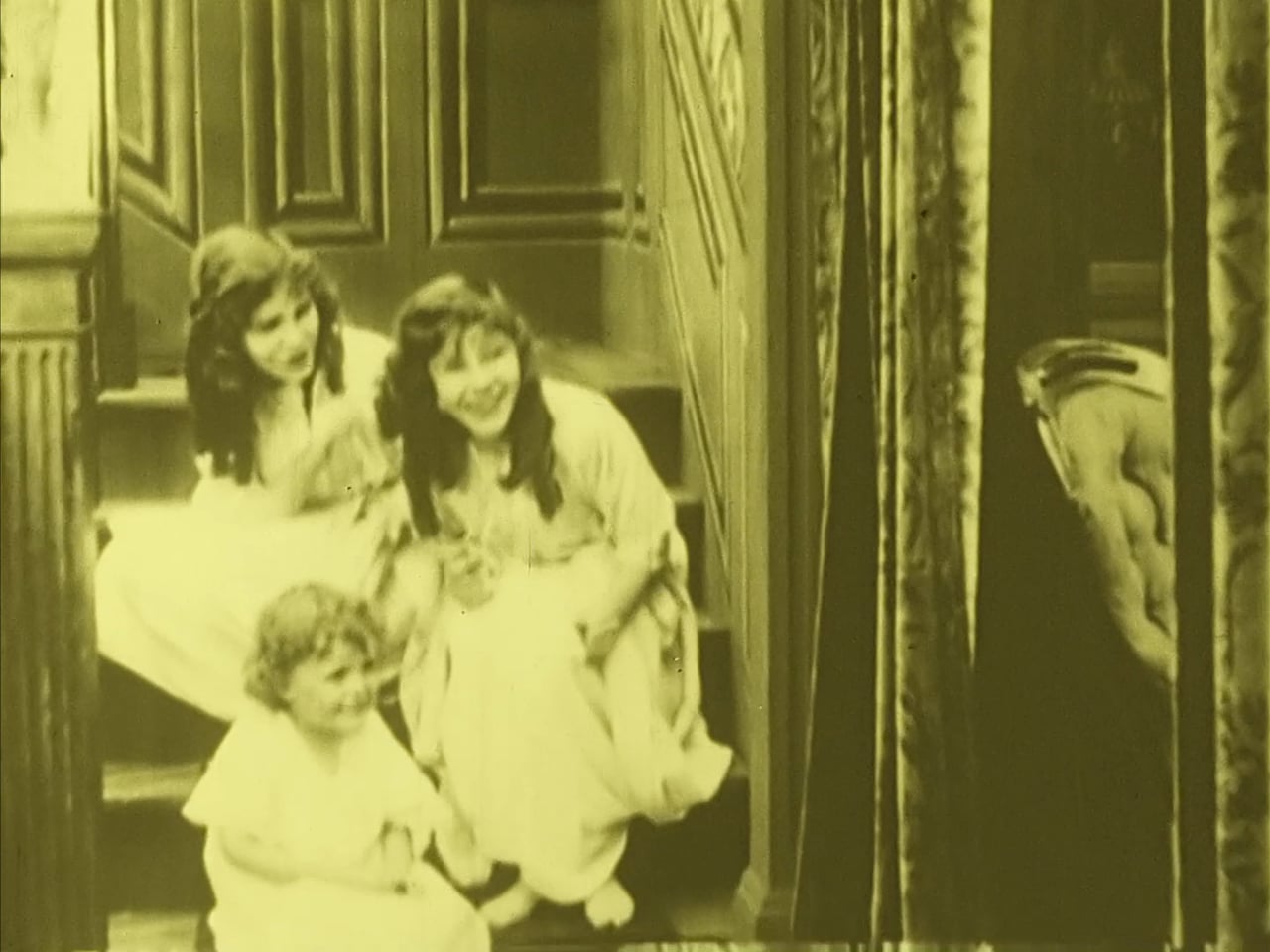
1913Thanhouser CompanyOne reelComedy

How Filmy Won His Sweetheart

No copy you can watch online. No print is known to survive. What follows is what does: the release, the cast, the story, and what the trade press said at the time.

The story

“Filmy, an operator at a picture palace, visits his sweetheart, proposes to her, but is rejected by her father on the plea that his position is too humble, and his salary of two guineas [Ed. note: equivalent to slightly more than $10] is not enough to support Stella. Filmy is decidedly absent-minded on account of this, with the result that he puts a feature film on the screen backward, for which he gets the ‘bounce.’ He then gets a job as a cameraman with a local producer, but instead of taking a local flower show, he takes a policeman spooning with a servant maid; then some lovers in the park, and finally wanders into Lord Montgomery’s grounds and takes his lordship spooning with the cook. ‘I will give you 5,000 pounds [Ed note: about $24,000] to destroy that film. If my wife sees it, I am ruined,’ said the lord. Filmy accepts and Stella’s pa willingly accepts Filmy as a son-in-law with his newly acquired wealth.”

Summary from The Moving Picture World · 1 November 1913

Another synopsis, from Reel Life · 25 October 19131 min

“Filmy won his sweetheart just by being so desperately and so romantically absent-minded, that he blundered into a fortune. Lots of good things in life seem to come to us in about that way—not by any conscious virtue of our own, but purely by a happy accident. The play is a delicious piece of absurdity—and yet quite like life, after all. Filmy is an operator in a ‘Picture Palace’ (which stamps the comedy as English at once). He has long been attentive to Stella, and one evening he proposes—only to be rejected by her father—who refuses to see in a two-guinea picture operator a desirable match for his daughter. Filmy is so upset that he puts a film on the screen backwards—and loses his job. He is lucky enough, however, to get another place, as camera man with a local producer, and is sent out to photograph the Flower Show. Instead, he comes back with pictures of a policeman spooning with a servant maid, two lovers in a shady recess in the park—and a scene in the grounds of Lord Montgomery, in which his lordship appears in a romantic scene with his cook. Montgomery gets wind of the film, offering Filmy 5,000 pounds to destroy it. The camera man joyfully accepts—and rushing to Stella’s pa with his newly acquired wealth, is promptly accepted. For a good laugh, and plenty of English local color (which, someway, always tickles the American sense of humor) the play is unique among the new offerings.”
What the papers said

2 reviews · 1 advertisement

This review is reprinted in the narrative section of the present work.

The Moving Picture World · 1 November 1913

“This farce, although without much strength of plot, holds the interest from start to finish. Philiny [sic], a motion picture operator at something like $7 per week (they get that only when necessary to make a plot), loves a girl, but has been rejected, not because of his looks, nor of his family connections, but because of the $7 per …

Read in full · 1 min

“This farce, although without much strength of plot, holds the interest from start to finish. Philiny [sic], a motion picture operator at something like $7 per week (they get that only when necessary to make a plot), loves a girl, but has been rejected, not because of his looks, nor of his family connections, but because of the $7 per by a very practical and sordid-minded father. We see him back on the job, so indifferent that he runs his films backward. For that he loses his job. He is engaged by another firm to take local events, and starts out with a camera. A fat woman flirting and a policeman taking a drink (not of water) are his first two scoops. His third is that of one of the local aristocracy making love to his mother’s maid. The destruction of this particular length of film nets Philiny all the available cash that particular local aristocrat carried with him. Philiny is discharged for incompetency, but the sight of all that cash wins him his sweetheart. The part of Philiny is well acted throughout. It is refreshing to note that both Philiny and his sweetheart are what one might call middle-aged.”

The New York Dramatic Mirror · 5 November 1913

Advertisement

25 October 1913Reel Life1 min

“Filmy operated the picture machine at the theatre and, being rejected by his lady love, was very nervous all evening. In fact, he threw some of the pictures on the screen upside down and the audience howled. Filmy was ‘fired’ by the red-hot manager and you’d have thought his love prospects were worse off than ever, wouldn’t you? Instead his bad luck sent him good luck and the girl.”

Have you seen this film, or a print of it?

Prints of films thought lost still turn up in attics, private collections and archives. A record like this one is how the next one gets found.

Tell us about a print

Cast and crew

Muriel Ostriche as ticket seller

Every name opens that person's page, with each film they appear in and which of them you can watch.

Watch instead

Films you can watch from the same company

Matched by cast, director and kind

More about this film

Bowers’ notes
  1. The film title was subject to numerous misspellings of “Filmy,” with “Flimy” appearing various times in schedules in The Moving Picture World (including in the issues of November 1, 8, and 13, 1913), “Philmy” in a review in The Moving Picture World, November 1, 1913, and “Philiny” in various listings in The New York Dramatic Mirror. 2. This film represented Lydia Mead’s first screen work for Thanhouser. 3. A guinea (21 shillings; equal to a pound plus one shilling) in the British monetary system was worth slightly more than $5 in equivalent U.S. funds.

From Volume II: Filmography of Q. David Bowers’ Thanhouser Films: An Encyclopedia and History, reproduced with permission and unchanged. Read the history of 1913 →

Cite as: Bowers, Q. David. Thanhouser Films: An Encyclopedia and History, “How Filmy Won His Sweetheart”. thanhouser.org/films/how-filmy-won-his-sweetheart/

Where a print is held

Held by
No print known