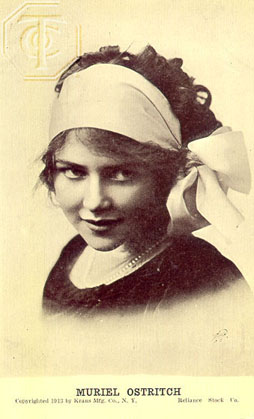
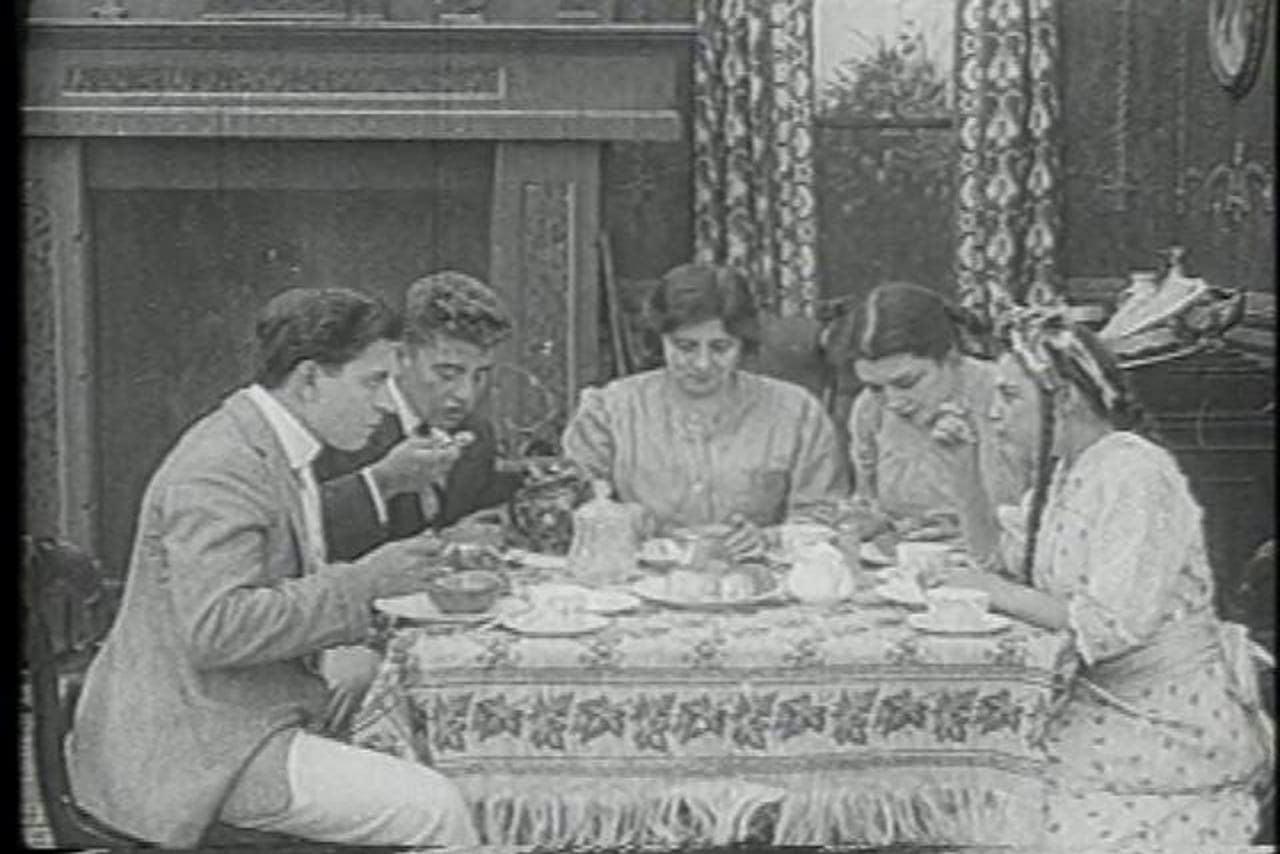
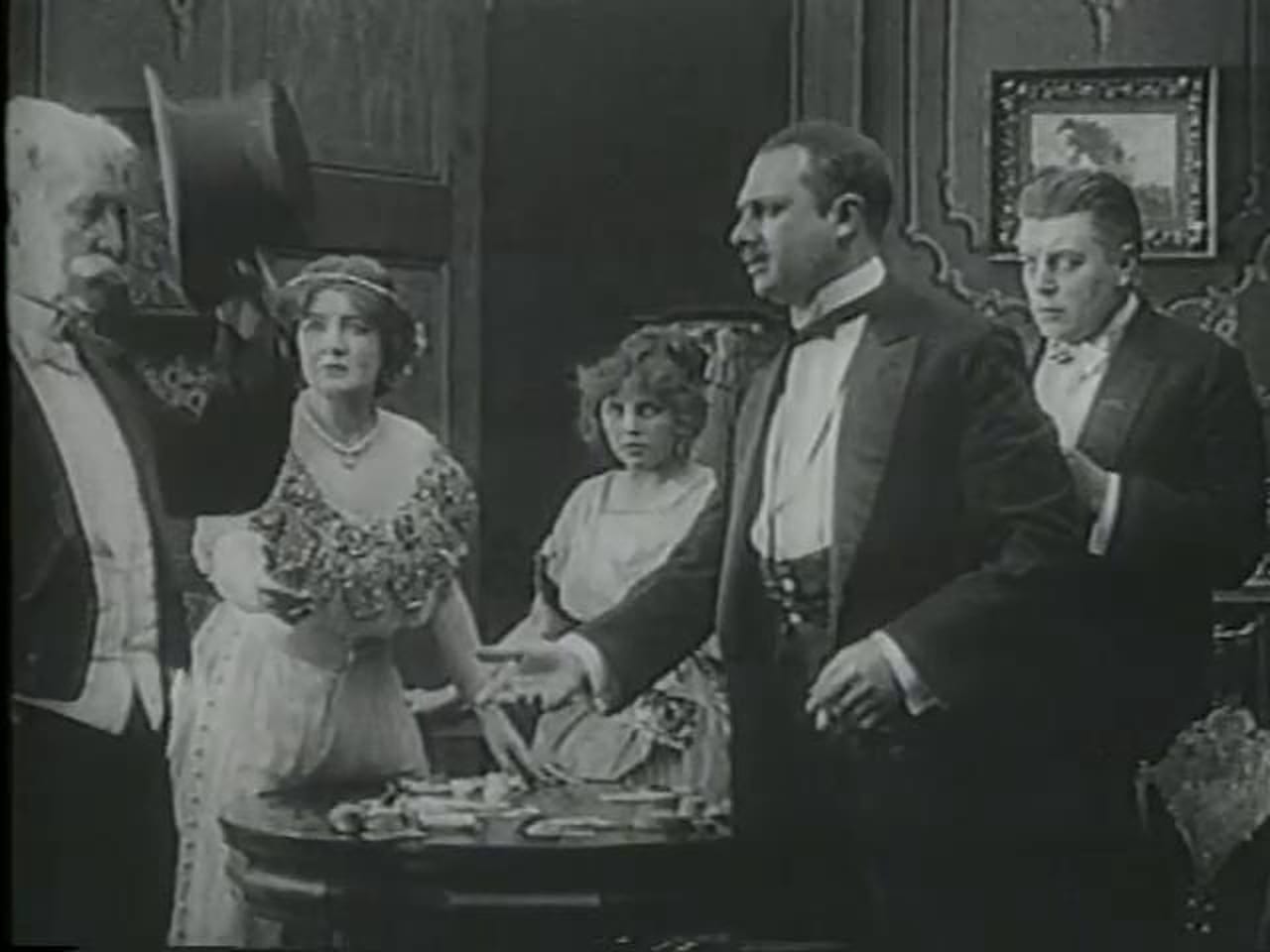
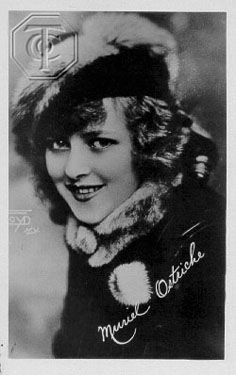
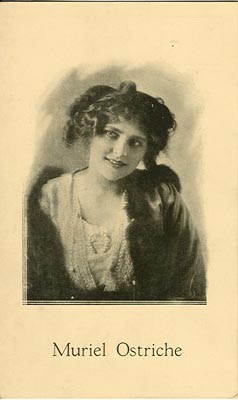
Charles J. Hite, president of the Thanhouser Film Corporation, was impressed with Miss Ostriche’s acting and the favorable reviews her films garnered in the trade press, and in the autumn of 1913 he set up a special division, the Princess Department, to showcase her talents. For most of the next year she appeared in weekly single-reel Princess releases, usually with Boyd Marshall as her leading man.
A note in the November 15, 1913 issue of Motography told of her activities: “Muriel Ostriche, as the little princess of the new brand of Princess Films, is so busy these days that she finds it impossible to get to her home in the Bronx any evening before seven. ‘And then I am so tired I ought to go to bed at nine, but—.’ But of course she doesn’t.”
Muriel Ostriche was the subject of dozens of articles in trade and fan magazines over the years. The following two are samples from Reel Life, house organ of the Mutual Program:
Issue of May 16, 1914: “The little leading lady of the Princess playlets recently has won several trophies for her beautiful dancing. It has been the custom lately, in New York, for the cafés on certain evenings to offer cups to the most graceful amateur dancer on the floor, and two nights in succession Muriel Ostriche carried off the prize in the largest and most popular restaurants. Her latest triumph was at the new Rector’s. On this occasion she appeared in a soft cream-color frock and a golden headdress, eminently suited to her youthful beauty. Miss Ostriche says that she stands more chance of winning if she makes no special preparation for the contest. Going on short notice, she almost invariably carries off the cup. She also says she prefers to dance with a variety of partners, as novelty inspires her to invent new steps.”
At the time, Rector’s was one of the best-known restaurants in New York City. Among the waiters there was Rudolph Valentino, who was a frequent dancing partner of Miss Ostriche and a close friend. A so-called taxi-dancer, Valentino would dance with patrons. At the time he was playing small parts in movies, including My Official Wife, a 1914 Vitagraph film in which Leon Trotsky, who was later to be a principal figure in the Russian Revolution, had a part. After some trouble with the law, and an uncertain early career in films, Valentino went on to great success and fame as a matinee idol. Upon his death of a perforated ulcer on August 23, 1926, he was mourned by countless women fans, and a memorial parade was staged for him in New York City.
Issue of September 5, 1914: “The Moving Picture Girl, dedicated to Muriel Ostriche, ‘The Little Princess of the Thanhouser Co.,’ is the title of a song just published by the Wadsworth Publishing Company, 1547 Broadway, New York City. The music is by William J. Lewis and the words by A. Fagenson. The melody has a good swing to it and should prove popular, having already found favor with many motion picture audiences.” William J. Lewis was Muriel Ostriche’s piano teacher.
The New Rochelle Pioneer, October 31, 1914, printed a biographical sketch by John William Kellette: “Muriel Ostriche came to the screen without stage experience, and in a little more than a year with Thanhouser-Princess has won her way into thousands of hearts. Most of her work has been done with Boyd Marshall and together they made a great team. She was a leading lady at 15, and has played parts that many an older actress and with greater experience would have given a lot to have enacted. To Muriel it’s all in a day’s work. She loves the screen and has only one objection: It doesn’t give her time to attend to her own shopping, but it does give her time to attend dances and win all the dancing cups in sight. Her home looks like the vault in a jeweler’s, and if the cop on the beat ever got in there and didn’t know that Miss Ostriche was some dancer, he’d pinch the house as a ‘fence.’
“Seriously, Muriel knows how to dance so well that she appeared at the Grand Palace Motion Picture Exposition recently and won the cup away from a lot of others who had greater reputations. She has no fear of the Castles and if there was an open competition she’d take a chance against the divine Irene Foote Castle. She’s so plucky, as a matter of fact, that she’ll take any kind of a chance that Carroll Fleming wants her to. If it’s the kind that means dropping out of a tree from a ledge. Muriel is there with the ‘try-stuff.’ She has enacted the leads in almost 100 plays here, but before that time she was with Biograph, and at 15 was playing leads opposite Irving Cummings in Reliance. Before her Reliance connection, however, she played in Eclair films and gave exceptional promise, and when the late Charles Jackson Hite discovered her work with Reliance, he had her transferred to New Rochelle and created the Princess brand for her. This was in the fall of last year.
“Then as her talents began to develop, she was placed in the parent company under the direction of Mr. Fleming, who is working wonders with her. One of her strongest emotional portrayals will be seen in The Madonna of the Poor, a two reel Thanhouser shown at one of the local theatres next Wednesday night. She was excellent in The Varsity Race, a Phil Lonergan story of two reels, opposite Irving Cummings, and in The Diamond of Disaster. She has an exceptional future before her and a wide range of emotional and serio-comedy parts. Her home is in New York City with her parents, where she was born.”
After Hite’s death in August 1914, the interim management of Thanhouser placed her in other films, but she later returned to Boyd Marshall and the Princess productions. During the time she was with Thanhouser she lived at home with her parents at 565 West 144th Street, New York City. As did many other Thanhouser players, Muriel Ostriche departed by early 1915, during the time when the future of the studio was uncertain and the management lacked direction.
In a conversation with the author, on February 23, 1988, Miss Ostriche reminisced about the days of long ago: “I remember that a boyfriend of mine, ‘Corney’ Shields, who at one time raced for the America’s Cup, would bring his sailboat to the dock in back of the Thanhouser studio in New Rochelle and take me sailing. I recall that one day we went out and the water was really rough, and I got seasick. He had to help me back to my dressing room, and it was just awful. Charles Hite was originally a schoolteacher. He was very nice. He planned to have me do Alice in Alice in Wonderland, but he died, so it never happened. I remember that after Harry Benham—we used to call him ‘Earl’—left films he went into the clothing business. All of the actors would buy from him, and he was highly successful.”