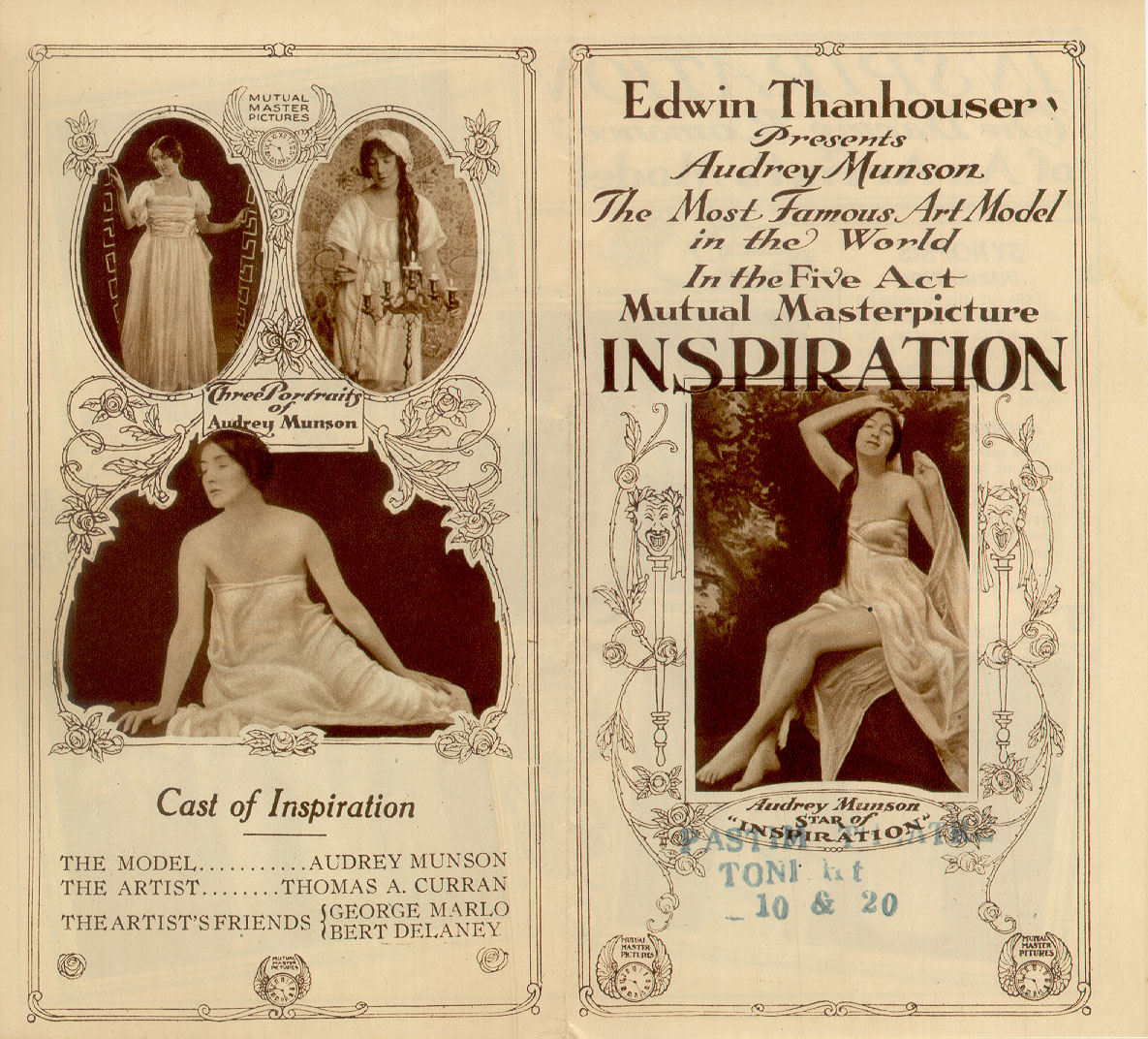
The story
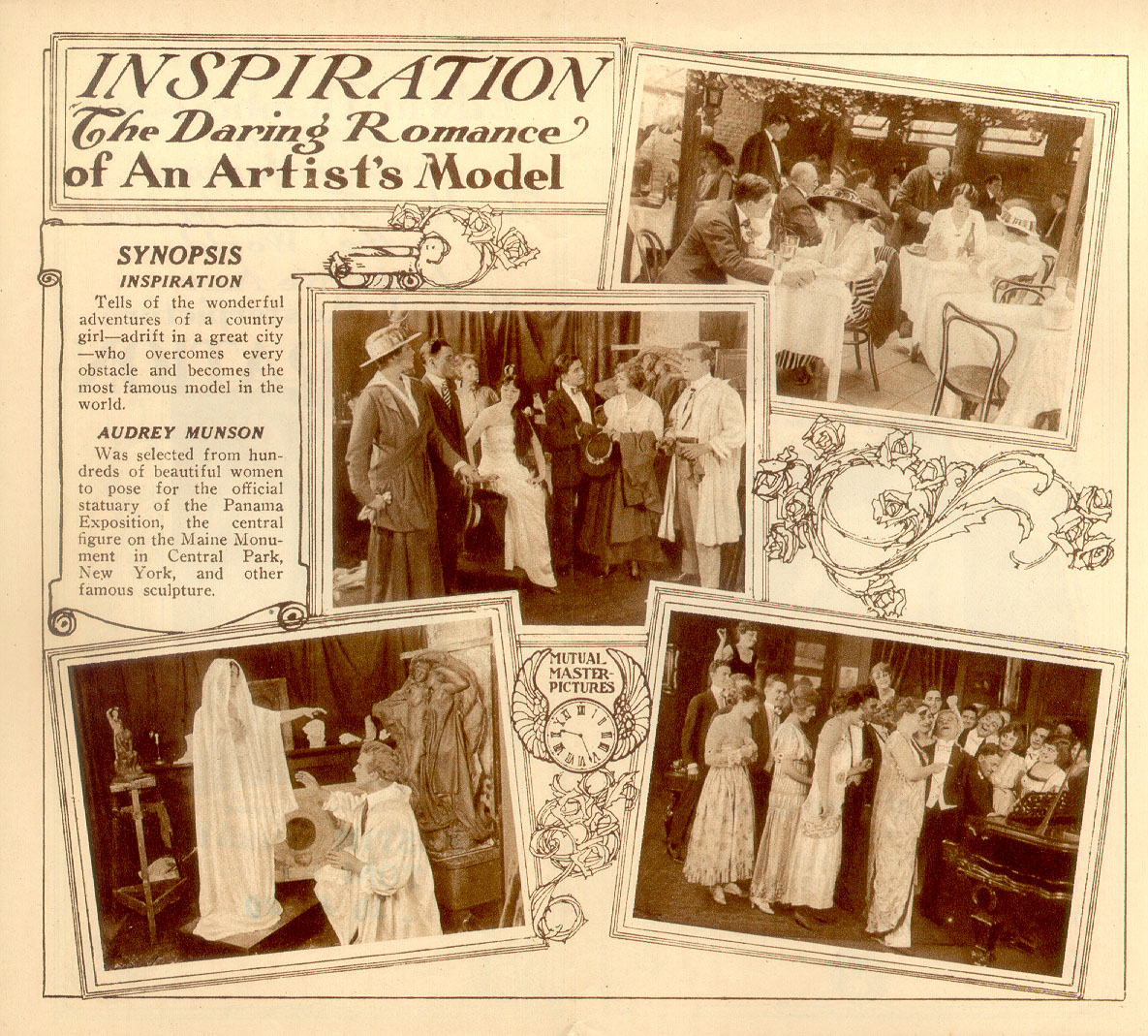
“The classic tale of Pygmalion and the statue, Galatea, which he first fashioned with his own hands, then grew to love, and at length persuaded the gods to imbue with the breath of life, has been the subject for the art of countless poets, of artists and of sculptors, even of modern playwrights, who have garbed its ancient beauty in modern atmosphere and characterizations—frequently with modern satire. Its theme was the underlying theme for the play Pygmalion, by Bernard Shaw, presented in the United States last season by Mrs. Patrick Campbell. Under the title Inspiration, the ever interesting tale has come to life again in a motion picture.... But instead of being located in ancient Greece, where the gods appeared in visible forms to the people on earth, the setting for Inspiration is laid in New York—the New York of to-day, brilliant, gay, fascinating. It is in New York’s Bohemia, among its artists, and the tale is of an American girl who became a famous artist’s model. This is the story, as told on the screen:
“In the presence of a group of his wealthy young friends—the type of men who find the freedom and unconventionality of Bohemia much to their tastes—a young sculptor remarked that he needed only one thing to make of the statue on which he was working the achievement of his career. ‘And that is—,’ queried one of the youths, evidencing unusual interest in the artist’s work. ‘A model—the sort of a model such as I have only dreamed of. But there is none such. She would have to be my inspiration as well as a perfect creature whose grace of body and beauty of face would be the ideal for which I must strive in my work. I am afraid I am doomed to eternal disappointment.’
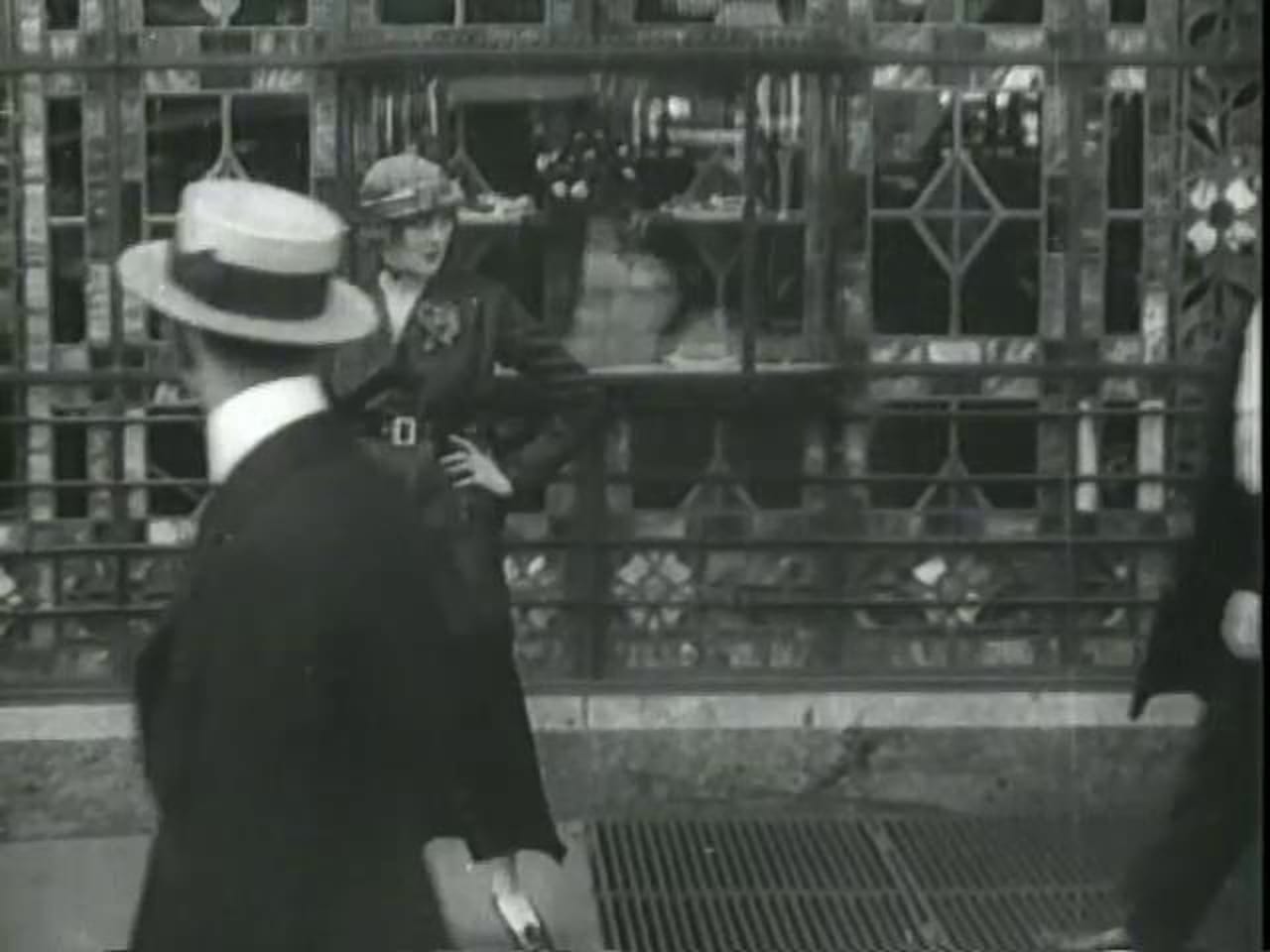
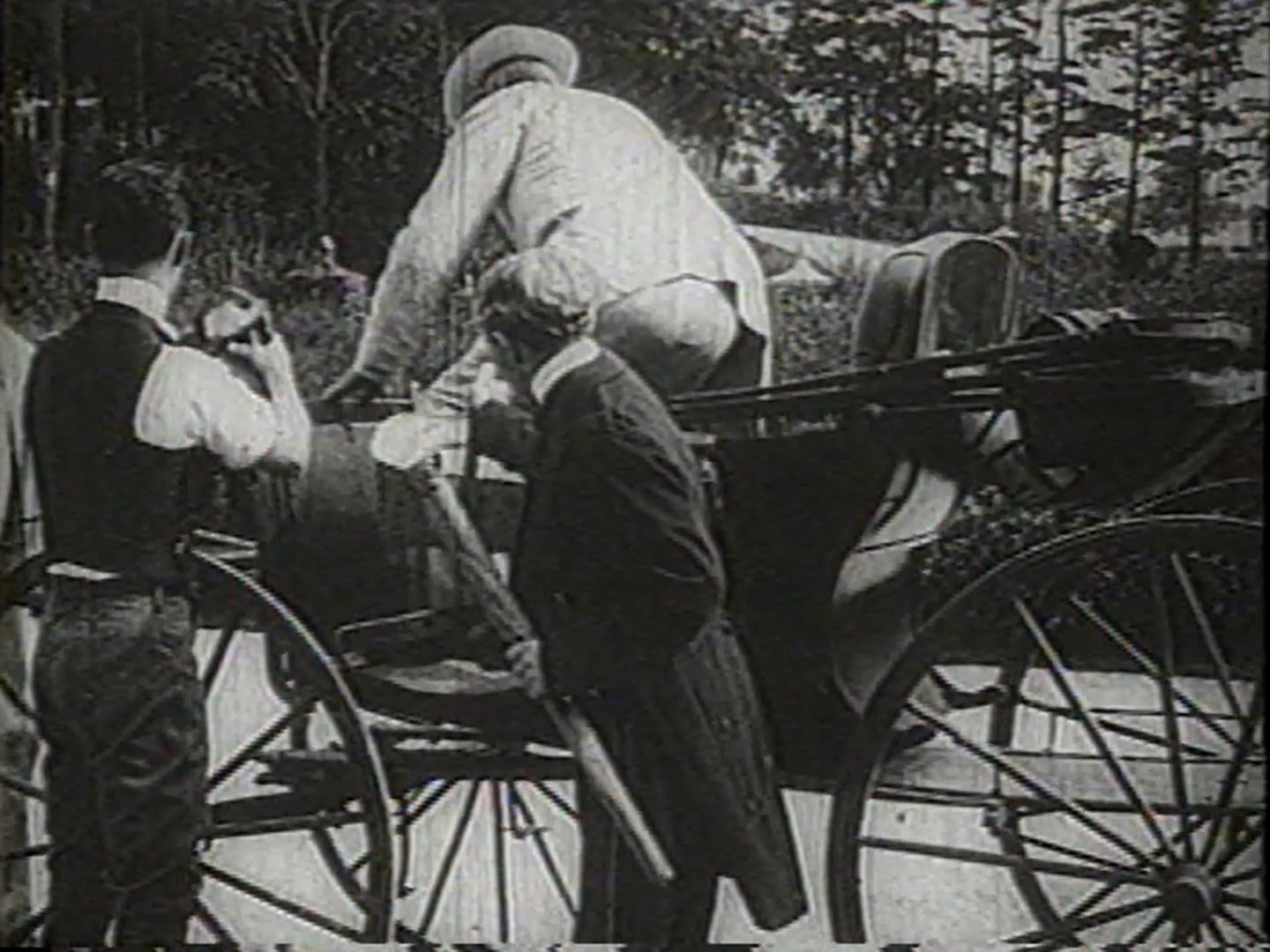
“Several days later the young artist and his friend were members of a motor party. As they drove through the triumphal arch in Washington Square, they ran down a girl, a very pathetic, unhappy-looking little girl, with large brown eyes and blanched features. As she was struck, she crumpled in a heap on the pavement. The men picked her up. She came to herself, and stared at them in wild confusion. ‘Let us take you home,’ said one kindly.
“’No, no,’ she answered, half-hysterically. ‘I cannot go home. I must find work today. I will lose my room if I do not.’ The man had an inspiration. He bundled her into the car, then drove her hastily to the studio of the sculptor. The artist was at work with a chorus girl model—one of the many which his rich young friends had sent to him, in their desire to help him attain his ideal. He did not enthuse over the newcomer. ‘She can’t be worse than I have,’ he told his friends aside, and promised to try her.
“When the crumpled, brown-eyed girl, with a new light in her eyes, brought by the fact that she at last had work, took her position on the modeling stand of the young sculptor, the next day, she unconsciously fell into the pose of the girl of his dreams. Daily the rough clay grew into a work of great art. The hours passed like minutes. The fame of the new model grew. At first she would not accept other offers She was happy only when posing for the young genius—whom, known only to herself, she had grown to love. He urged her to, and at length, grown unhappy, because she thought her sculptor loved one of the wealthy girls who came often to his studio, she consented.
“Her first pose was for the statue of ‘Evangeline,’ by Daniel Chester French, which has been placed before the home of the immortal Longfellow in Cambridge, Mass. There followed many more by other famous artists. Then came orders to the members of the artist’s colony to make pictures and statuary to adorn the buildings at the Panama-Pacific Exposition. The beautiful girl was in great demand. She divided her time between posing for the ‘Ascending Night’ of Adolph Weinman; the figures of ‘The Fountain of Eldorado,’ by Mrs. Harry Payne Whitney; the ‘Genius of Creation,’ by Daniel Chester French; the ‘Court of Four Seasons’ and the ‘Spirit of Spring,’ by Piccirilli, and countless others.
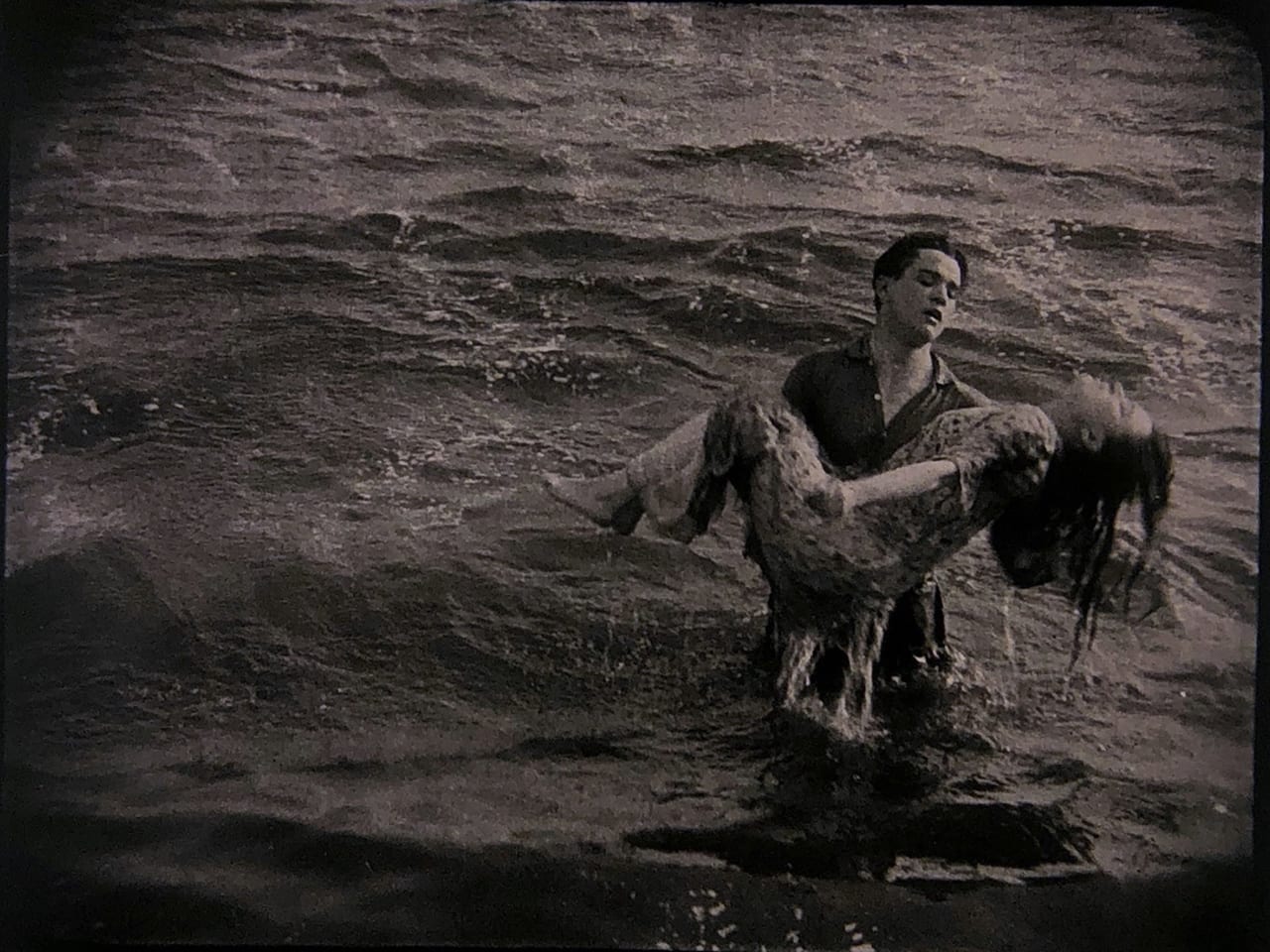
“All the time she remained true to the man who had first discovered her. She posed for him until he finished his wonder work. Then, feeling that he needed her no longer, she disappeared, leaving him a note, stating that she had gone forever. With this, the man awoke to the love pulsing within his own heart, and after weeks of weary waiting and searching, she came back to him, back again to be his own, his inspiration, his Galatea. He found her in a miserable heap, weak and sick, at the base of the Maine Monument, at Columbus Circle, where he had gone to look on her features in the cold stone of the statue. The story of the achievements of the model in Inspiration is the story of Audrey Munson, the famous model, who, herself, plays the role. She is known as the ‘Panama-Pacific Girl.’ The love tale which is woven in, so the pretty model declares, is merely the figment of a scenario writer’s imagination. But, even if that is true, it is a beautiful story, is it not?”
Summary from Reel Life · 6 November 1915