1917Pathé Gold Rooster PlayFive reelsDrama

The Candy Girl

No copy you can watch online. No print is known to survive. What follows is what does: the release, the cast, the story, and what the trade press said at the time.

The story

“Nell’s fudgemaking was the talk of the countryside. She was called the candy girl by the youngsters. Sweetness was one of the chief characteristics of the sunny-hearted girl. Speaking to her aunt, Nell exclaimed, ‘We’re going to New York, and I’m going to make candy for everyone there, and we’re going to be rich.’ The following week found her established in New York, the proud possessor of a little store not far from the Great White Way. Two men enter Nell’s life, one a musician and the other, Jack Moore [sic; should be Jack Monroe], the idle son of a millionaire. Inducing the musician to play ragtime, instead of operatic compositions, Nell leads him to the road of success, while Jack for the first time experiences impulses of goodness. Aspiring to win Nell’s favor, Jack tries to make good. Listening to his pleadings, Nell married Jack, whose father was opposed to his marriage. He tells her that for several years Jack has been addicted to the drug habit. All efforts to save him have been useless. Stunned, Nell listens silently until the father offered to secure an annulment of the marriage. Refusing the offer, Nell rushes to Jack and throwing her arms about him, she says, ‘We’ll return to my little country home and there we’ll wage this fight together.’”

Summary from The Moving Picture World · 26 May 1917

What the papers said

4 reviews · 2 articles

“Following closely upon the heels of recent Gladys Hulette successes, The Candy Girl offers a typical vehicle for this particular star and a story that is brimming over with human interest. Its success lies in the quaint pathetic appeal intermingled with a tinge of humor that increases the holding power upon an audience. The story is simple, dealing with a …

Read in full · 4 min

“Following closely upon the heels of recent Gladys Hulette successes, The Candy Girl offers a typical vehicle for this particular star and a story that is brimming over with human interest. Its success lies in the quaint pathetic appeal intermingled with a tinge of humor that increases the holding power upon an audience. The story is simple, dealing with a country girl who goes to the city to start a candy store and the trials that follow such a venture. The dramatic value is increased by the subtle romance woven through the plot. This tenseness is increased after the fact that the youthful husband is a drug fiend is unfolded to the audience. In choosing the characters the director has never lost sight of the human side, such as the policeman who takes such an interest in the welfare of Al, and the old miserly landlord who is completely won over by the girl’s smiles. Able direction successfully accomplishes an even continuity, and at no time does the action drag. The photography is commendable.

“The power of appeal of the character of Nell is enhanced greatly by the clever portrayal by Gladys Hulette. After an exhibitor has become acquainted with past releases featuring Gladys Hulette, he will understand the convincing manner and the almost pathetic touch given the part by her. The star’s acting is realistically presented, which makes the character of Nell a living, breathing human being. William Parke, Jr. and J.H. Gilmour as the son and father, respectively, present able roles, while little Helen Badgley adds just another human side to the cast. There is no doubt but that The Candy Girl will provide an excellent attraction for community theatres or for those theatres whose patrons enjoy real stories from life with all the sexy and sensational features eliminated. It is a meritorious Thanhouser production of exceptional box office value.”

REVIEW by Joseph F. Reddy, The Morning Telegraph, May 6, 1917:

“The personality and fine acting of little Gladys Hulette and the high-class support rendered her by William Parke, Jr., makes The Candy Girl an interesting feature in spite of the lack of originality and strong story. Miss Hulette as Nell, a petite country girl with a penchant for making delicious fudge, received the greatly overfilmed task of winning her young sweetheart, then her husband, from the morphine habit, with the usual outcome. What is there than can stand between true love? Nell introduces no new methods into breaking Jack Monroe of his vicious habit, but then the vehicle needed none to assure the winsome Miss Hulette of success.

“For three reels the picture is just as sweet as the name implies. In that period the director introduced a number of human touches—they were needed to keep up the action—giving a host of kiddies one grand May party with fudge as the chief source of happiness. Tiny Helen Badgley, as Nell’s sister, gets home some of the best touches of the picture with her exceptionally clever delineation of the happy kid surrounded by a world of candy. Then enters the venomous morphine habit—in Jack Monroe. William Parke, Jr., however, does not portray the exaggerated type of a ‘dope fiend’ but holds his acting within bounds and never becomes objectionable, as many do who play similar parts.

“The story has good continuity, but was obviously written as a vehicle for the two youngsters who take the leading parts. Nell, a little country girl, finds things going against her aunt whose chicken farm is not paying; and comes to New York to open a candy shop—she has become noted for ability to make fudge. Things go bad for her until she meets Jack Monroe, who wakes up business with the aid of a host of dirty-faced but enthusiastic kiddies to whom he plays banker. Then comes the marriage—even after Jack’s father had warned Nell his son was a weakling. Nell does all in her power to win her husband away from his habit, but he continues it, until one day he knocks Nell onto the floor unconscious. Things bring him to his senses and, with the aid of a physician, he is restored to normal manhood.”

REVIEW by Edward Weitzel, The Moving Picture World, May 19, 1917:

“The most illustrious example of the girl who started making candy at the kitchen at home and ended up by becoming the owner of an extensive shop on Broadway is Mary Elizabeth. In The Candy Girl, a five-reel Thanhouser photoplay written by Philip Lonergan, the heroine of the story aspires to the same exalted position. She achieves the star and a deal of romance as well. Two men fall in love with her. One is poor and a musician; the other rich, but given to wasting money. He has a good heart, however, and Nell, the Candy Girl, marries him. She at once discovers that life is not all love and kisses. Young Monroe is a drug fiend and, although his father has tried every available means to have him cured, the boy is still addicted to the habit. Nell’s devotion triumphs in the end and gives her husband the moral courage to throw off his chains.

“The change from the simple motives of the earlier part of the story to the discovery of young Monroe’s secret vice is somewhat startling, to say the least; but, taken as a whole, the picture will be enjoyed by those who may be termed middle class spectators. Gladys Hulette is Nell, the candy girl. She enters into the spirit of the part with enthusiasm and makes Nell the wholesome, attractive little woman intended by the author. She is well supported by William Parke, Jr., J.H. Gilmour, Thomas A. Curran, and Helen Badgley.”

Exhibitor’s Trade Review · 12 May 1917

“The announcement of the release of a picture in which Gladys Hulette is the star has come to mean that exhibitors are provided with a feature that will be a welcome relief to melodramas and sex films. The Candy Girl, Miss Hulette’s first picture in some time not written by Agnes Johnston, follows in the track of those preceding, containing …

Read in full · 1 min

“The announcement of the release of a picture in which Gladys Hulette is the star has come to mean that exhibitors are provided with a feature that will be a welcome relief to melodramas and sex films. The Candy Girl, Miss Hulette’s first picture in some time not written by Agnes Johnston, follows in the track of those preceding, containing the necessary appeal to make it popular with matinee crowds. Children will like it immensely. The part played by Miss Hulette is that of a young girl who makes an unsuccessful attempt to run a candy store, the stock of which is her own manufacture, delicious but unadvertised, so therefore unprofitable. Along comes the young son of a very wealthy man, who courts her and the result is a speedy marriage. The young fellow is addicted to drugs, and the remainder of the picture is concerned with the boy’s ultimate reform with the aid of his youthful bride.

“Miss Hulette is as charming as ever in the title role of The Candy Girl. Her vivacity and her appealing personality are just suited to a picture of this type. The rest of the cast, which includes pretty little Helen Badgley, William Parke, Jr., J.H. Gilmour and Thomas A. Curran, are pleasing. In transferring to the screen a script written in continuity, W. Eugene Moore, the director, has accomplished all that is necessary in visualizing a story of this kind. There is the right amount of detail and the speed of the action is correct. The photography is clear. Gladys Hulette is becoming more and more popular and the advertising matter should display her name prominently.—F.T.”

The New York Dramatic Mirror · 12 April 1917

More reviews2 · 8 June 1917 – 10 May 1917

8 June 1917Variety1 min

This review is reprinted in the narrative section of the present work.

10 May 1917Wid’s Film and Film Folk2 min

“While this is a long way from being an exceptional offering or one which will cause any one to enthuse to any great extent, still it is certainly a pleasing little bit of entertainment that registers thought, at the same time providing occasional bits of fun. The introduction of a number of human touches keeps the interest aroused, and we get a bit of pathos now and then to properly contrast with the comedy situations. The star and her leading man are both very youthful, but this story was written for young folks of their age, and consequently the action was rather convincing.

“The story told of a girl who made such good candy that she decided to sell it in the city to make a living for her dependent family. Of course, she had difficulties in attracting trade, encountered a willun [sic; villain], and a hero, the son of an indulgent father, eventually married her. We then found that the young husband was a dope fiend, and there were a few dramatic moments before he managed to conquer the drug, with the assistance of the brave little wife who helped in the fight.

“Miss Hulette is a pleasing youngster and her personality registers rather well in this. William Parke, Jr., as the wealthy man’s son who became hubby, gave a splendid performance, it being probably the best bit of acting that he has registered on the screen. The general atmosphere was rather ordinary, with nothing distinctive from a technical angle, but it will be acceptable to those who are impressed by the story. Others in the cast were Helen Badgley, Thomas A. Curran and J.H. Gilmour.

“The Box Office Angle: Figured as a program release, I would say that this is a good bet because it has enough human stuff to make it register as pleasing entertainment. It isn’t a big picture and it lacks distinctive, classy atmosphere and big dramatic situations, but for the program house I would say that the average community audience would accept this as worthwhile. Whatever you do, don’t promise too much on this one, because it is just ‘good’—that’s about all. You can safely say that it is human, which means much these days.”

Articles2 · 18 January 1917 – 19 May 1917

18 January 1917The Evening Standard (New Rochelle)1 min

“After much argument and trouble the Thanhouser Company has succeeded in getting permission of the Society for the Prevention of Cruelty to Children to allow the company to use 20 New York City children in one of the feature scenes of the five-reel Golden Rooster movie, The Candy Girl. After the permission of the society was obtained, Mayor Griffing approved the application. The play is written by Philip Lonergan and is considered a masterpiece. Director Eugene Moore is directing the picture. The scene containing the children is being taken this afternoon.”

19 May 1917The Moving Picture World1 min

“Gladys Hulette, who in a few short months has won an enviable reputation through her fine work in The Shine Girl, Prudence the Pirate, Her New York, and Pots-and-Pans Peggie, stars in The Candy Girl, the Pathé Gold Rooster release for May 20. The Candy Girl is characteristic of the type of play the public has learned to expect from Miss Hulette—whimsical, pathetic, humorous and dramatic all at once. Phil Lonergan wrote the scenario. The Candy Girl is the story of a young orphan girl who is brought up by her aunt. Poverty makes it difficult for them to get along. Having acquired a reputation for her home-made candy, the girl decides to open up a shop in the city for the sale of her candy. Fortune does not smile upon her efforts, her few customers being chiefly those whom she has charmed with the sweetness of her character. A rich man’s son, busily engaged in sowing wild oats, meets her and falls in love with her. They marry and she learns too late that her husband is a victim of the drug habit. Her efforts to win him back to manliness and decency, and her final success, finish the story. The characters are well drawn, especially that of the candy girl herself. Miss Hulette does not merely play the part—she lives it. The Candy Girl seems destined to rank with the best of her previous successes. Thanhouser produced it.”

Have you seen this film, or a print of it?

Prints of films thought lost still turn up in attics, private collections and archives. A record like this one is how the next one gets found.

Tell us about a print

Cast and crew

Carey L. Hastings as Simon Skinner’s wife
Gladys Hulette as Nell, the candy girl
Helen Badgley as Nell’s little sister
J.H. Gilmour as Jack’s father
Justus D. Barnes as Officer Quinn
Thomas A. Curran as George Wingate
William Bowers as Simon Skinner
Photographed by
George Webber

Every name opens that person's page, with each film they appear in and which of them you can watch.

Watch instead

Films you can watch from the same company

Matched by cast, director and kind

More about this film

Bowers’ notes
  1. The 1917 and 1918 editions of the Motion Picture News Studio Directory state that John E. Bowers appeared in this film, while notices in The Moving Picture World give William Bowers as a member of the cast. A detailed story, by Philip Lonergan, author of the scenario, appeared in the June 1917 issue of The Photo Play Journal and credited the role to William Bowers. 2. Some listings credit George Bauer for the role of Officer Quinn, but this is incorrect; Justus D. Barnes played the part.
Posters and media
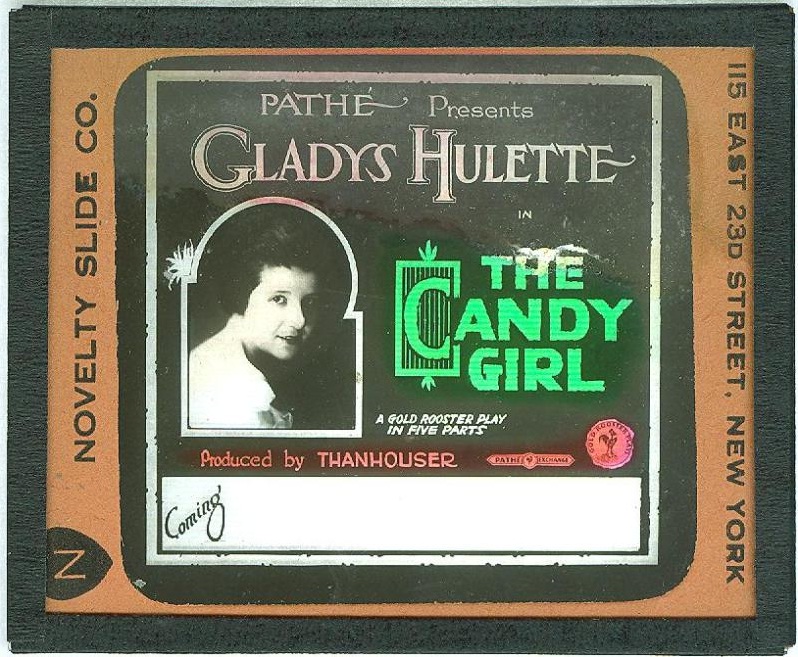
Glass slide for The Candy Girl. (Pathé Exchange)

From Volume II: Filmography of Q. David Bowers’ Thanhouser Films: An Encyclopedia and History, reproduced with permission and unchanged. Read the history of 1917 →

Cite as: Bowers, Q. David. Thanhouser Films: An Encyclopedia and History, “The Candy Girl”. thanhouser.org/films/the-candy-girl/

Where a print is held

Held by
No print known