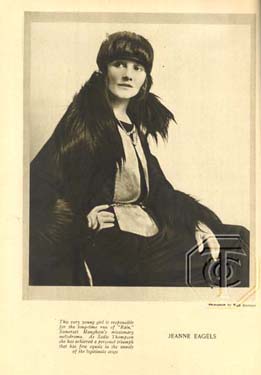
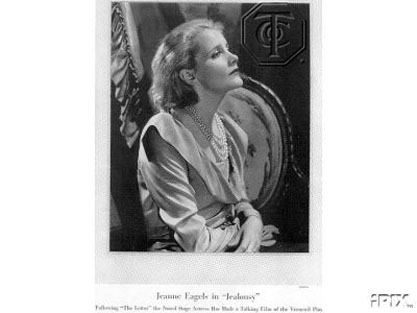
During the 1920s, Miss Eagels was in and out of hospitals and sanitariums many times, as she contended with what were described by the press as “illnesses.” Although she was treated at St. Luke’s Hospital, New York City, during the second week of September 1929, for eye ulceration caused by a sinus infection, most of her medical problems were due to alcoholism and drug addiction.
Late in the afternoon of October 3, 1929, Miss Eagels was stricken at her home at 1143 Park Avenue, New York City. She was taken by her maid, Christina Larson (who answered to the nickname ‘Stina), to a nearby private facility, the Park Avenue Hospital, at 591 Park Avenue. She was assigned to a private room under the care of Miss Jennie Hoglund, a nurse who happened to be on duty at the time. Edward Spencer Cowles, Jeanne’s doctor and person physician for nine years, who owned the facility, was out of the building and was summoned. A few minutes before seven in the evening, the face of the actress suddenly contorted, and then she collapsed, lifeless, across the bed. Dr. Alfred Pellegrini, assistant to the absent Dr. Cowles, was called for, but when he arrived there was nothing to be done.
Several hours later, the body was transferred to Campbell’s Funeral Church, 66th Street and Broadway, where Dr. Thomas A. Gonzales, deputy chief medical examiner, performed an autopsy which showed the cause of death as alcoholic psychosis. In a statement, Dr. Gonzales said: “Miss Eagels died of alcoholism. Not from acute alcoholism, but from alcoholic psychosis. She had been acting strangely for three or four days, but had taken no drink in two days.” Later, Charles Norris, chief medical examiner, stated that her death was not caused by alcoholic psychosis, as first thought, but from an overdose of chloral hydrate, a sedative and soporific. This finding was seconded by Alexander O. Goettler, toxicologist for the City of New York. Eight months later, Dr. Thomas A. Gonzales issued still another revision, stating this time that the actress had died from an overdose of heroin.
David Belasco, the well-known theatrical manager and producer, tried to paint a silver lining to the cloud, and in a statement published in The New York Post, October 5, 1929, commented: “I probably knew her better than most people here in New York. She had gone through many varied experiences.... As I remember the girl she was charming, sympathetic, kind, and gentle. She had been told that she was consumptive, but she led a quiet and sweet life. She had spasms of pain which caused her great concern; she wasn’t a bit like the temperamental star many probably thought her to be. She did not take a drink except when it was ordered by her physician, and this was necessary for her health. In the latter days of her life she did not drink for the pleasure of it. I shall always remember Jeanne Eagels as a splendid comrade, as a person who was good and generous to her friends, and as one who could not overcome a temperament that was no fault of hers.”
Miss Eagels’ body was on view at Campbell’s Funeral Church, in the Louis XIV room, where three years earlier the body of Rudolph Valentino, the romantic screen hero, had rested. A memorial service conducted on October 5th by Rev. James M. Gillis was attended by an estimated 300 to 500 people, including numerous stage and screen figures. The publicity given to the event attracted about 3,000 curiosity seekers, who could not be accommodated for the service but who filed past her bier before and after. Later, her casket was placed aboard the Twentieth Century Limited and sent over the rails to Kansas City for burial. Just before her death, she planned a comeback on Broadway and was studying a new play, Diana, based on the life of dancer Isadora Duncan, written by Irving Kaye Davis.
Jeanne Eagels was survived by her mother, who lived in Los Angeles; a sister, Helen, who lived in New York City; a sister, Mrs. W.K. Ackerly, who lived in Needles, California; and two brothers, George and Paul, who were residents of Los Angeles. Until a short time before Miss Eagels’ death, her father had lived with her in Ossining.
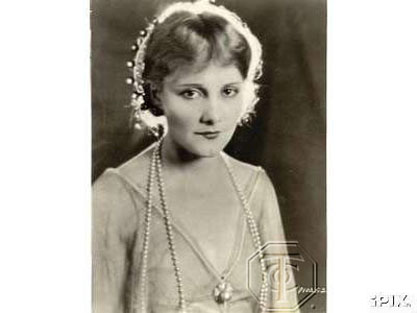
An article in The New York Times, October 7, 1929, stated that when she died, Miss Eagels was wearing $250,000 worth of jewelry, including a flawless pearl “as big as a penny,” valued at $100,000, a six-carat diamond ring worth $20,000, a wedding band set with seven diamonds, and two strands of pearls, one with 59 and the other with 52. In an article published the same day in The New York Sun the jewelry was valued at $300,000.
Miss Eagels’ life contained the ingredients from which titillating stories could be written, and beginning eight months after her death a biography, “Jeanne Eagels,” by Edward Doherty, was published in 15 instalments in Liberty magazine, and stated, among other things, that she was born in Kansas City, not Boston, that her father was not a Spaniard but was from Southeastern Pennsylvania, and that she was 11 years old, not seven, when she appeared on stage as Puck. Doherty’s biography is discussed in following paragraphs in the present work.
In 1933 her life was the subject of a play, Shooting Star. In 1957, Kim Novak portrayed her in a biographical film, Jeanne Eagels. Among Thanhouser “graduates,” Jeanne Eagels was one of the most prominent in later years. Many modern mentions of Miss Eagels have emphasized her alleged sexual promiscuity and the sensational circumstances surrounding her death.
An exposé article about the Body & Mind Clinic, operated by Dr. Edward Spencer Cowles on Park Avenue, appeared in the New York Sunday News, April 26, 1942, and pictured Miss Eagels as one of the alleged charlatan’s victims. His Park Avenue Hospital, established in 1919, catered to moneyed people with mental or nervous problems. Later, he opened the Body & Mind Clinic to serve “less opulent sufferers,” as the article put it. In one ritual described in the article, a long line of patients would pass a ticket-window type of dispensary, where each person would receive a cup filled with a brownish substance which the doctor stated was a mixture of chloral hydrate, bromide, and digitalis. With senses dulled, the patients would then be subjected to a “laying on of hands” by the doctor, after which they gathered in an auditorium to listen to a lecture and to hear testimonials.
Another “remembrance” of Jeanne Eagels achieved nationwide circulation in 1975, in Walter Scott’s column in Parade magazine: “Jeanne Eagels, portrayed on the screen in 1957 by Kim Novak, once charged an actor, Glenn Hunter, $3,000 for spending the night with her; but she was no prostitute. She explained that she was merely punishing Hunter for his expansive ego. John Wharton describes the incident in his recent book, Life Among the Playwrights.”
Note: Jean Eagels’ surname was frequently misspelled as “Eagles” in contemporary articles and publicity. Her name may have been Eagles to begin with (see following Doherty information), but in her professional life she used Eagels.