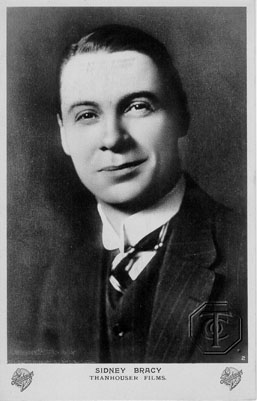
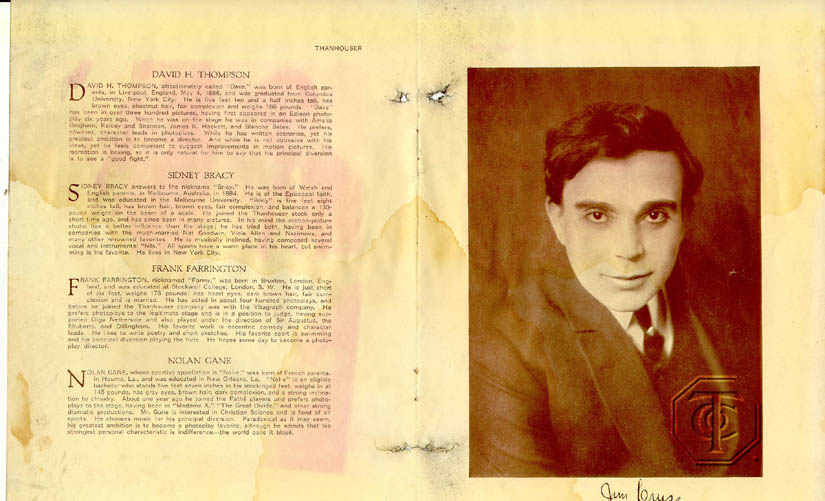
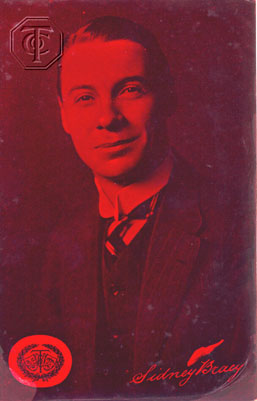
Bracy was a British citizen, but on Monday, September 28, 1914 he declared his intention to become an American and took out naturalization papers (as did his friend Frank Farrington on the same day).
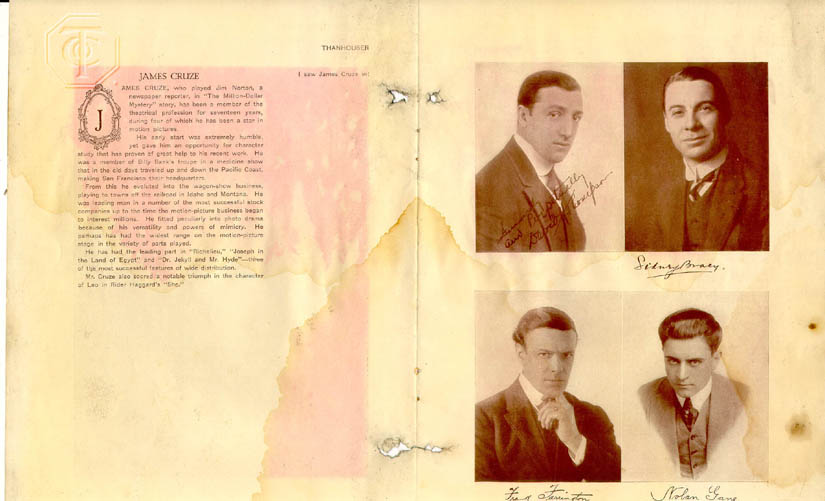
The New Rochelle Pioneer, October 24, 1914, carried this item: “Sidney Bracy and Frank Farrington, who scored a tremendous triumph at Loew’s [theatre in New Rochelle] last Thursday, Friday, and Saturday, will open in New York, Monday, over the Loew circuit, their manager, John William Kellette, having completed arrangements with Joseph M. Schenck for a whirlwind tour. They are to appear nights only and are to be headlined along Broadway in the same offering that took New Rochelle by storm at their initial appearance.”
A week later, on October 31, 1914, the same newspaper reported: “Sidney Bracy and Frank Farrington end their first week over the Loew circuit tonight, having played four theatres this week—The Boulevard at Simpson Street; Seventh Avenue at 124th Street; The Orpheum, over which Sol Meyerson, formerly of the local house, is manager, at 86th Street and 3rd Avenue, and at Lincoln Square, 66th Street and Broadway. They appear nights only, one show or two shows a night in each house.”
The Chicago Tribune, April 25, 1915, told of a brush with death: “Speaking of woman’s intuition: A friend asked Sidney Bracy the other day where he kept his power yacht during the winter. ‘Oh, she’s in dry dock,’ Bracy explained. They were sitting in his dressing room in the Thanhouser-Mutual studios in New Rochelle. ‘There’s a picture of her,’ he added, pointing to a framed photograph on the wall.
“’Nice looking boat,’ said the friend. ‘What do you call her?’
“’Named her Evelyn,’ the actor went on. ‘That’s my wife’s name, and since our last cruise I’ve been particularly glad I named the yacht for her. Funny thing about a woman’s intuition. We were way out in the sound that day when suddenly everything grew dark and fog fell round us like a great gray curtain. We were all straining our eyes in every direction. Suddenly my wife dodged into the pilot house, grabbed the wheel from the steersman, put it hard aport, and signaled the engine room for full speed astern. I hadn’t time to get back to find out why, when a destroyer shot by like an arrow, her siren whining like a lost soul. There hadn’t been a sound before. ‘Evelyn, did you see that boat coming?’ I asked.
“’Oh, no,” she answered. ‘I just sort of felt it.’ Can you beat that? Her feeling in the matter saved our lives, though.’”
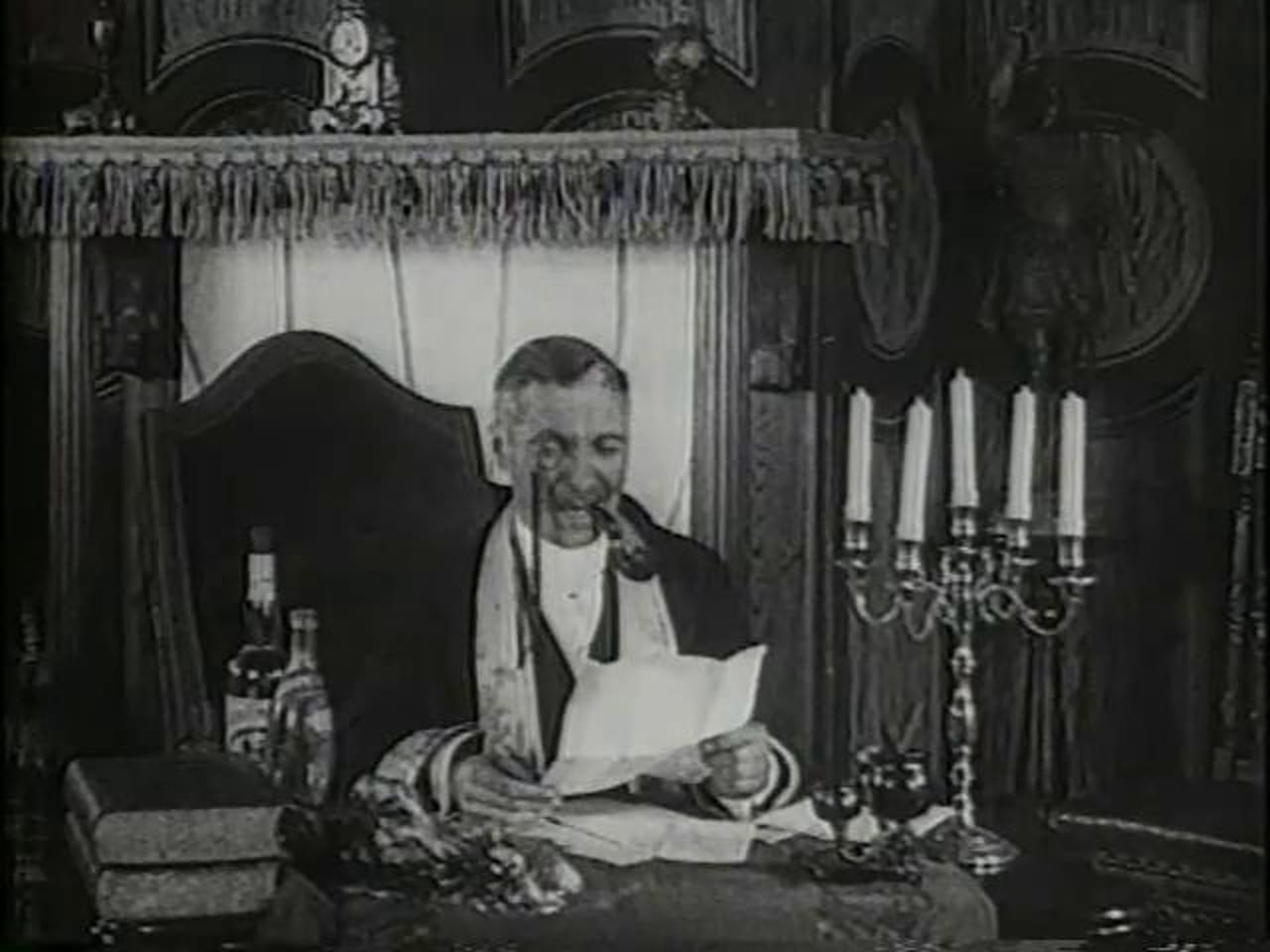
One Thanhouser film in particular bore Bracy’s imprint. He co-authored the scenario for Sid Nee’s Finish, directed the picture, and acted the title role as well.