The story
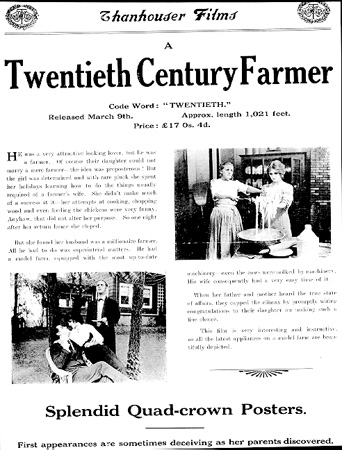
“Her parents were anxious and believed she would be advanced in the social scale by marrying a young banker, who was very attentive to her. The girl, however, regarded this suitor as a pinhead. At a dance one evening she met a real man, and it was a case of love at first sight on both sides. There was nothing slow about the new suitor, and within a month he had won the girl’s consent to their marriage. When he asked her parents for her hand, however, trouble ensued, because when questioned as to his business he had to admit that he was a farmer. The thought of their child as a farmer’s wife was too much for the old folks, and they forbade the match. The girl was steadfast in her love, but at first refused to elope with the young man. She told him that she was not fitted to be a farmer’s wife because she knew absolutely nothing about how to care for a farm or a kitchen. She determined to learn, however, and spent her vacation on a run-down old farm, learning how to milk cows, make bread, and chop wood. In the fall she told her sweetheart that she was now competent to assume her position and consented to elope with him. After her marriage he took her to his farm, which she found with surprise to be a model structure noted all over the United States. She did not have to do the chores or get up at 4:00 a.m., or blow a fish horn to call the hired men for dinner. In fact, she was far better off than she ever had been at home. Even her parents admitted it, especially when they found out that the banker whom they revered was only a $10 a week clerk with no prospects of ever being anything more.”
Summary from The Moving Picture World · 1 November 1913
Another synopsis, from Reel Life · 25 October 19131 min
“Farming, in these days, may be a very different proposition from the sort our grandfathers knew—and the word often has a much wider application. This play of Mr. Lonergan’s illustrates the difference in a humorous way and also drives home the fact that it is never safe to judge altogether by appearances. The girl’s parents had social ambitions for her—and favored the attentions of a young banker. But she met a real man, one evening, at a dance—and became permanently interested. He told her parents that he was a farmer. Having the old notions of the sort of life that meant for a woman, they refused to encourage him—but the girl spent her vacation upon an old run-down farm and announced in the fall that she was ready to qualify as a farmer’s wife. They eloped—to save argument—and he took her to a model farm, noted all over the United States, where she found herself in more comfortable and independent circumstances than she ever had been at home. Later on, the ‘banker’ turned out to be a $10.00 a week clerk—dear, at the price. And the old folks rather shamefacedly acknowledged their mistake. The different methods of love-making and life on a model farm are graphically shown upon the screen—in fact, the play is good all through. Now, we wish that Mr. Lonergan would give us something on the other sort of a model farm—where each apple, cabbage and potato costs about ten dollars to grow. We have such farms right in the family and are convinced that they would make a very moving picture, if the dollars could be shown.”