1913Thanhouser CompanyOne reelDrama

Little Brother

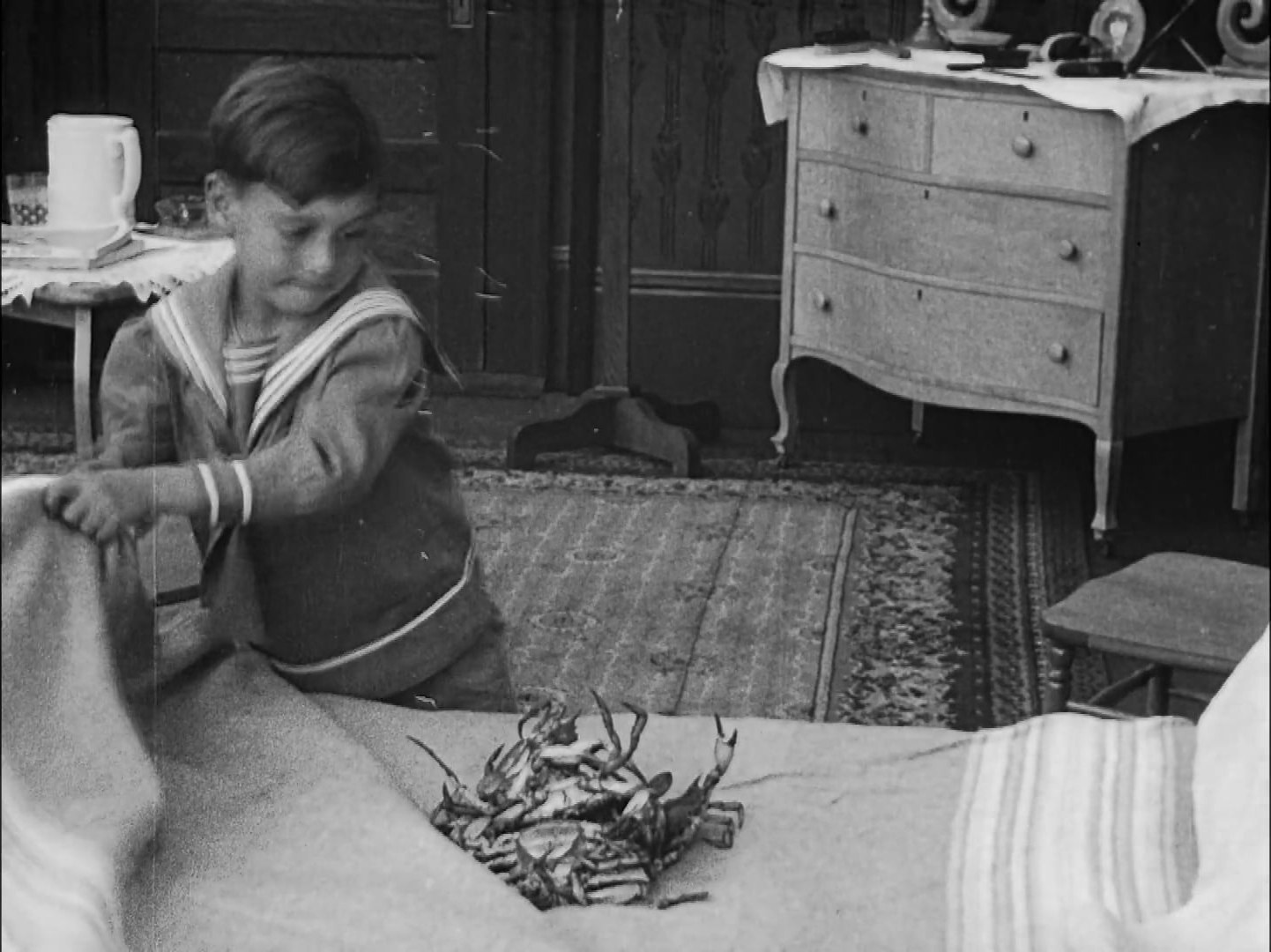
A frame from Little Brother

6:47 running time · Score: Ben Model · theatre organ · Vimeo uses cookies · Privacy

Why watch it

7 minutes, and what to watch for

May's "Little Brother" puts his crab catch to good use and reunites May and Jack.

The story

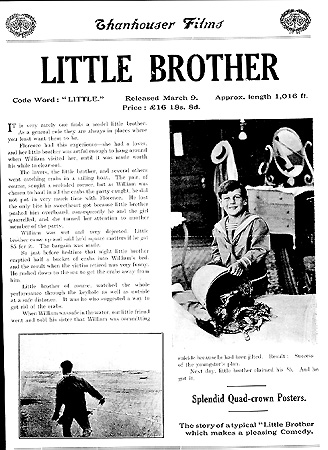
“They were the model engaged couple at the summer resort until—well, until they quarreled. They were members of a crabbing party, and May caught the biggest one that had ever been seen at Cape May, but Jack foozled [sic] with a landing net and fell overboard. Worse than that, he didn’t land May’s prize. They argued, and finally the ring was given back by the girl. Both believed that life would never be the same to them again, and perhaps it would not have been if ‘Little Brother’ had not wanted a velocipede. ‘Little Brother’ was regarded by his sister as a dear, and by sister’s sweetheart as a nuisance. But he offered to square things if Jack would give him funds to buy the velocipede, and Jack eagerly accepted. If you saw the man you love rush wildly into the foaming sea would you or would you not call him back? May did, for she called Jack back, and they were happy ever afterward. He did not deceive her at that—even though he had no intention of committing suicide. Jack later rewarded ‘Little Brother,’ who bought his bicycle and proudly rode it. Jack’s reason for paying up was not entirely gratitude. He figured that a boy who could make one suffer so exceedingly while doing a favor was a person who might rise to remarkable heights if he tried to be an avenger. So ‘Little Brother’ got his velocipede, and May and Jack got married.”

Summary from The Moving Picture World · 8 November 1913

Another synopsis, from Reel Life · 1 November 19131 min

“Every man who ever fell in love with a girl and spent much of his time at her house will remember how he felt toward her little brother when that young person devoted his entire attention to them both. There were times, of course, when the boy wasn’t quite so objectionable—when it seemed as though one could manage to live in the same house with him. But, taken altogether, he was a person to be reckoned with in fair weather or foul. This play of Mr. Lonergan’s shows up Little Brother at his best—and worst. The young man was out boating with the girl—crabbing, to be strictly accurate—and she hauled up the record-breaking grandfather crab of that locality. But the young man foozled with the landing net—lost the grandpa crab—and tumbled overboard. Being wet, he was irritable. Losing her crab, the girl was likewise. The remarks became pointed. She returned his ring. And life was never going to be the same again for either. Then—Little Brother got into the game. He happened to want a velocipede. Told the young man he’d square things up for the price of one. Later—he told Sis that Young Man was going to commit suicide—and in a moment, she saw her former lover rush across the beach and plunge into the breakers. She wildly screamed to him to come back and all would be forgiven—and he came. Not entirely because he repented, however. In starting to take a nap, he had found his bed full of crabs that nipped him and wouldn’t let him go until he jumped into salt water—hence, his frenzied rush across the beach. And in the case of a boy who earns his Machiavellian reward in such a Machiavellian way, he didn’t care to stir up his inventive faculties by refusing to pay for the velocipede. So everyone was happy—eventually.”
What the papers said

2 reviews · 1 advertisement

This review is reprinted in the narrative section of the present work.

The Moving Picture World · 15 November 1913

“A little one-reel comedy featuring William Russell and Florence LaBadie. The play is interesting, the photography average, and the laughable climax is worthwhile waiting for. The lover and his girl are not able to get off to themselves. They don’t manage it on a crabbing expedition, either, where the rest of the crowd do their best to annoy the lovers. …

Read in full · 1 min

“A little one-reel comedy featuring William Russell and Florence LaBadie. The play is interesting, the photography average, and the laughable climax is worthwhile waiting for. The lover and his girl are not able to get off to themselves. They don’t manage it on a crabbing expedition, either, where the rest of the crowd do their best to annoy the lovers. Finally, when he misses the only crab she gets on her line that whole day she refuses to speak to him, and we see her solacing herself with another man. Now for the little brother of the little sister who wants $5 for a velocipede, and who offers to restore the lover for that amount. Having gotten the promise, the kid put some of the crabs in the young man’s bed, and when the latter goes to rest that night, early, for the young lady won’t talk to him, the crabs get him, and he rushes to the beach in agony. At the kid’s advice, he swims into the surf to get the crabs to let go their hold, and then the kid brings his sister to witness what he tells her is an attempt at suicide on the lover’s part. The lovers are reconciled, and the kid gets his $5.”

The New York Dramatic Mirror · 5 November 1913

Advertisement

1 November 1913Reel Life1 min

“This is a ‘By-the-Sea’ yarn from Cape May, too. It’ll make you clamor for the whole celebrated series. Now, they were oh-so-much in love, and naturally there was a red-hot quarrel that sent them drifting. The man wanted her love again, nevertheless. She had a brother—yes, the Little Brother—and it was via him that the man ‘made up’ with her again. But the little brother had a mint of fun with the maker-up while helping him!”

Cast and crew

Cast
Florence La Badie as his girl
Leland Benham as the little brother
William Russell as the lover

Every name opens that person's page, with each film they appear in and which of them you can watch.

Keep watching

Watch next

Matched by cast, director and kind

More about this film

Filmed in
Cape May, New Jersey
Bowers’ notes
  1. An erroneous release date of November 8, 1913 was listed in several schedules. The New York Dramatic Mirror, issue of November 15, 1913, listed the release date as November 11, 1913. 2. This was the sixth and last release in the “Cape May series” of Thanhouser films. The group of films included the following: Louie, the Life Saver (October 7, 1913), A Deep Sea Liar (October 12, 1913), Beauty in the Seashell (October 19, 1913), The Mystery of the Haunted Hotel (October 21, 1913), The Water Cure (November 2, 1913), and Little Brother (November 7, 1913). 3. The Motion Picture Story Magazine, February 1914, erroneously named Marie Eline as the little brother.
Posters and media
Still for Little Brother. A frame from Little Brother (1913), from the Thanhouser restoration on Vimeo.Press for Little Brother. Thanhouser advertisement with William Russell and Leland Benham. Courtesy Ralph Graham, MD.

From Volume II: Filmography of Q. David Bowers’ Thanhouser Films: An Encyclopedia and History, reproduced with permission and unchanged. Read the history of 1913 →

Cite as: Bowers, Q. David. Thanhouser Films: An Encyclopedia and History, “Little Brother”. thanhouser.org/films/little-brother/

Where copies are held

Completeness
Fragment
Scored by
Ben Model · theatre organ
Note
Only a fragment of the original 1,016-foot film survives. It was repatriated from the New Zealand Film Archive through the National Film Preservation Foundation in 2010, and is the only surviving footage from the six Cape May Productions films.