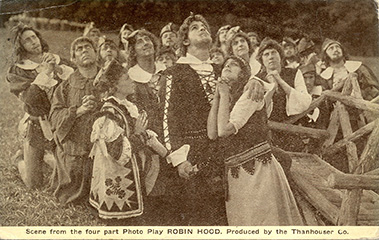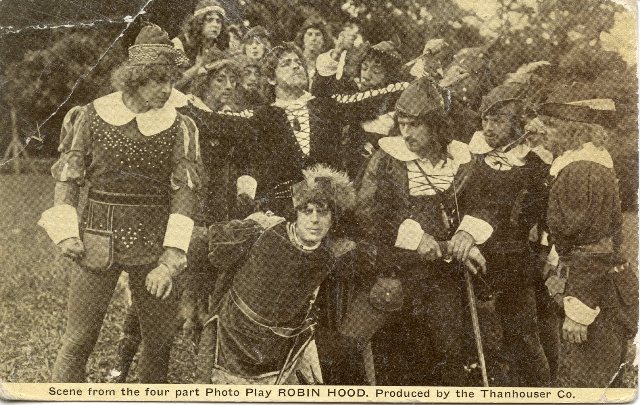
The story
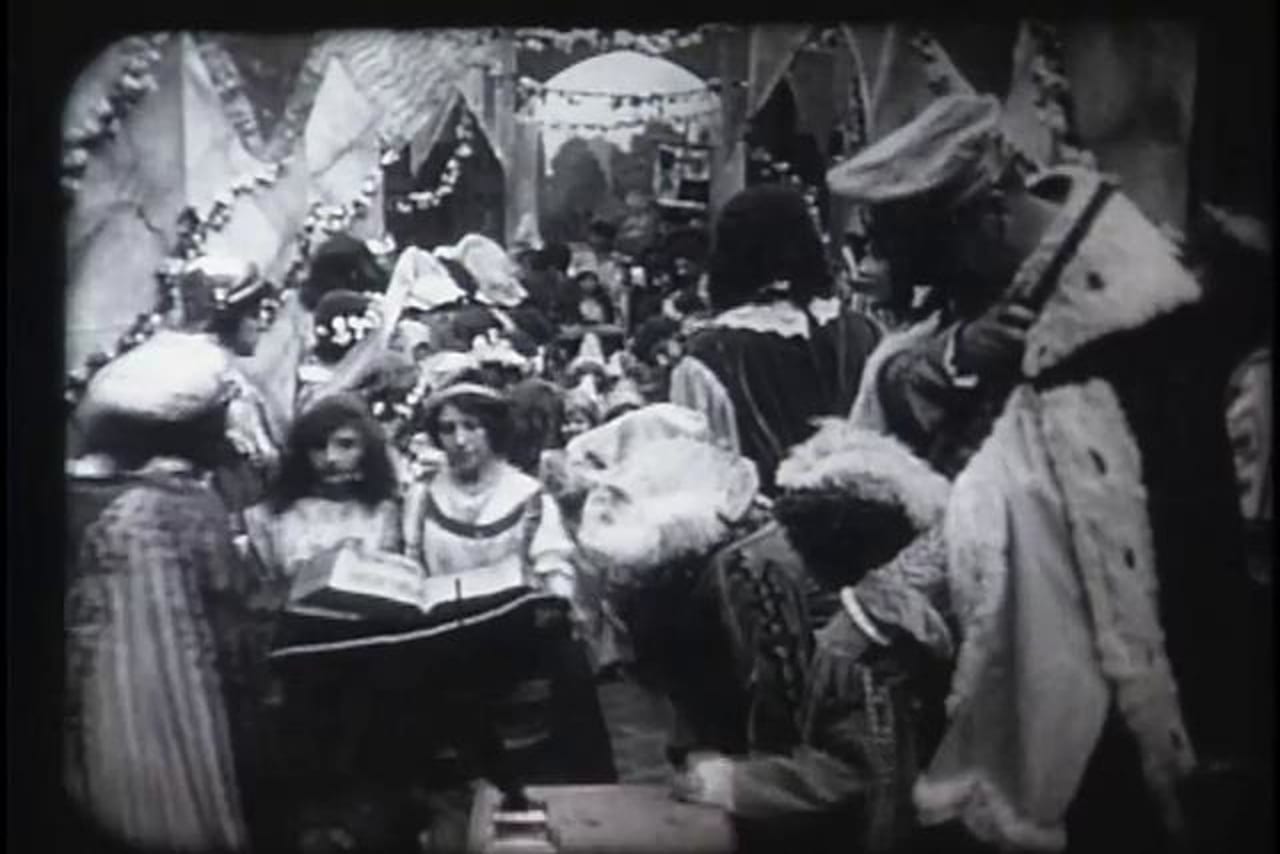
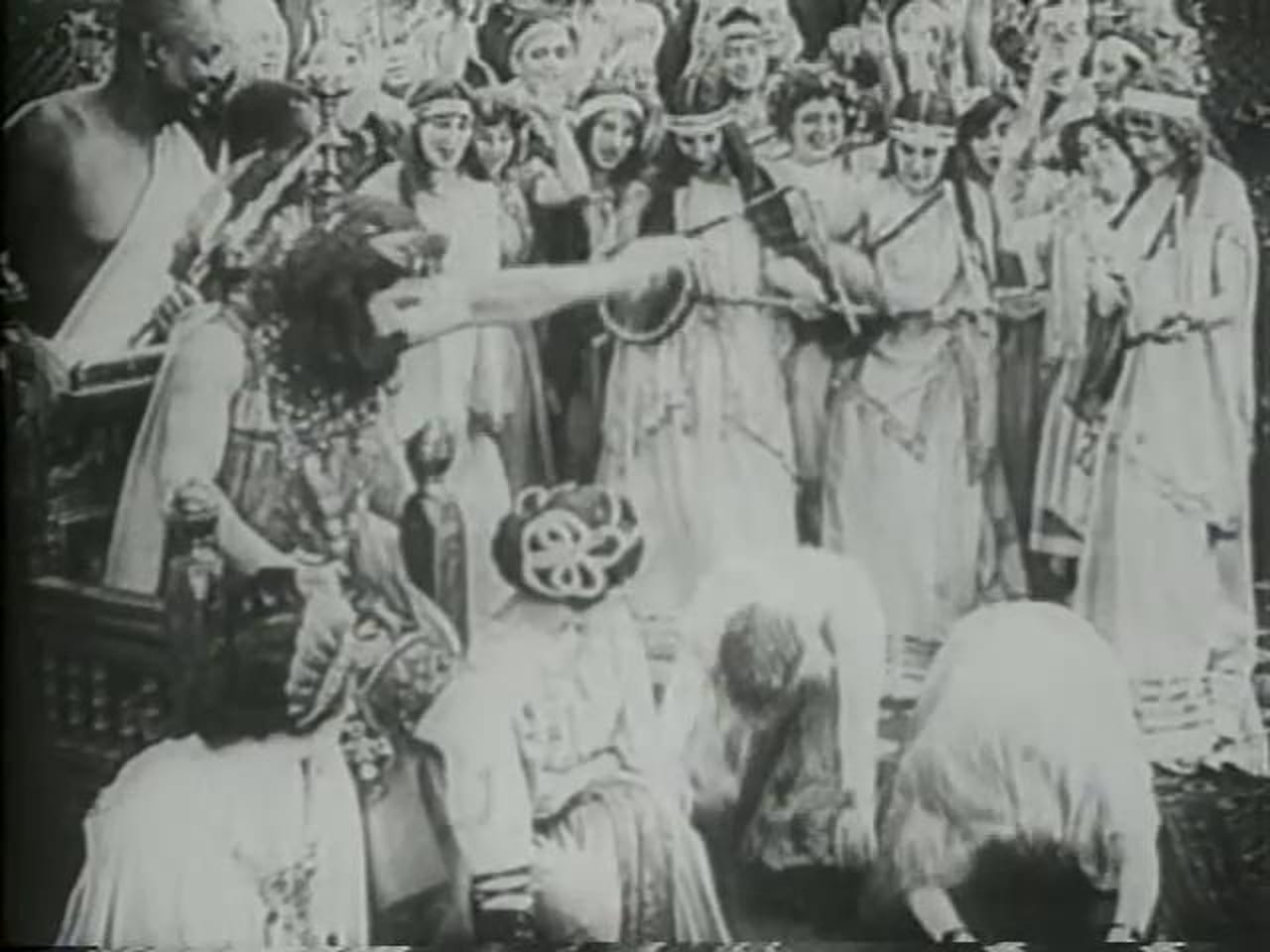
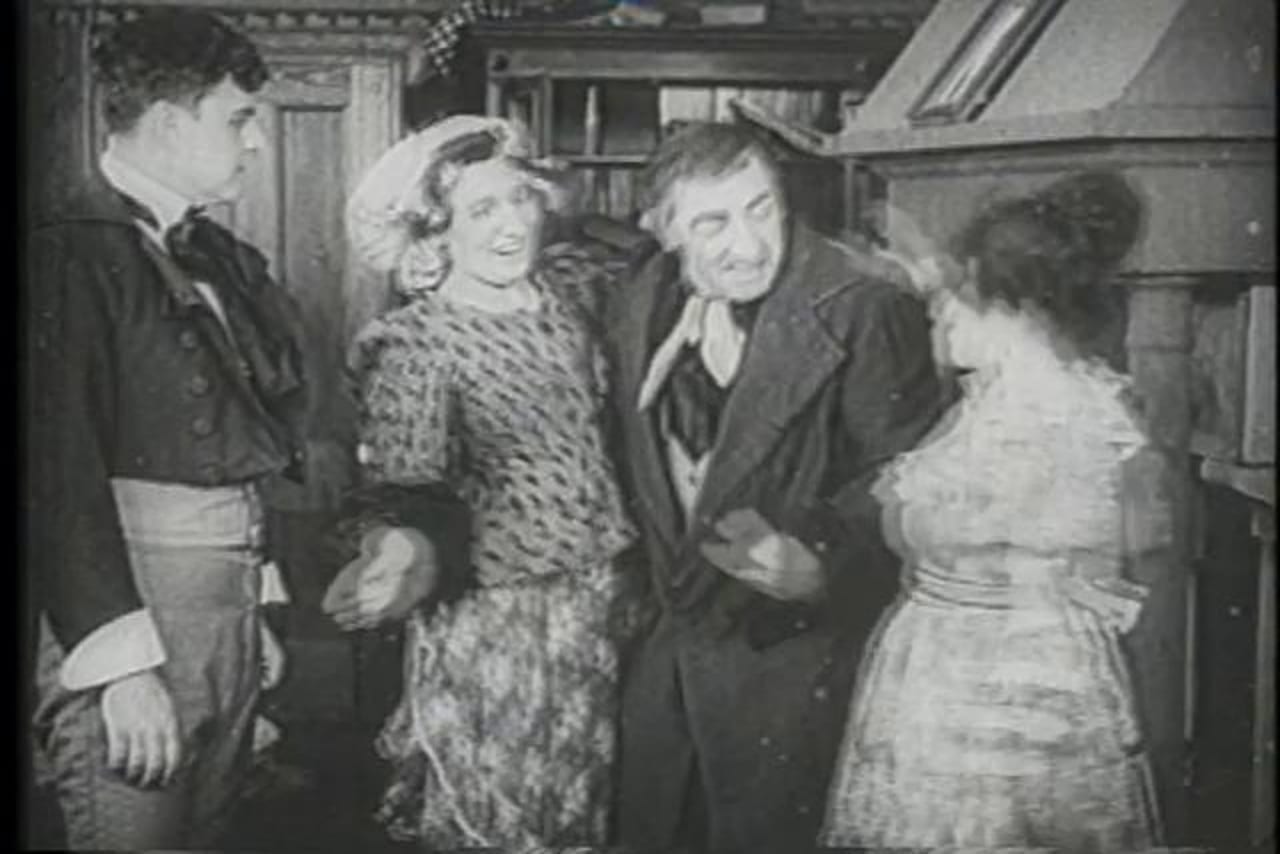
“The story opens showing Robin Hood, bow in hand, searching for Marian, whom he finally meets, and together they see a notice on a tree, which reads that no Saxon shall slay a deer in Sherwood Forest. And this sign soon plays an important part in their lives, for Robin ignores it, shoots a deer, and the next picture shows his table, spread for a feast, and surrounded by guests. They knew that the penalty for disobeying the law was to cut off the ears of the offender, so great consternation seized them when the sheriff and his men came to arrest Robin, and not being admitted, they fired their arrows into the court, one of which struck Marian’s father dead. The sheriff and his men retreated, only to return reinforced by more soldiers, and a bitter hand-to-hand struggle took place on the drawbridge, the woman having reached the forest by a secret underground passage. They were later joined by Robin and his men, who after Robin and Marian had been married by the Friar, pronounced them King and Queen. They took oath to punish the rich and cruel, and aid the poor and oppressed.
“Alan-a-Dale appears on the scene, and is made a captive, but after he tells his story they agree to help him. He seeks the hand of a young lady whose miserly father wants her to marry a decrepit old nobleman, who promises her parent money if she will marry him. Marian disguises herself as a gypsy and visits the girl to assure her that Robin and his men will aid her at the critical moment. They are ready, and when the Saxon maiden is standing before the bishop, who is about to pronounce her the wife of the nobleman, Robin Hood and his men pour in through the windows and doors, and Friar Tuck places her hand in Alan-a-Dale’s and pronounces them man and wife, whereupon they all return to the forest, where they are free from molestation. On one occasion the sheriff arranged for an archery contest, open to all comers. Robin appears in disguise, and wins the prize. The King, disguised as a mendicant, is shown such consideration by Robin and his men, that he returns to the palace and pardons them for all past offenses.”
Summary from The Motion Picture News · 29 November 1913
Another synopsis, from Reel Life · 8 November 19138 min
“The legendary story of Robin Hood is probably so well known to every man, woman and child who has gone through the usual course of English history in our schools that it scarcely needs explanation. Yet, because the legends are many—and in some cases, conflicting—those who are to see this wonderful reproduction upon motion-picture screens all over the world will probably get a little keener enjoyment from the play if they previously fix, in their minds, the most widely accepted version of the Robin Hood story. There is little question that there was, in the time of King Richard I, of England, a Saxon nobleman who bore the title, Earl of Huntington—and tradition bears out the belief that he had a son, Robin, who gave offense to the Norman overlords and was forced to take refuge in Sherwood Forest, portions of which still exist to this day in the vicinity of Nottingham. For a century or so after the Norman Conquest, the Saxon thanes who had ruled England before that were reduced to a condition of practical vassalage by their Norman conquerors—their lands being confiscated, or taxes imposed which amounted to confiscation, and their rightful titles entirely ignored. Aside from this, the Norman rule was intolerable and exasperating in many different ways to a native aristocracy which could certainly claim as good birth and as much education as the Normans.
“Cruel punishments were inflicted for slight offenses. A man, for example, who killed a deer in the forests, had his ears cut off. Saxons who were not locked in their houses when the curfew rang were severely punished. In short, everything was done to intimidate and restrict the conquered people that they might have no courage to rebel and throw off the Norman yoke. It is needless to say that many of the Saxon earls felt a sense of outrage and injustice—that they would have roused the country against the Normans if they could have depended upon adequate support from the people. But the lower classes had become thoroughly cowed into submission—the penalties were too dreadful to think of risking—and Norman rule persisted. Robin Hood, the Earl of Huntington’s son, was from boyhood an expert with the Saxon longbow—a terrible weapon, as the Normans learned to their cost, more than once. And with some little strain of royal blood in his veins, he recognized no right of the Norman conquerors to impose restrictions upon his conduct—the age-old inward conviction of personal and national liberty for which men have fought and died since the world began—which is probably why this story has always appealed to every citizen of a free republic. He shot his deer in the forest near his ancestral castle when he pleased—and defied the Norman authorities. This naturally resulted in a determination upon their part to make an example of him.
“The sheriff of Nottingham, being the nearest government authority, took his case in hand—secured evidence that he had killed a deer upon a certain date—and organized a force with which to secretly attack Huntington Castle at a time when Robin was entertaining a number of the Saxon thanes and earls, among them being his fiancée, Marian, and her aged father. Robin and the Saxons fought bravely, but when reinforcements arrived to aid the sheriff, they realized that they were hopelessly outnumbered. They sent the women away through a secret underground passage—closed the trap-door over it and defended the castle until the great oak door was battered in. Then—they fought their way to freedom through the thick of their enemies, and escaped to the innermost wilds of Sherwood Forest. Here, Marian and the other women joined them. As return to their homes in the towns was out of the question, they built fairly comfortable log huts in the forest and entered upon a carefree, open-air life which—all things considered—was an ideal one in that day and under the existing conditions. Maid Marian became the wife of Robin Hood—most of the other women also married—and they began a campaign of equalization against their Norman oppressors, which means, in plainer English, that they levied upon every wealthy Norman whom they succeeded in capturing for money and goods, and distributed what they gained in this manner among the poor.
“Sherwood Forest was regarded by Robin and his band as their own private territory. There is little question that such a nominal outlaw actually lived there about that time and was recognized as the supreme authority in the forest. Several expeditions were sent in by the Normans to hunt him out and destroy his band—but every hunter who has spent a few weeks in our own North Woods will appreciate the difficulty of such an undertaking and the ease with which men familiar with the forest evaded and defeated their pursuers. Aside from that, the people of all the surrounding shires unquestionably sympathized with and aided them—with information, shelter, and even food, when necessary. Strangers to the forest were captured and taken before Robin for examination. This was the manner in which the celebrated Alan-a-Dale became a member of the band. He told Robin that he was in love with a Saxon whose miserly old father, Hardfast, had determined that she should marry an old Norman baron. The story so interested the greenwood men that they determined to help the lovers. Maid Marian disguised herself as a gypsy and was admitted to Hardfast’s little castle, where she managed to warn Ellen of what was about to happen. Next evening, the old baron arrived with a priest, and the wedding was about to take place when Robin and his men burst into the castle and told the priest he must perform the ceremony for Ellen and Alan-a-Dale instead. This, he refused to do—fearing the Normans would kill him for such an act. But the famous Friar Tuck, who had been one of the greenwood band for some time, stepped out of the ranks and performed the ceremony with entire satisfaction to everybody but old Hardfast and the Norman baron.
“According to Sir Walter Scott’s story, King John was presiding over the great tournament at Ashby-de-la-Zouche when Richard the Lion Hearted returned from his French captivity in disguise. The sheriff of Nottingham had laid a shrewd plan in connection with this tournament for Robin’s capture. After the two days tilting among the knights, came Saxon sports and contests—among them, the great archery tournament, with prizes of such value that every first-class archer within a hundred-mile radius was expected to attend—Robin Hood among the number. He did so—in disguise. He won the tournament, easily, and was arrested by the sheriff, who was greatly elated and complimented by King John over the capture. That night, however, Robin was rescued by the greenwood men, and the sheriff left trussed up in the same dungeon. During the tournament, King Richard—disguised as The Black Knight—had been spending his time in the depths of Sherwood Forest with Robin’s men, and had seen for himself the amount of good they were doing for the poor and oppressed. History concedes that Richard was a thoroughly just man and one of the best-loved monarchs that England ever had, because of his manly qualities and fighting prowess. It is evident that he must have recognized by Robin and his men—else they never would have extended their hospitality to a Norman knight or permitted him to learn so many of their secrets. And the rest of the tradition bears out this supposition—because, when Richard made himself known and took up the reins of government again, one of his first acts was to reinstate Robin Hood as Earl of Huntington and pardon his companions for whatever technical offenses they had committed. All of them (with Robin himself), became ardent supporters of King Richard during the short time he remained in England after that, and were so well liked by the neighboring barons that, according to the best of the old chroniclers, King John never dared molest them when he came to the throne.
“Some of the old legends describe a relentless persecution of Robin in his old age by King John, and the death of the famous one-time outlaw, in poverty, at a nunnery in the outskirts of Sherwood Forest. But, considering the troubles which John had with all the barons in that section, almost from the moment when Richard was killed in Aquitaine, it is probable that Robin Hood died in full possession of his title and estates as Earl of Huntington. There are, also, excellent grounds for the belief that the present family of that name trace their descent from him and Maid Marian. The story has been produced upon the legitimate stage a number of times—and well produced, too. But artificial scenery necessarily hampers the actor and detracts from the atmosphere of reality. In this beautiful Thanhouser production, however, nothing seems lacking but the spoken words—and the action all through is so thoroughly convincing that one never thinks of missing the words. How is it done? How is it possible to reproduce Sherwood Forest—the deer hunting—the battles and skirmishes between Saxon and Norman—so realistically that no one in the audience can point out a single discrepancy? These are among the first questions which occur to anyone seeing this reproduction.
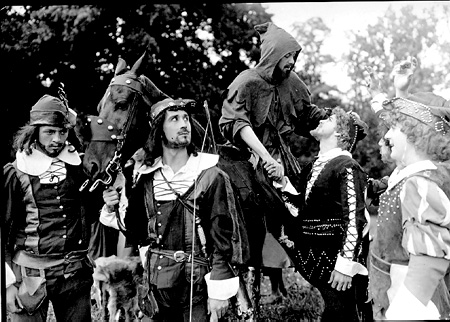
“The herd of deer are about the liveliest, most active deer that any one ever saw. They’re running through wild forest and glen that are about as real as anything the good Lord ever created. You see Robin and Maid Marian—in exceedingly becoming trunkhose—sneaking after them through the bushes with arrows fitted to their bows. You see them draw the bows—and shoot. See the deer on the ground, with the arrow sticking in him. There isn’t one particle of fake in the whole scene—it actually happens before your eyes. Then—take the attack upon the castle. There are the grim stone walls, with their narrow lance-windows. One minute, the windows are empty,—the next, each one is occupied by an archer who does some real and mighty pretty shooting. At one of the castle gates, there is a fight with quarter-staves and swords. You see the conical Norman helmets and mail shirts. You see the cloth and velvet caps of the foresters—the Lincoln green tights and jerkins. And all these real live people are not acting against a painted canvas background, with unmistakably fakey stage ‘props’ or accessories. They are in the real out-doors—a real Sherwood Forest—with real weapons in their hands. The whole play is a triumph of realism—an achievement which could not possibly be carried out within the confines of a regular theatre. To those who have loved the story of Robin Hood—who have read it in their childhood, and re-read it just before bedtime to their own children, it is a living, breathing Robin Hood and his Merry Men—visualized.”