1913Thanhouser CompanyOne reelDrama

Retribution

No copy you can watch online. No print is known to survive. What follows is what does: the release, the cast, the story, and what the trade press said at the time.

The story

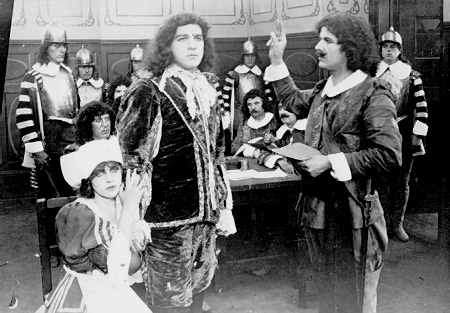
Although the young man was a prosperous storekeeper in a little country town, he was not contented with his lot in life, for his ambition was to be rich and to have a handsome home in the city. And when uncle died, his desire was gratified, for he was left a large fortune and a city home. The young man left the little town, but told his pretty fiancée that he would soon return to wed her and bring her to his handsome home. But when he arrived at the city and was launched in the gay social life, he soon began to feel that the little country belle would not make a fit wife for him, so he wrote to her, breaking the engagement and brutally telling her to seek ‘a husband in her own station in life.’ The girl was heartbroken for a while, but soon a manly farmer won her heart and made her forget that she had ever cared for her unworthy suitor. The rich man became engaged to a beautiful girl, very prominent socially, who professed to care very much for him. He made her many handsome presents and looked forward to the time when she would be his wife. But his dream was rudely dissipated when news was received that his trustee had lost his fortune in speculation, for his fiancée promptly cast him aside. None of his city friends cared for him, now that he was penniless, and he steadily sank in the social scale. Several years later, a tattered, weary tramp stopped at a little farmhouse to ask for food. The farmer’s wife, a pretty young woman, came to the door, and the tramp, in surprise and shame, recognized the girl whom he had once spurned. She did not recognize the natty storekeeper in the dirty vagrant, but gladly gave him food. As the tramp shuffled slowly down the road, he saw the young wife run joyously from the house to greet her husband. Happily they entered their home, and the tramp sadly continued his journey, realizing that if he had been loyal he would not now be a homeless wanderer.

Summary from The Moving Picture World · 19 April 1913
What the papers said

3 reviews · 1 advertisement

Very excellent. The theme of this story has, it is true, been done over in many different guises, but it must also be admitted that the Thanhouser director has succeeded in making this particular production intensely interesting.

The Moving Picture News · 19 April 1913

The country boy, who inherits a fortune, goes to the city. After six months there he writes a brutal note to his former sweetheart, breaking their engagement. She weds another, and her first lover loses his fortune and becomes a tramp. Good photography and artistic scenes help this along and altogether it is quite an interesting offering.

The Moving Picture World · 26 April 1913

More reviews

23 April 1913The New York Dramatic Mirror1 min

As a moral story, this picture answers in a large way its purpose—the acting, settings, and detail work are commendable. Yet the play does not realize its highest possibilities. One looks with little favor or sympathy upon this young fellow who heartlessly casts his sweetheart aside for the reason that his character appears weak from the outset. Wealth and dissipation will, in time, break down the moral and mental stamina of most men, but in the present case sufficient time, perhaps, has not been devoted to showing this gradual transition; the change in him is too sudden, with the result that one believes that he had the yellow streak in him from the first. And this impression the author, no doubt, did not intend to give. If the boy’s step had resulted partly from the influences of his associates and partly from his weakened will, the final climax—where he returns to behold the happiness that he threw away—would have been more pathetic and touching and the lesson would have been more lasting in the spectator’s mind.

Advertisement

19 April 1913The Moving Picture World1 min

It came large to the country man who, on a city success, cast over the village belle who was not up to his new, false city standards.

Have you seen this film, or a print of it?

Prints of films thought lost still turn up in attics, private collections and archives. A record like this one is how the next one gets found.

Tell us about a print

Cast and crew

Cast
Florence La Badie as the country girl
William Russell as the husband

Every name opens that person's page, with each film they appear in and which of them you can watch.

Watch instead

Films you can watch from the same company

Matched by cast, director and kind

More about this film

Bowers’ notes

Retribution was an exceedingly popular film title of the era, and among the releases so named were those of Defender (July 1910), Republic (January 1912), Powers (May 1912), Lubin (May 1913; a film which was sometimes confused with the Thanhouser release in the popular press), Solax (September 1913), Kalem (September 1913), Nestor (December 1913), Beauty (April 1914), and Selig (March 1915). The popularity of the word may have been derived from its connection with the aftermath of the Civil War; retribution denoted the settling of accounts and differences between the North and the South. Various tent shows titled Retribution, pertaining to the Civil War, toured American carnivals and fairs for about 20 years after 1895, until the World War in Europe created a new focus of attention for the public.

From Volume II: Filmography of Q. David Bowers’ Thanhouser Films: An Encyclopedia and History, reproduced with permission and unchanged. Read the history of 1913 →

Cite as: Bowers, Q. David. Thanhouser Films: An Encyclopedia and History, “Retribution”. thanhouser.org/films/retribution/

Where a print is held

Held by
No print known