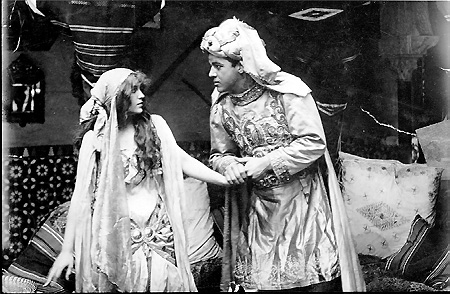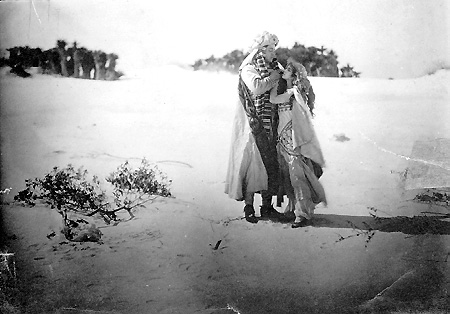
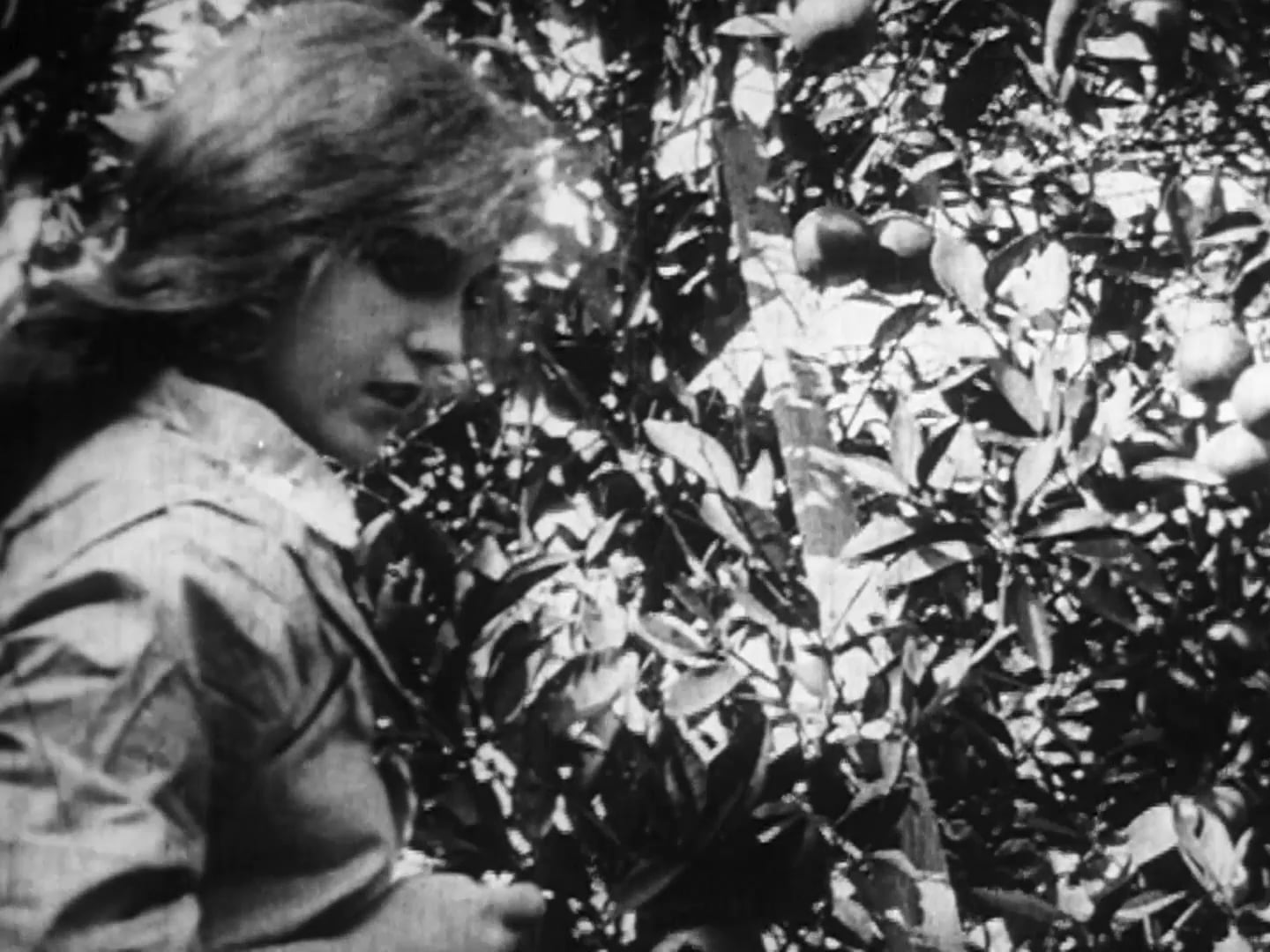
A frame from The Arab’s Bride. Production stills from St. Augustine, Florida. Courtesy of the Academy of Motion Picture Arts and Sciences.

1912Thanhouser CompanyOne reelRomance

The Arab’s Bride

No copy you can watch online. No print is known to survive. What follows is what does: the release, the cast, the story, and what the trade press said at the time.

The story

“A wealthy Moor had one treasure he failed to prize at its real value, his beautiful daughter. To him she was simply a woman, a source of expense while a child, and a treasure only if a rich suitor came along to whom she could practically be sold. In course of time the rich man did appear, and was enthusiastically greeted by the father. The daughter, however, had the temerity to say that she did not love the man. In fact her heart had been won by another, a young Arab sheik she had seen while in the market place. She knew little about him, but was convinced that he was far more worthy than the suitor her father had selected. The father was obdurate, however. He did not deign to argue with the girl, and simply commanded her to prepare for the ceremony, and with sighs and tears she did so. The girl had a faithful attendant, homely, but quick-witted and resourceful. The attendant proposed a plan which she thought had merit, for it could make three persons happy. And affairs came out as she had predicted. The father was happy because he got the money that had been promised him, the daughter and the sheik were pleased because they married, and the attendant was satisfied, for she won a rich husband, although having neither cash nor beauty. The only unhappy person was the rich suitor, but then he was wealthy, and riches bring their own consolation.”

Summary from The Moving Picture World · 24 February 1912
What the papers said

3 reviews · 1 article

“The Thanhouser Company selected one of the most difficult feats in stage production when endeavoring to present Orientalism and Oriental types in this photoplay, combined with a serious drama. The result is pleasing, and it is with difficulty that a writer can find words to express proper appreciation of the photographic effects and the scenical results. The view of the …

Read in full · 1 min

“The Thanhouser Company selected one of the most difficult feats in stage production when endeavoring to present Orientalism and Oriental types in this photoplay, combined with a serious drama. The result is pleasing, and it is with difficulty that a writer can find words to express proper appreciation of the photographic effects and the scenical results. The view of the city in the distance, evidently an effect in double printing or double exposure, is well worthy of praise. The interiors, the house exteriors, the properties and the costuming all call for favorable comment while the acting is a continuous series of excellent portrayals of a difficult line of parts. The story, simple, direct and forceful, tells how a rug weaver wins a girl from an Oriental nobleman and elopes with her to his desert home.”

Note: This review incorrectly places Arabia in the Orient.

The Morning Telegraph · 3 March 1912

“The backgrounds of this clever picture very strongly suggest Arabian desert lands near some Baghdad or a fabled city in the East. The action shows how the master rug weaver (Mr. Russell) fell in love with the vizier’s daughter (Miss LaBadie) who bought the rug, ‘work of his hands.’ In his carrying her away there is true old-time romance. Many of this picture’s scenes are extremely beautiful. It is a sure feature for almost any occasion.”

The Moving Picture World · 9 March 1912

More reviews

6 March 1912The New York Dramatic Mirror1 min

“The atmosphere of the East is admirably conveyed in this picture, both by backgrounds and action. Altogether it is an excellent example of Thanhouser versatility. The story also has elements of great dramatic strength. The Arab having woven a rug takes it to the city to sell. The daughter of a person of consequence, out shopping in true Oriental fashion, sees the Arab and the rug and buys the latter. He follows to her home and they have a secret meeting managed with all the romantic detail we have learned from the Arabian Nights to expect in such affairs. But the girl’s father sells her to the potentate and she is about to be delivered, when our Arab appears and gallantly fights his way until he rescues her and bears her off to his desert home. The picture is a model of its kind. Flo LaBadie played the bride with excellent romantic fervor, and William Russell was a commanding Arab. James Cruze was the father and Joseph Graybill the buyer of the girl.”

Article

24 February 1912The Moving Picture World1 min

“The Thanhouser factory at New Rochelle is working overtime on the first Florida negative to be issued, The Arab’s Bride, releasing Friday, March 1. Some ‘peachy’ photographic effects are reported by the darkroom men and it is patent that the New Rochelle firm is ushering in its Florida subjects with a strong opening attraction. New Rochelle, of course, says that all the Florida pictures will be up to the standard of this first one....”

Have you seen this film, or a print of it?

Prints of films thought lost still turn up in attics, private collections and archives. A record like this one is how the next one gets found.

Tell us about a print

Cast and crew

Cast
Florence La Badie as the rich Moor’s daughter
James Cruze as the wealthy Moor
Joseph Graybill as buyer of the daughter
William Russell as the young Arab sheik [rug weaver in some reviews]
Photographed by
Alfred H. Moses, Jr.

Every name opens that person's page, with each film they appear in and which of them you can watch.

Watch instead

Films you can watch from the same company

Matched by cast, director and kind

More about this film

Filmed in
Filmed on the beach at St. Augustine, Florida by Thanhouser’s Southern Company, and billed as “the first Florida feature.”
Posters and media
Still for The Arab’s Bride. Production stills from St. Augustine, Florida. Courtesy of the Academy of Motion Picture Arts and Sciences.Still for The Arab’s Bride. Production stills from St. Augustine, Florida. Courtesy of the Academy of Motion Picture Arts and Sciences.

From Volume II: Filmography of Q. David Bowers’ Thanhouser Films: An Encyclopedia and History, reproduced with permission and unchanged. Read the history of 1912 →

Cite as: Bowers, Q. David. Thanhouser Films: An Encyclopedia and History, “The Arab’s Bride”. thanhouser.org/films/the-arab-s-bride/

Where a print is held

Held by
No print known