The story
“A rich old man owned an estate in the Adirondacks, where he spent most of his time. Having nothing of real importance to occupy his time, he devoted all his energies to hunting down poachers who would sometimes stealthily visit his estate. The theft of a rabbit would drive the old man into a frightful rage, while for an outsider to kill a deer he regarded on the plane of high treason. Therefore, it was with feelings of great joy that he greeted two keepers who had captured a man shooting game on the magnate’s estate. The rich man was a magistrate, partially because he enjoyed sending persons to jail, and in this particular case he signed the commitment papers with great personal satisfaction. It was a flimsy old country jail, and the prisoner managed to break out. Then he started through the woods, hoping to keep out of the way of his enemy.
“There was only one person the magnate really loved, his little grandson. The boy had been present when the poacher had been arraigned, and had expressed sympathy for him. This child was accustomed to having his own way, and impressed by what he had heard, decided to be a poacher himself. With his sturdy toy gun, he started out for an expedition in the woods all alone. He was lost, but finally found refuge in a cabin, where he sank exhausted, unable to go further. There was no one in the shack to help him, as it was deserted and falling into decay, and the child would undoubtedly have perished of the cold had it not been for the arrival of the fugitive poacher. The man was in a quandary. If he left the boy, the child would certainly perish from exposure. He needed care and medicine, and needed it at once. The nearest place of refuge was the home of the magnate, but to take him there meant that the poacher would be recaptured. In fact, his only chance to escape was to cover the greatest possible amount of ground in the shortest possible space of time.
“It was a choice of liberty or humanity, and the poacher decided to sacrifice himself for the boy. He carried him through the woods, intending to leave him at the door of his home, and then escape if possible, but he was pounced upon and captured just as he wearily toiled up the steps with his burden. The keepers triumphantly produced him before the magnate and waited for words of praise, but the boy revived in time to make it clear that he owed his life to the man who was fleeing from the law. The magnate marked ‘Complaint Dismissed’ across the warrant, in the case where he was both accuser and judge, and told the prisoner that he would see that he had a fair chance to succeed in life. ‘And I never thought I would place a poacher at the top of my list of friends,’ he added, ‘but I have.’”
Summary from The Moving Picture News · 2 March 1912
Another synopsis, from The Morning Telegraph · 3 March 19121 min
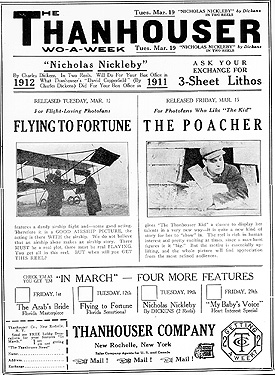
“The poacher is taken up by the Thanhouser producers in a story of the Adirondacks issued Friday, March 15. It is called The Poacher and it is not all tragedy, as some might suspect, but solely a human interest story that is very pretty and very comforting right through, and that is mainly light and sunshine. The particular poacher wasn’t a half bad fellow at all, and was largely driven to his deed by hard circumstances; unfortunately he was apprehended on the estate of a man who was the borough magistrate—and a hard one. He immediately consigned the poacher to jail. The place was flimsily constructed, as country jails are, and the poacher succeeded in getting out. Fleeing, he finds a hut, and in it a little boy who is dying, almost, from the cold. The fugitive wraps the child in his own tattered coat and thereby saves his life. And learning that the boy is the stern magistrate’s son, our poacher even ventures to carry him to his father’s [sic; synopsis suggests grandfather’s] door. The reader may guess the rest—how the magistrate did not decide to send the poacher to a stronger jail, but, rather, gave him help and saved him from the commission of further transgressions.”