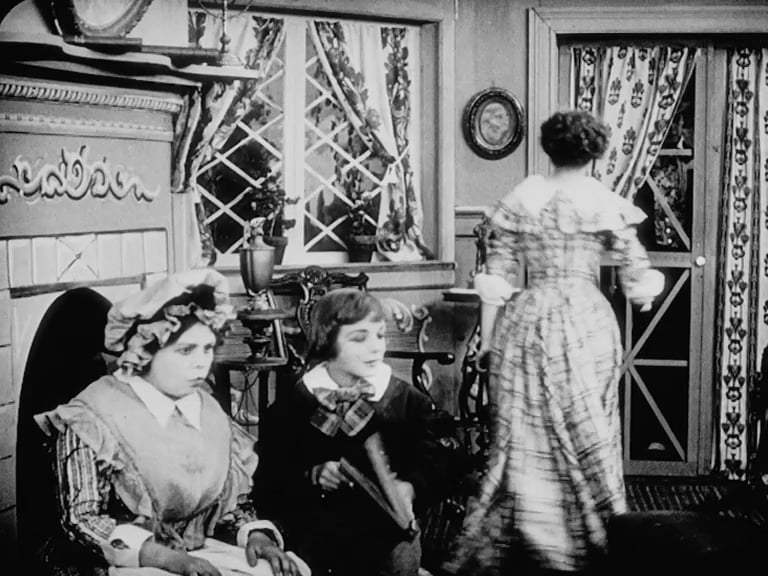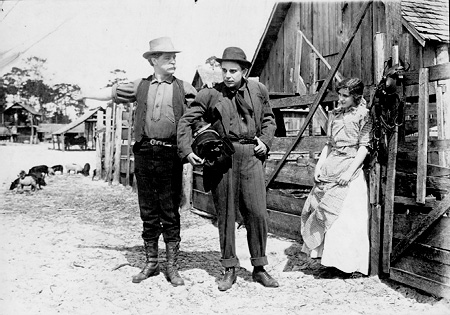
A frame from Whom God Hath Joined. Production still with James Cruze (center) and Marguerite Snow (right).

1912Thanhouser CompanyOne reelDrama

Whom God Hath Joined

No copy you can watch online. No print is known to survive. What follows is what does: the release, the cast, the story, and what the trade press said at the time.

The story

“A young mechanic, temporarily residing in a Southern city, found that business was slack in his trade, and decided to send his wife to a relative’s in the North until happier days dawned. He did not dream that he was putting her in peril, and when he later received word that the ship upon which she sailed had been lost with all on board, he was frantic with grief and self-reproach. Life in the city became hateful to him, and having no ties that bound him here, he abruptly departed into the country, deciding to wander wherever fate might lead him. He found that after a period of sorrow and suffering, he met a kindly old farmer, who offered him a job, and soon grew to absolutely trust him. His employer had a daughter, and as time passed on, the girl showed him favor, while the farmer made it manifest that he would be only too glad to trust the future of his child in the hands of one who but a short time before been a stranger. The young man did not love the girl as he had loved his wife; but he was very fond of her, and had almost a filial affection for her father, and gradually, as time dulled his anguish, he became convinced that his happiness depended upon a second marriage. So he proposed, was accepted, and the course of true love seemed to be running very smoothly.

“In the meantime, the wife was slowly regaining her strength. She had not met death in the wreck, but was the one survivor, having been found nearly dead, by some fishermen, who had discovered the broken fragments of the ship. When able to sit up, her memory was gone, and it was not until many weary months had passed that she was able to remember who she was, what had happened. By this time the husband had vanished, and the poor, weak woman found it impossible to trace him. She kept up the search, however, and finally by chance located him, reading the paper of his approaching marriage. The wife reached the house on the day set for the ceremony. There she met her rival, arrayed in a wedding gown, and told her who she was. The untutored country girl, in her first moment of anguish, denied the man of her choice was the husband of the other woman, and fiercely ordered her away. In terror of her life, the wife departed, and the country girl followed her to the porch of the house, and grimly watched her as she staggered off. She saw her attempt to cross the railroad tracks, slip and fall, striking her head on the tracks and lying there unconscious. At the same moment the watcher heard the whistle of the approaching train, and knew that if she refused aid, the obstacle that might prevent her marriage to the man she loved would be removed. First she watched her grimly, determined that she should die. The train was coming on rapidly, but the woman’s thoughts traveled far more swiftly. She hated her rival bitterly, but she could not let her die. In the end she dragged her from the tracks, restored her to her husband, and tearfully watched the couple as they departed from her life, happy after their long period of suffering. The girl remained at the farmhouse, and during the long, lonely years that followed she frequently wondered whether she had done the right thing in sacrificing her happiness. ‘Is love worth a crime?’ she mused, and somehow she could never answer the question to her satisfaction.”

Summary from The Moving Picture World · 25 May 1912
What the papers said

3 reviews · 1 advertisement

“Directors and players may well take an extra trip to the nearest Independent picture theatre where this may be shown, for its detail is so creditably carried out that it reflects the highest credit upon the makers. The manner of inserting the letter with just the last sentence showing is logical and natural instead of the usual tawdry way of …

Read in full · 2 min

“Directors and players may well take an extra trip to the nearest Independent picture theatre where this may be shown, for its detail is so creditably carried out that it reflects the highest credit upon the makers. The manner of inserting the letter with just the last sentence showing is logical and natural instead of the usual tawdry way of showing a childishly brief note written in a Spenserian sort of child script. Also the insertion of the envelope when being sent, and later when being returned and marked ‘Not Found,’ deserves mention. The story while not new in plot is played in such new environs that it can be accepted as a welcome offering. A wife goes on a journey, and the river steamer she takes is reported as having been sunk, with all on board lost. Her husband leaves his home and retires to the backwoods, where he settles in a turpentine forest. At the farmhouse he meets the daughter of the owner, and the pair fall in love, and soon their engagement is announced in a local paper. The wife had meantime been rescued by a fisherman and taken to his home, where, after a lapse of time, her memory had returned, the shock having dulled all recollections of her past. Recalling her husband and home, she writes to him, but the letter is returned by the post office, his whereabouts not being known. Then in the local paper she reads of his engagement and wanders on until she finds the farm. There she meets the girl, who in anger drives her from the house. Blindly the wife staggers forth, tottering along a railroad track, where she swoons as a train is seen approaching. The girl sees her fall, rushes to her and drags her from the rails as the train passes. The husband, returning to the house in the carriage which was to take him and his bride to the nearest church, meets his wife, takes her to his arms and the wedding is forgotten. They drive off, leaving the heartbroken girl at the gate, where she slowly tears up her bridal veil, dramatically, but with no false heroics to mar the action. It is splendidly acted throughout, and the story is told with a smoothness that is most praiseworthy.”

The Morning Telegraph · 2 June 1912

“Miss Snow and Mr. Cruze play the leads in this picture well supported by Miss LaBadie and others of the Thanhouser company that was in Florida this winter. The picture tells a good, substantial story on lowly scenes and backgrounds. These are well set on scenes to be typical and aid the story with suggestive atmosphere; but the producer hasn’t …

Read in full · 1 min

“Miss Snow and Mr. Cruze play the leads in this picture well supported by Miss LaBadie and others of the Thanhouser company that was in Florida this winter. The picture tells a good, substantial story on lowly scenes and backgrounds. These are well set on scenes to be typical and aid the story with suggestive atmosphere; but the producer hasn’t depended upon any beauty except what the human situation afforded; he didn’t need to. The situation is this: The wife of a young man is on a steamboat that is wrecked. She is saved; but her husband doesn’t know it. Her husband in his sorrow has left the village and she can’t find him. She sees in a newspaper that the supposed widower is to be married again and comes in time to stop the wedding after a dramatic episode. It is a picture to thrill and make one hold his breath; yet also to satisfy the artistic feelings, because it is so well acted and so skillfully drawn. The camera work is very good. It is a very desirable picture.”

The Moving Picture World · 15 June 1912

More reviews

5 June 1912The New York Dramatic Mirror1 min

“This photoplay is well acted and contains several genuinely thrilling situations. The wife of a laborer leaves on a ship for an extended trip. Shortly after her departure he learns that the boat on which she is a passenger has gone down with all on board. Believing her to be dead, he abandons their cottage and goes back to the country, where he obtains a position as foreman of a turpentine still. The owner of the still is the father of a charming daughter, with whom the widower soon becomes very friendly. The wife in the meantime has been picked up from the sea by a fisherman and has been taken to his lodge. From there she writes a letter to her husband, but it is returned unclaimed. In glancing through a paper one day she comes upon an item announcing her husband’s marriage on the following day to the daughter of the still owner. In desperation she hurries to the village in which the event is to take place, arriving just in time to intercept the bride, as the latter is awaiting the groom’s carriage. The bride declines to give the wife’s assertions any credence, and the frenzied woman, preferring death to the thought of her husband’s union to another, hurls herself on the rails in front of an onrushing express. From this horrible end she is rescued by the young bride, who cancels all claims on the husband. The play ends in a very conventional manner. James Cruze’s portrayal of the husband is reasonably consistent, weakening only in the last situation, when he fails to make it clear whether he is pleased or displeased over the appearance of his wife.”

Advertisement

25 May 1912The Moving Picture World1 min

“Here is the simplest story in the world, but it will set many, many people thinking. In that it is a Higher Motion Picture. It creates thought, study. They are happily wed when she goes aboard a boat that is lost at sea. He, lonely, contemplates a second marriage. The wife-to-be loves him much. And then the wife who was lost, but really wasn’t, returns, and you get food for thought aplenty.”

Have you seen this film, or a print of it?

Prints of films thought lost still turn up in attics, private collections and archives. A record like this one is how the next one gets found.

Tell us about a print

Cast and crew

James Cruze as the husband
Marguerite Snow as the wife
Photographed by
Alfred H. Moses, Jr.

Every name opens that person's page, with each film they appear in and which of them you can watch.

Watch instead

Films you can watch from the same company

Matched by cast, director and kind

More about this film

Filmed in
Florida
Posters and media
Still for Whom God Hath Joined. Production still with James Cruze (center) and Marguerite Snow (right).

From Volume II: Filmography of Q. David Bowers’ Thanhouser Films: An Encyclopedia and History, reproduced with permission and unchanged. Read the history of 1912 →

Cite as: Bowers, Q. David. Thanhouser Films: An Encyclopedia and History, “Whom God Hath Joined”. thanhouser.org/films/whom-god-hath-joined/

Where a print is held

Held by
No print known