“As a whole: pleasing; story: pathetic; star: virile; support: good; settings: adequate; photography: clear.
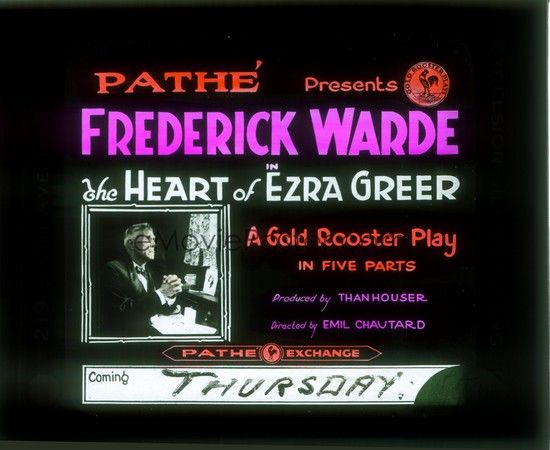
“The Heart of Ezra Greer, written by Lloyd Lonergan, is a fairly pleasing film with Frederick Warde in the role of a faithful old man servant. Warde is a past master of expression, and with stronger vehicles in which he could show his worth, would soon be a factor in filmdom. In the present instance he is given no opportunity. The part is small and he is surrounded by mediocre players with the exceptions of the two Badgley children. The subtitling is weak; there is little suspense and the obvious play for heart appeal. The direction was in the hands of Emile Chautard, and aside from considerable padding in the first reel, was capably handled throughout.
“The story: Greer, a kindly old servant, has saved and stinted to put his motherless daughter through college. She falls in love with a wealthy fellow student and elopes with him, believing he means to make her his wife. When disillusionment comes she is ashamed to return to her father and supports herself and child by sewing. In the meantime the father enters the young man’s employ as valet, and when the millionaire’s child is left at the house, he persuades the man of wealth to save the baby from the foundling home. The young man has fallen in love with a ‘baby vampire,’ but the advent of the child fills his soul with remorse and he quits ‘the vampire.’ While out with its nurse the child is injured in an auto accident and taken to the hospital. Here, Mary, who has become a nurse, meets her father and the man who wronged her. Greer attempts to kill Jack but realizing his repentance is sincere, allows a proper marriage.”
REVIEW by Charles E. Wagner, Exhibitor’s Trade Review, October 13, 1917:
“The heart interest found in this story together with the capable characterizations by the principals in the cast makes this production an acceptable attraction for the Pathé program. The appeal in the story lies in the fact that it is true to life. The play carries a moral that is interesting and forcibly told. It is a slightly new handling of the old situation, that is, the girl who is wronged and the return of the husband through the unnamed child. It is told plainly and interestingly without any recourse to the sensational. The direction is worthy of the highest praise, and the photography is above the very best. One point that should be criticized is the realism surrounding the accident to the baby. From all appearances it seems that the real child had been left in the coach. The baby coach can be plainly seen after being struck by the auto to reel on one end, plunging the baby to the street. If this child of four had been placed in such a precarious predicament, it might cause a stir in the ranks of the children’s society. Aside from the fact of placing a child in danger, the effect upon the audience will be noticeable. It will at least cause a shudder and might stir up a little comment.
“The cast is indeed commendable. Frederick Warde is supplied with a vehicle that is somewhat better than he has appeared in for some time. He offers, like he always does, a careful and pleasing interpretation of the role of Ezra Greer and surrounds the the character with a heart appeal that only he can. Aside from his acting abilities, his screen presence is such as to fill the bill entirely. Leila Frost, as the daughter, offers another clever character portrayal. While her part fails to call for any strong emotions, still what is to be done is accomplished with ease. Her work is consistent throughout. George Forth, as the young Denbeigh, and Lillian Mueller, as Amy, add the finishing touch to an already very satisfactory cast. The Heart of Ezra Greer is a satisfying offering for community theatres. It has a fair amount of action and contains enough pathos to add to the value of the play. It is free from all sexy suggestiveness and will, without a doubt, prove a strong attraction for the Pathé program.
“Balance of the program: A good two-reel comedy together with a newsreel or one-reel educational would be most appropriate. Musical suggestion: See cue sheet supplied by manufacturer for this feature.”
REVIEW by Frances Agnew, The Morning Telegraph, September 30, 1917:
“The Heart of Ezra Greer offers the type of story that has a sentimental appeal for the average spectator. It unfolds a romantic tale that is neither strikingly original in plot nor developed with any considerable amount of suspense, but it holds enough human interest in its characters and situations to make it worthwhile screen entertainment. While it doesn’t give Frederick Warde or any of the other characters exceptional opportunities, his is a sympathetic role whose influence exerts itself throughout.
“The story chiefly concerns Ezra Greer, employed as a valet, and his daughter Mary, who is lost to him by the dastardly neglect of a wealthy young college mate, John Denbeigh, who forgets his promise to marry her and becomes enamored of a ‘baby vampire’ of the stage. After failing to find his daughter Greer, unaware of Denbeigh’s identity, is employed by him. Later, when her baby is two years old, Mary reads of Denbeigh’s engagement and, going to his home, she leaves the little boy and a note to demand that he care for him. Denbeigh at first refuses, but Ezra intuitively understands and tells him it is his duty. He also convinces the ‘baby vamp’ that she is playing a losing game. Later the baby is hurt and at the hospital, where May is discovered as a nurse, all are reconciled and restored to happiness. The high life flashes give opportunities for many rather lively scenes, all lavishly staged. Technically the production is excellent in every detail. Frederick Warde contributes another quietly effective character portrayal. Leila Frost, a very pretty and clever ingenue, appears to good advantage as Mary and the rest of the cast are capable, not forgetting the Badgley kiddies in particular. Ezra’s adoption of the orphan adds nothing to the story, but little Helen in the role makes it an incident to be remembered and also gives an excuse for several slangy sub-titles. The title and cast of this feature will make it a good program drawing card.”