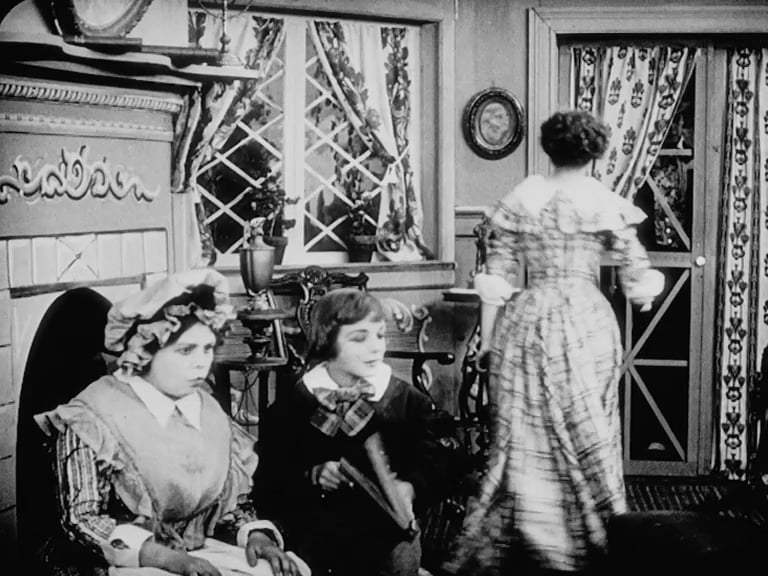
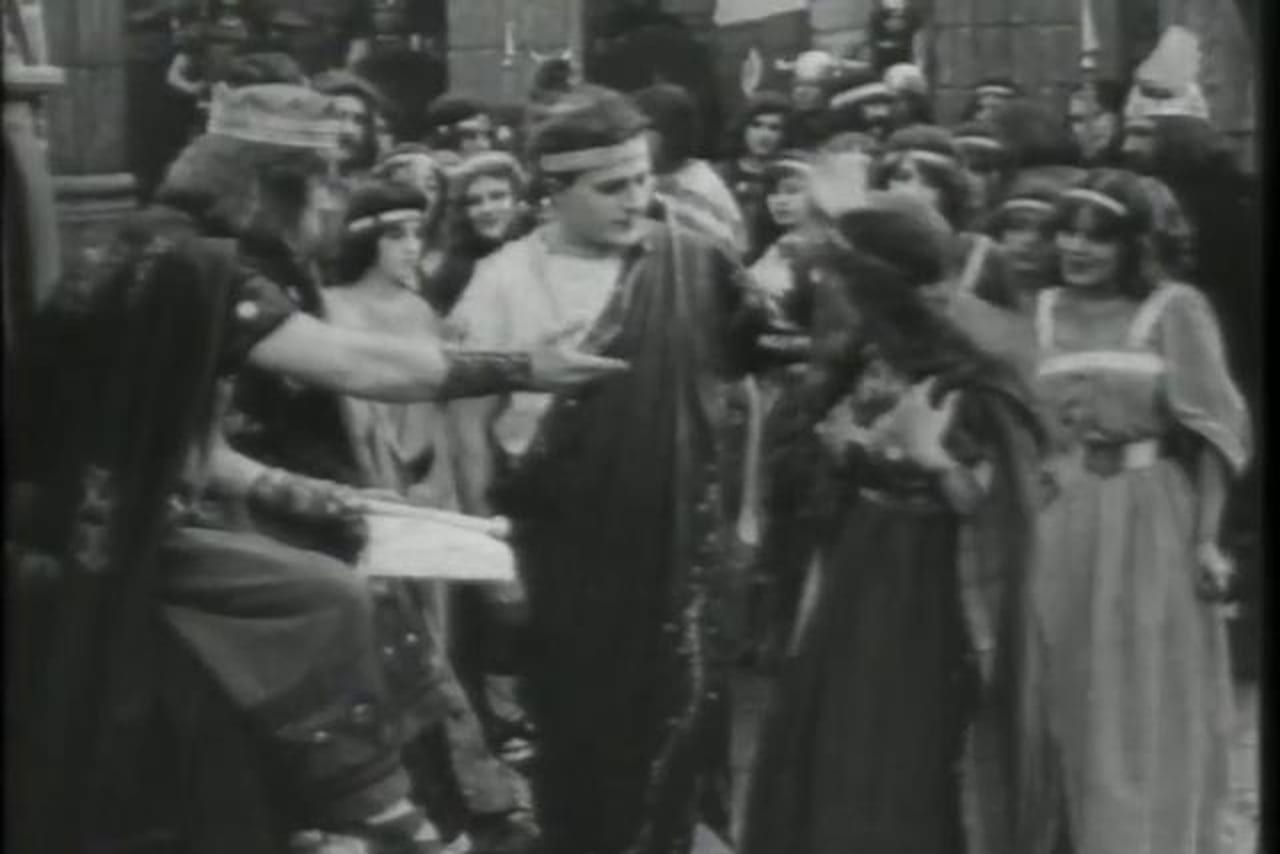
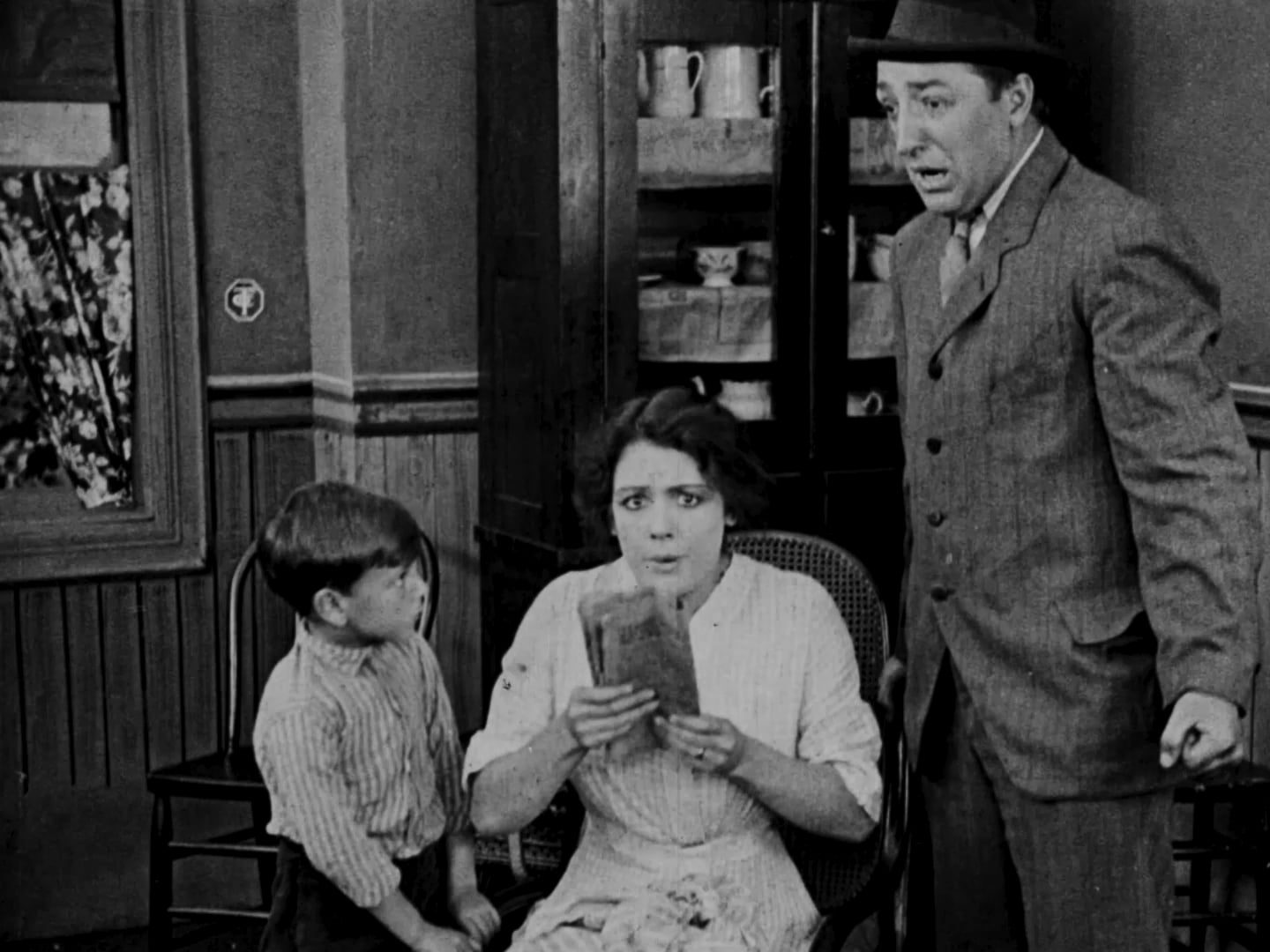
“A masterpiece. Charles Reade’s novel by this title and from which the film story was taken is too well known to require repeating here. The chief characters of the story are splendidly interpreted by the Thanhouser players. The Thanhouser Company has certainly done itself proud in this production. The scene when Henry Little is at work in his forge, secreted in the old deserted church, is something to be remembered.”
REVIEW by Louis Reeves Harrison, The Moving Picture World, October 19, 1912:
“The Thanhouser productions are growing more interesting because of the progressive spirit that is plainly perceived by those who look beyond the screen into the studio and its methods and into the directive minds and selective taste evinced in what is materialized from an author’s ideals. No one in the business is better aware than Mr. Thanhouser himself that there is a certain amount of convention in all drama, that pictorial representation on the stage is necessarily artificial, that painted scenery and footlights make realism in the legitimate performance theoretically impossible, yet no one has been quicker to recognize that moving pictures offer opportunity such as the artist enjoys of getting out into the light of day, into an entirely new and clear atmosphere of artistic influence, where it is possible to reduce visual convention to a minimum and make it a source of half-conscious delight. It is rather remarkable that a man long trained in the tradition of the stage should be divesting himself of its tawdry old trappings at the very moment so many are engaged in trying to vest the old fundamental conventions with the jarring inconsistencies of modern interpretation. Here is a man who has been in show business long enough to settle down in the well-known rut of artificiality, yet who is in the front rank of those who realize that there is a pictorial phase as well as a dramatic one in the New Art. The trend of his production is to make each scene a veritable picture by itself, with instinctive attention to composition, placing and balance.
“The non-critical spectator in front is suffused with an undefined pleasure when the best of the Thanhouser photodramas are flashed on the screen for a reason—love of the beautiful is so universal, even among those of humble circumstances, that the ability to sense a picture might be called common property. Aiming always toward finer presentation of a subject at hand, it seems to me that we may look to Mr. Thanhouser for some splendid achievements when he takes hold of photodramas of modern construction and purpose, for he is engaged in the most difficult branch of the art, that of making old lamps shine like modern electric illumination. He has been preserving standard plays and illustrating works of fiction that were not intended for all ages. The convenience of this method alone recommends it. The characters are accurately delineated in print, the scenes well described by the author, and only a few alterations in construction are really necessary, difficult as they may be in some instances. The delicacy shown in his selection of types, the care exhibited in costuming, pains taken to choose appropriate settings, these all lead to a masterly quality of production, but are greatly nullified in attempts to vitalize works of fiction written under other conditions than those existing today, because frequent use is required of that most disturbing of all anachronisms, the explanatory subtitle.
“Like many another scenario writer I have found it easy to set forth a play without an explanatory, and therefore disturbing subtitle from beginning to end, injecting a few to cover lapses of time or to sharpen a certain point to be made to its keenest edge. We have found that the most delicate character analysis can be made without such aid, and it becomes a matter of pride for the self-respecting photodramatist to so manipulate his material that the audience will not be required to wrestle with it mentally. The difference is that between the masterly painting that speaks for itself and a picture in which the characters are represented by a bubble of information projecting from their mouths. The grand problem of the photoplaywright is to indicate such characterizations as permit the people in the story to lay bare the inmost workings of their mind in preparation of the action to follow and during that action.
“The two most attractive characters in Put Yourself in His Place are Grace Carden and Jael Dence. They are such interesting personalities in the work of fiction and so equally interesting in the photoplay that criticism is somewhat disarmed in the latter instance, but my own idea as an impressionist is that they should have been shown in sharper contrast, the author intending to present one as the result of superior culture and the other a country maiden of rare physical charm, their gentle rivalry in love being that of refined intelligence as opposed to innocent simplicity.... There is really no complaint to be made of any of these performers—they all act well up to their opportunities, while it is a genuine source of delight to watch Miss Snow and Miss Drew every moment they are to be seen. The interior settings are as correct as those we have come to expect in Thanhouser productions, and the extras are beyond improvement from our present standard of comparison.
“The story itself largely concerns the love of Henry Little for Grace Carden and its reciprocal sentiment, with the time honored interference of those who attempt to arrange the affairs of Cupid to suit social exigencies. There is a complexity of kinship involved—Edith Raby has married a man beneath her station and lost her husband at a time her brother might have helped her, and she accuses the Squire of being the direct cause of her widowhood—this presents us with a hero in Henry Little of noble descent and far more noble character. And there is an incidental clash between Henry Little as a skilled workman, carver of wood and a forger of steel tools, the thick-headed members of a union; then the fate of the principal characters hinges on such a trivial incident that the plot seems to depend on the element of chance. The real motif is the triumph of a thoroughly modern and efficient young man when he is at first opposed to a low environment of inefficiency among fellow workmen and when he is afterwards opposed by the equally inefficient leisure class from which he is descended. Henry Little is the type of young man highly honored in America, the one who is tried out and proves his innate quality. He is supporting his mother, because she refuses to permit any relations with her wealthy and aristocratic brother, Squire Raby, when Grace Carden engages him to instruct her in the art of woodcarving. Grace is the godchild of Squire Raby, and the Squire favors the suit of a pleasing gentleman of leisure named Coventry. Henry has succeeded in reaching the sympathetic interest of Grace and has established an independent forge in a deserted church on the domain of Squire Raby. When he becomes sick with jealousy over the interposition of a man he knows to be of no value to himself or to the world. As it is not possible for him to earn his living where organized labor has become organized persecution he has been compelled to pursue his work in secret, and he is aided in this by his former employer.
“The church is long deserted by reason of a shifting population and is on the road to decay, is not a ruin. It has been protected from complete destruction by Squire Raby, but it is so far out of the way as to be rarely visited by curious tourists. Into this romantic setting are projected a forge, anvil, bellows, tools and lathes of steel, and amid these solemn surroundings the young mechanic pursues his vocation, the strange flares of light within it at night awakening uncomfortable suspicions among the nearest night watchers, some shepherds on neighboring hills. After discovering that the pretensions of Coventry are dangerous ones, Henry loses heart and tries to work away the misery from which he suffers, spending nearly all of his time, night and day, in a feverish attempt to conquer unfavorable circumstances by determination and unremitting labor. One day, when Coventry and Grace are exploring the neighborhood of the church, they are overtaken by a storm. They become exhausted in a vain struggle to reach shelter and are on the verge of collapse when they note a light in the windows of the deserted church. They make a last desperate attempt and succeed in reaching the church door. Henry takes them into his peculiar workshop and revives them. After explaining the strange necessity which forced him to pursue his honorable calling in such a place, he extracts an oath of secrecy from both, and in due time they rejoin their friends.
“From all accounts it seems about as easy for an English gentleman to turn villain as it is for a New York politician to turn crook. Grace keeps her word, but Coventry has seen enough to excite his jealousy and he visits a resort of factory workmen with the news. He leads them to the deserted church, they break in and a desperate fight ensues. Henry using his tools and hot cinders as weapons until he is nearly overpowered. Squire Raby arrives and effects a rescue only to find that the young workman is his own nephew. Henry is now in business for himself, with a factory of his own, but the villain’s villainies grow more and more villainous. Henry’s factory is blown up at a time when he supposed to be within it, although he is in reality on his way to America. Grace mourns him as dead for a while, but finally consents to marry Coventry. The number of ladies who have nearly married villains is only exceeded by those who really have. Coventry has succeeded in intercepting all communications from Henry except the very last one, a telegram received on the eve of her marriage. Now Miss Sweet Simplicity, in Jael Dence, no longer deserving her name, gets her pretty fingers on the dispatch and reaches Grace with happy consequences better shown in the picture than I can describe them. While adaptations do not compare with original plays and live interest, I give great credit to those who succeed in condensing and making of interest these nearly-forgotten works of fiction.”