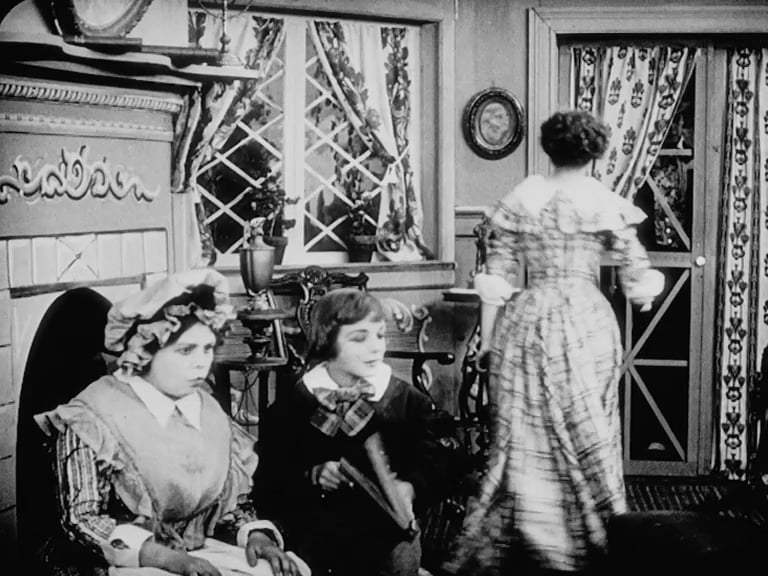
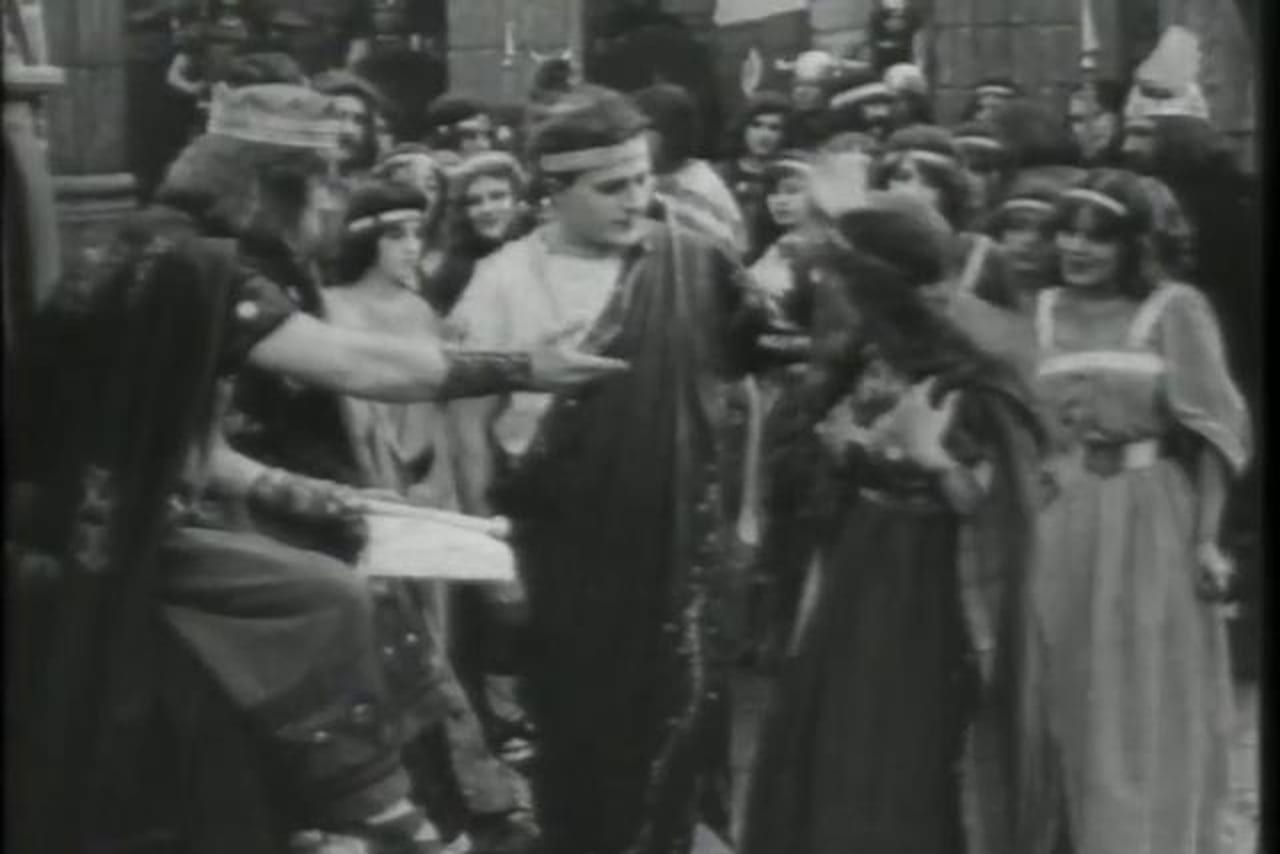
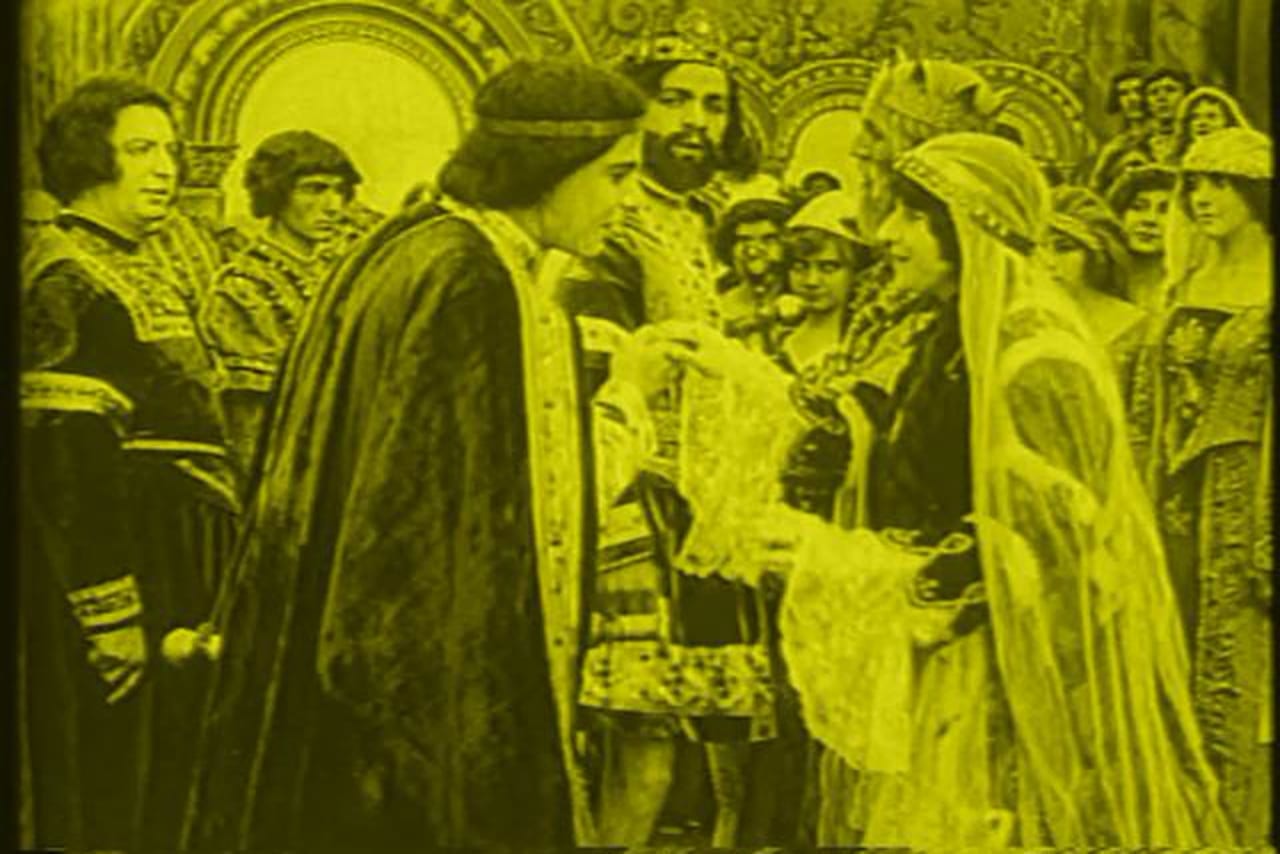
“Owen Meredith’s world-known poem of Lucille [sic] is treated in a wholly delightful way in this photoplay production. The story is so well known that its repetition is needless. The theme of the poem is followed as closely as possible and there is little left to the imagination, for the plot is easily followed from beginning to end. In costumes, scenes, both interior and out of doors, it is exceedingly well made. It is splendidly acted and the photography is as clear and sharp as could be desired. Little bits of stage business are carefully done, as in the writing of a letter, which is folded and sealed as was done in the days before the invention of the envelope. An exterior, beautiful and appropriate, shows a door which is closed after the people exit or enter, though the interior scene, supposedly from the inside of this doorway, shows a French windowed entrance open all of the time. Few, however, might note such a slight discrepancy. In the cast of the three reel offering are Marguerite Snow as Lucille, James Cruze as Lord Alfred, Flo LaBadie as Matilda, William Russell as the Duke, William Garwood as Richard and Mignon Anderson as the niece. For a feature production it reflects the highest credit on the makers, the director and the players. It will be enjoyed wherever shown.”
REVIEW by Margaret I. MacDonald, The Moving Picture News, August 17, 1912:
“Of the recent pretentious productions attempted by the Thanhouser company, the one of Owen Meredith’s story of Lucile, is, in the writer’s mind, the best and most flawless in general contour. The story of Lucile lends itself beautifully to the motion picture production. It has all that appeals to the human heart—tense dramatic situations, sweetness and simplicity, and an old-fashioned atmosphere about it that suggests quaint old engravings that have been stowed away in the attic for generations. Although the story of Lucile is thoroughly familiar to the bookworm, there may be some among our readers who cannot answer to that name, and for their benefit it might be well to give a brief outline of the story. It is also interesting to know that Owen Meredith, the writer of Lucile, was a son of the famous Bulwer-Lytton, and that, being unwilling to learn his laurels through the reflection of the literary genius of his ancestor, was known only as Owen Meredith until such time as he won fame through the success of Lucile... Much credit is reflected in this production on the work of all the participants, but perhaps more particularly upon Miss Snow, whose work is exceptionally fine. Miss Anderson is refreshingly sweet, and Miss LaBadie is always charming.”
REVIEW by Louis Reeves Harrison, The Moving Picture World, August 24, 1912:
“There are many delightful surprises in this beautiful play, but the last reel captures us with an unexpected movement when we are completely off our guard. The spirited scenes there depicted fall upon and suddenly imprison us by a ‘tour de force’ that is a splendid example of military action. Such soldiers in what has all the appearance of actual warfare! Such magnificent horses in the cavalry maneuvers, dashing into the thick of fight without swerving from the bomb explosions! It does not seem to be a moving picture of prearranged military strategy, but a view of the real thing. It is battle. The play is lovingly adapted from a narrative poem published a half century ago by the Earl of Lytton, ‘Owen Meredith,’ and is a veritable restoration. So far as I am concerned the distinguished author has always seemed overshadowed by a still more distinguished father, and the noted Bulwer-Lytton, but Lucile shines forth as the gem of his early conceptions. Its restoration to the modern world in pictured form by Thanhouser is so delicate in finish and complete in detail that I dare say that the work was a labor of love. The increasing political power and intelligence of those who frequent the moving picture theatres has been so often manifested during my recent observations that I am constrained to believe most people know and care a great deal about the quality of presentation, and, if there still remain a number who do not know or care, it is part of the exhibitor’s responsibility to educate the lower element while catering to the best class of patrons who attend the picture shows.
“Here is the story of a woman’s sweet unselfishness and noble magnanimity—the theme entirely modern—which represents characters of good red blood and questions of moment, amid highly picturesque views of other times and customs than our own, and it is superior to small, silly and temporary aspects of life as we know it. It has a dainty flavor of old-time romance pervading its manners, costumes and settings that is like a whiff of perfume from an old jar of rose leaves. It will please millions who enjoy any form of entertainment that appeals to good taste and enjoy it in a quiet and refined way, the ones who can afford to come often, who keep aloof because of vapid and spineless productions of commercialism pure and simple.
“The types are all well chosen; the acting of the principals is so consistent that the picture should please in France and England quite as well as at home, the actress who portrays the title role being especially strong in emotional situations. The cast in Part One is as follows: Lucile—Marguerite Snow, Lord Alfred—James Cruze, Matilda—Flo LaBadie, Duc de Luvois—William Russell. Lord Alfred receives a letter from Lucille stating that she has heard that he is to marry Matilda, a young heiress known as Miss Darcy, and that it is time for them to return certain love letters exchanged before they ‘parted as friends, soon mere strangers to grow.’ Each had made a pledge at this parting to return to the other the pictures and letters given before the quarrel that parted them. Lucile is at Luchon, one of the most beautiful sights in the Pyrenees, and there Lord Alfred rides to restore the pledges of love. The exterior where he meets her in the midst of adoring friends and is presented to her suitor, Monsieur le Duc de Luvois, is one of rare beauty in itself and gives a sweeping glimpse of distant mountains that is very attractive. It cannot, however, give more than a faint indication of what is in the heart of the woman—the poet, only, can do that—and more is the pity, Lord Alfred is manly enough as such men go, but is incapable of appreciating that a woman’s beauty is more than skin deep, that her form is the stem and her face the flower of the soul—the soul that may fade is sorrow, yet bloom again and again in ever-renewed loveliness. He symbolizes unenlightened MAN. She is inscribed by ‘George [sic] Meredith’ as one of a type now becoming familiar, a woman whose high intellectuality and lofty aspirations accentuate her endowment of natural beauty, the one who usually loves most and suffers deepest, the one who learns another’s woe and hides the pain she feels.
“To shelter her heart
From approach, she then sought in that delicate art
Of concealment, those thousand adroit strategies
Of feminine wit, which repel while they please
A weapon, at once, and a shield to conceal
And defend all that woman can earnestly feel.
“Had her life been but blended
With some man’s whose heart had her own comprehended
All its wealth at his feet would have lavishly thrown
For him had she struggled and striven alone;
For him had aspired; in him had transfused;
All the gladness and grace of her nature; and used
For him only the spells of its delicate power.
“Even when the stage actress indulges in soliloquy it is difficult to penetrate the heart and conscience of a character, yet this is one of the highest delights of the drama affords. In the picture play the opportunities of character portraiture are more limited and more subtle. It is only by significant action, artful gesture and facial expression that personality is made to emerge from its cave of solitude and stand forth in full view of human perception. The entrancing twilight realms of Lucile’s soul are not all explored in the impersonation of Marguerite Snow, but the character becomes wonderfully effected in the important scenes. Lucile exerts a powerful fascination, that of refined intelligence, upon Duc de Luvois, firing him to desperate measures, and causes Lord Alfred to promptly regret his shabby conduct. After the exchange of letters is made, he meets Lucile while riding through the forest; they are driven to shelter in a storm, and he falls in love all over again. He becomes pledged to two women at the same time. Circumstances bring the impetuous Duc de Luvois knowledge that Lucile is about to throw herself away upon the fickle Englishman and he is about to put the latter where he can no longer torture the heart of the women when Lucile intervenes.
“In the pictured version, Lord Alfred sees Lucile and the Frenchman in an attitude of intimacy—he becomes clasped in his arms while taking away his pistol—and this leads to another change of heart. Lord Alfred marries the rich and pretty Miss Darcy. Luvois, his case hopeless, retires to his castle. Lucile consecrates her life to the church. After many years Monsieur le Duc adopts Constance, the young and attractive daughter of his sister, and takes her out into the world of society long renounced because of his true-hearted devotion to Lucile. Constance meets Richard, a young officer who is the son of Lord Alfred and Matilda. These new characters in Part Two are thus cast: Constance—Mignon Anderson, Richard—William Garwood. We are now presented with a familiar situation. Constance and Richard fall in love, deeply and passionately, only to learn that their union will not be permitted because of a bitter enmity of the guardian of one and the father of another. The lovers are bodily separated and Richard goes away to the Crimean War then being waged in the Danubian Principalities between Russia, on one hand, and the allied forces of Great Britain and France on the other. The Duc de Luvois responds to the call and meets Richard.
“Enduring and dying, Gaul and Briton abreast,
Where the towers of the North fret the skies of the East.
“In a splendid cavalry charge Richard goes down.
“Thus fighting he fell
On the red field of Inkerman; found, who can tell
By what miracle, breathing, though shattered, and borne
To the rear by his comrades, pierced, bleeding and torn,
Where for long days and nights, with the wound in his side,
He lay, dark. But a wound deeper far undescried
In the young heart was rankling; for their, of a truth,
In the first earnest faith of a pure pensive youth,
A love large as life, deep and changeless as death,
Lay ensheathed. Lives there are though in love,
Which cling to one faith, and die with it; nor move,
Though earthquakes may shatter the shrine.
“Richard is carried to a town and there has a vision of a pale woman who administers silently cheering him and changing the aspect of all things about him. When he recovers full consciousness it is defined that she knows who he is, and she bears none of the malice in her heart that has characterized the relations of her two suitors all these years. She nurses the young soldier and encourages him during his waking hours and weeps over him while he sleeps. He is the image of the one she loved. When she comes to know his story, she is all compassion and tenderness, and she it is that gives him the reason to live. She brings him from the shadow of death that he may be united to the woman he loves, and she carries her noble mission to the end in a spirit of high unselfishness, reunited those who have been made unhappy by the clash of their baser passions, assuaging a mother’s anguish, lifting the cloud of a father’s despair, dreading loving hearts in supreme happiness, only to become a pale nun once more, mute and suffering, yet glorious in the power of her love for humankind. The poet’s own characterization of Lucile is:
“A power hid in pathos; a fire veiled in cloud;
Yet burning outward; a branch which, though bowed
By the bird in its passage, springs upward again,
Through all symbols I search for her sweetness in vain.
Judge her love by her life! Our life is but love
In act. Pure was hers, and the dear God above -
Led her soul into peace.
“Her nature was like a stream
That breaks its heart over wild rocks toward the shore
Of the great sea which hushes it up evermore.”